A Landmark Victory for Religious Freedom: HHS Mandates Respect for Vaccine Exemptions in West Virginia
Originally published: 2025-08-26
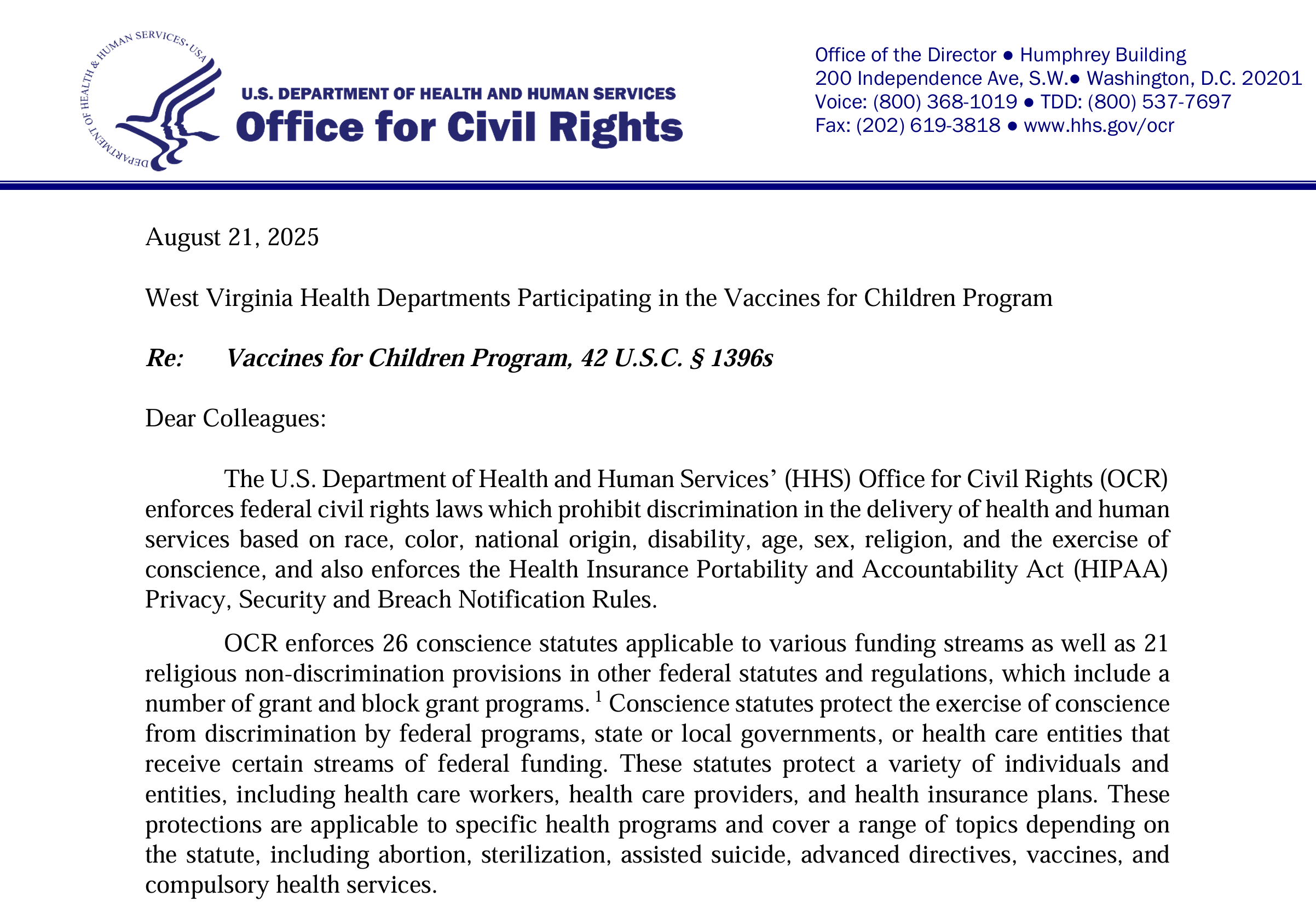
In a groundbreaking move that signals a profound shift towards safeguarding individual rights, the U.S. Department of Health and Human Services' (HHS) Office for Civil Rights (OCR) has issued a directive to West Virginia's health departments.
CLICK HERE for a copy of the letter
This letter, dated August 21, 2025, reinforces the necessity for the Vaccines for Children Program (VCP) to honor religious exemptions under state law. Far from a mere administrative note, this development represents a sea change in the landscape of personal autonomy, empowering families to make health decisions aligned with their deeply held beliefs without fear of discrimination or exclusion from essential programs.
The Context: Federal Oversight Meets State Sovereignty
The Vaccines for Children Program, established under 42 U.S.C. § 1396s, is a federal initiative designed to provide free vaccines to eligible children who are uninsured, Medicaid-eligible, or meet other criteria. Administered through state health departments, it ensures access to pediatric vaccines while mandating compliance with applicable state laws, including those related to religious or other exemptions.West Virginia's compulsory vaccination law (W. Va. Code § 16-3-4), enacted in 2015, initially offered only medical exemptions, lacking explicit provisions for religious ones.
However, the state's Equal Protection for Religion Act (EPRA), effective since May 2023, broadened these protections by prohibiting state actions that substantially burden religious exercise unless they meet strict criteria. This was further solidified by Governor Patrick Morrisey's Executive Order 7-25 in January 2025, which directed the establishment of an exemption process for religious or moral objections to vaccines required for public school attendance.
The HHS letter ties these state developments directly to federal obligations, emphasizing that VCP providers must adhere to EPRA as a "law relating to any religious or other exemption." This integration of federal and state frameworks marks a pivotal acknowledgment that personal convictions cannot be overridden lightly in public health programs.
"By specifically mandating that a State’s plan for administering Medicaid must respect State laws regarding religious exemptions, Congress recognized the importance of Americans’ religious convictions regarding vaccines and laws protecting such."
This quote from the letter underscores Congress's intent to prioritize religious freedoms, setting a precedent that could ripple across other states.
Key Provisions: Enforcing Conscience and Nondiscrimination
OCR, responsible for enforcing 26 conscience statutes and 21 religious nondiscrimination provisions, uses this letter to remind West Virginia, a VCP participant receiving $1.37 billion annually in federal Medicaid funds, of its duty to comply. The directive highlights that failure to recognize religious exemptions under EPRA could violate federal requirements, potentially jeopardizing funding and program integrity.
The letter also references a recent court affirmation: Judge Froble of the Raleigh County Circuit Court upheld the Governor's interpretation of EPRA in a August 12, 2025, ruling. This judicial backing strengthens the case for exemptions, aligning West Virginia's practices with federal conscience protections that cover topics like vaccines and compulsory health services.
"[N]otwithstanding any other provision of law, no state action may: (1) Substantially burden a person’s exercise of religion unless applying the burden to that person’s exercise of religion in a particular situation is essential to further a compelling governmental interest; and is the least restrictive means of furthering that compelling governmental interest; nor (2) Treat religious conduct more restrictively than any conduct of reasonably comparable risk..."
Citing EPRA directly, the letter illustrates how state law now demands a balanced approach, ensuring religious beliefs are not treated as second-class concerns in vaccination policies.
A Sea Change for Personal Autonomy
This HHS directive is nothing short of revolutionary. For years, debates over vaccine mandates have pitted public health imperatives against individual rights, often leaving families with religious or moral objections feeling marginalized. By mandating compliance with religious exemptions in the VCP, the federal government is heralding a new paradigm, one where personal autonomy takes center stage.This shift empowers parents to opt out of vaccines for their children based on sincere convictions, without forfeiting access to federally funded programs. It challenges the one-size-fits-all approach to health policy, recognizing that true equity includes respecting diverse worldviews.
In an era where trust in institutions is fragile, this move could restore faith by affirming that government serves the people, not vice versa.Moreover, it sets a potential template for other states. As OCR offers technical assistance and invites inquiries, we may see similar integrations of conscience protections nationwide, fostering a more inclusive health system that honors the full spectrum of American freedoms.
"OCR is available to lend assistance and provide support as West Virginia makes good faith efforts to ensure it and its health care providers comply with our nation’s robust protections for religion and conscience."
This commitment from OCR signals ongoing federal support, paving the way for broader implementation.
Looking Ahead: Implications and Next Steps
As West Virginia health departments adapt to this guidance, families across the state, and potentially beyond, stand to benefit from enhanced protections. This isn't just about vaccines; it's about reclaiming autonomy in an increasingly regulated world. For those navigating these changes, resources like OCR's conscience protection webpage and the January 2024 final rule on enforcement provide valuable insights.In conclusion, this letter is a beacon of hope for advocates of personal liberty. By bridging federal mandates with state-level religious safeguards, it heralds a transformative era where individual autonomy isn't an afterthought but a foundational principle in health policy. As we move forward, let's celebrate this victory and remain vigilant in defending these hard-won rights.
