Addicted to the Feed, How Compulsive Screen Use Is Fueling a Youth Mental Health Crisis
Originally published: 2025-07-24
The Digital Trap, Not All Screen Time Is Equal
For years, experts have debated how much screen time is too much for kids. But a groundbreaking new study published in JAMA on June 18, 2025, reframes the conversation entirely. According to researchers, it’s not how long children and adolescents are online, it’s how they use their devices that has the greatest impact on mental health.
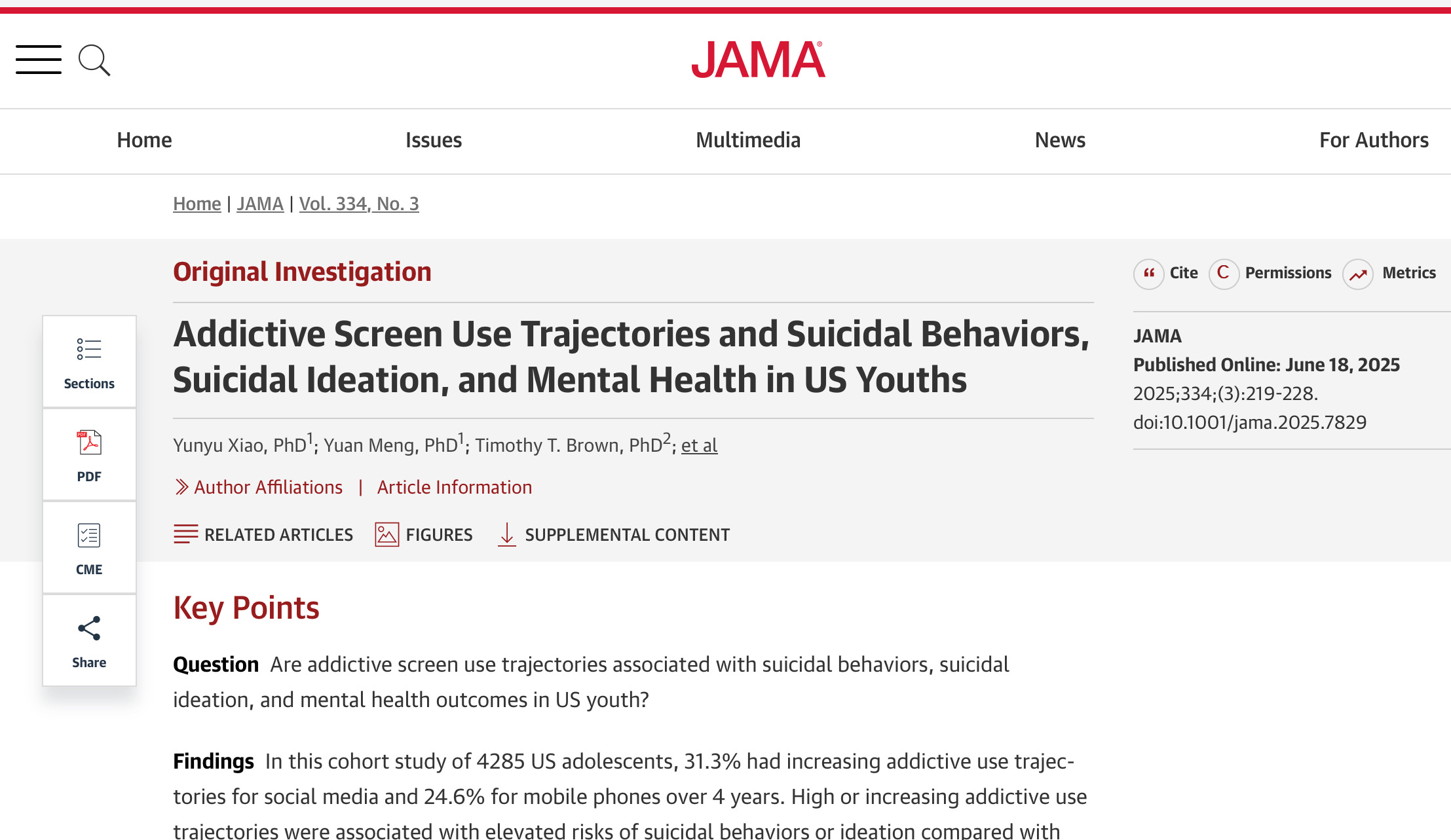
The longitudinal study, “Addictive Screen Use Trajectories and Mental Health Outcomes Among US Adolescents,”followed 4,261 youth starting at ages 9 to 10 and tracked their patterns of screen use over time. What it found was deeply concerning, teens who developed patterns of compulsive, addictive screen use, across social media, mobile phones, and video games, were at significantly higher risk for mental health problems than their peers.
“This study shows that the quality of screen engagement is far more predictive of poor outcomes than duration alone.”
Addiction, Not Access, Drives Mental Health Risk
Researchers identified distinct trajectories of screen use, focusing not just on how much teens used their devices, but on whether they exhibited behavioral addiction symptoms like:
Loss of control
Continued use despite harm
Withdrawal
Preoccupation
Conflict with others over device use
By age 14:
34% of teens showed addictive patterns with social media
25% with mobile phones
39% with video games
Youth in the highest-risk group, those with increasing or persistently high levels of addictive behavior, were twice as likely to report suicidal thoughts and 2.5 to 3 times more likely to report suicide attempts, compared to those with low-addiction patterns.
“Simply limiting hours is not enough, it’s about recognizing compulsive use and intervening early.”
Clinical Implications, A Wake-Up Call for Parents and Providers
This study delivers a clear message, mental health interventions must move beyond time-based limits and instead identify and treat patterns of addiction-like behavior. Strategies drawn from substance abuse and behavioral addiction treatment may be needed to address:
Escalating anxiety and depression
Increased aggression and attention problems
Impaired social functioning
Suicidality and self-harm risk
“Clinicians should consider compulsive digital behavior as a core component of adolescent mental health evaluations.”
Lead author Dr. Jason Nagata notes that even moderate daily screen use, when paired with addictive patterns, can be harmful. What matters most is the lack of control and functional impairment that defines digital addiction.
Shifting the Narrative, From Blame to Behavior
For years, the public debate around youth screen use has focused on total screen time, often with limited success in reducing mental health harm. This new research reframes that discussion, instead of blaming screens or enforcing rigid time limits, we need to understand the psychology of screen addiction.
A teen may spend hours editing videos or coding without harm, while another compulsively scrolls through social media to the point of sleep deprivation, anxiety, and isolation.
The difference lies in intentionality, regulation, and resilience, traits that can be cultivated, supported, and, when necessary, therapeutically addressed.
“Addiction is not about access, it’s about control.”
Conclusion, A New Paradigm for Digital Well-Being
The JAMA study confirms what many parents, teachers, and mental health professionals have long suspected, our kids are not just using screens, they are being used by them. And the cost is rising.
It’s time to:
Recognize screen addiction as a legitimate behavioral health issue
Shift research and policy toward functional digital health
Equip youth with skills for self-regulation and intentional engagement
Integrate early screening for addictive screen behaviors in schools and clinics
If we want to reverse the youth mental health crisis, we must stop treating screen time as a number, and start seeing it as a behavior.
Citation:
Xiao Y, Lin LY, Ganson KT, et al. Addictive Screen Use Trajectories and Mental Health Outcomes Among US Adolescents. JAMA. Published online June 18, 2025. doi:10.1001/jama.2025.7829
