Breaking News: Landmark Study Links Vaccinations to Neurodevelopmental Disorders, Vindicates Vaccine Safety Concerns
Originally published: 2025-01-27
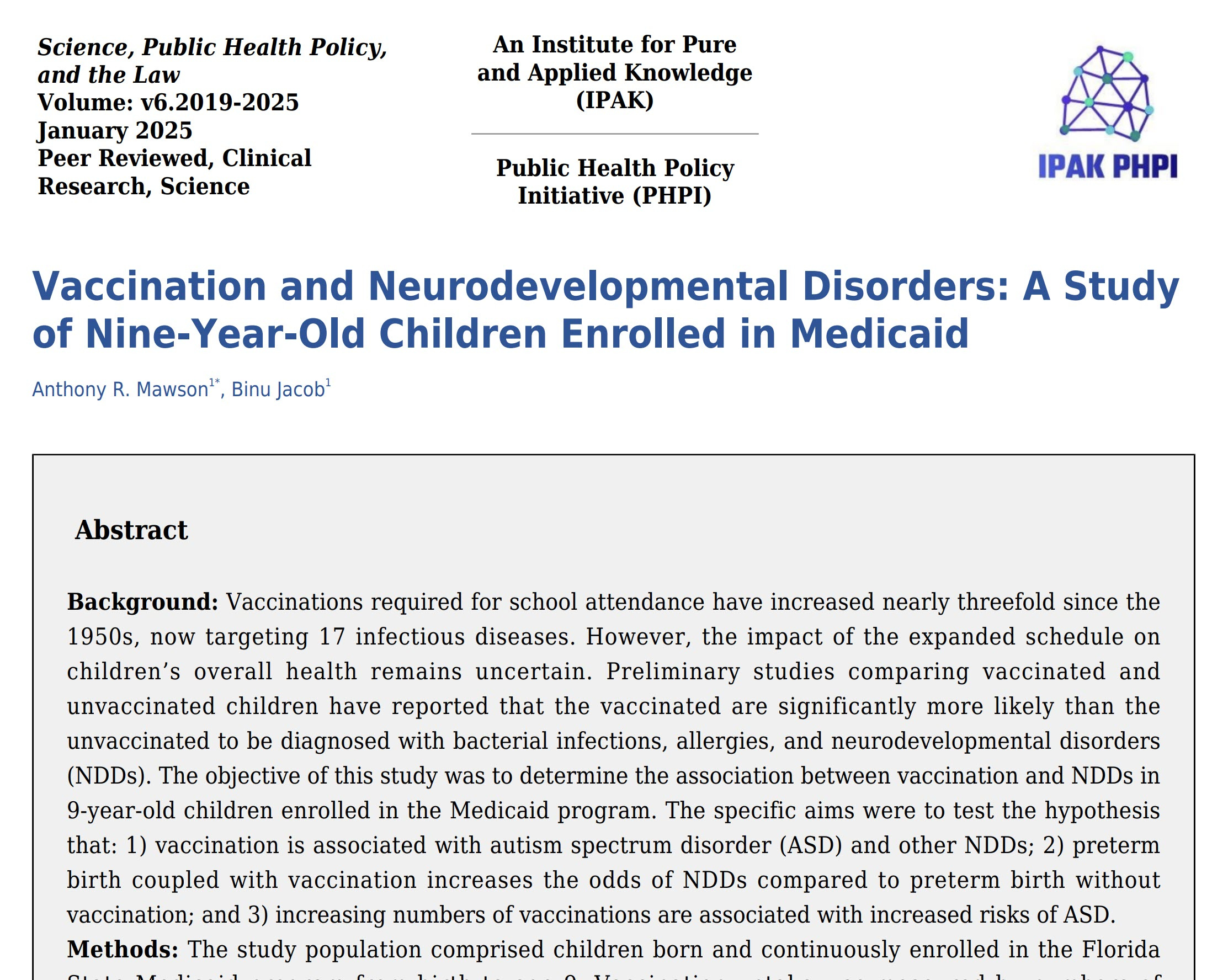
A groundbreaking study published today in Science, Public Health Policy, and the Law challenges the long-standing assumption of vaccination safety, especially in regard to its link to neurodevelopmental disorders (NDDs) like autism spectrum disorder (ASD). This comprehensive analysis, based on the claims data of 47,155 children enrolled in the Florida Medicaid program, sheds new light on the potentially harmful effects of the current vaccination schedule.
The study found that vaccinated children were significantly more likely to be diagnosed with a range of NDDs, with the risk rising in direct correlation to the number of vaccinations received. Alarmingly, children who received 11 or more vaccination visits were found to be 4.4 times more likely to be diagnosed with ASD compared to their unvaccinated counterparts.
One of the most striking findings of the research was the synergistic effect of preterm birth combined with vaccination. Children born preterm who were vaccinated had an increased risk of developing NDDs, with nearly 40% of them diagnosed with at least one disorder, compared to just 15% of unvaccinated preterm children.
The study’s lead author, Dr. Anthony Mawson of the Chalfont Research Institute, emphasized the importance of these findings, stating, “Our research highlights the urgent need for a thorough reassessment of vaccination policies, especially for high-risk groups such as preterm infants. The evidence strongly suggests that the cumulative exposure to vaccinations could have unintended adverse effects on children's neurological development.”
This study was funded by the National Vaccine Information Center (NVIC) and the Institute for Pure and Applied Knowledge (IPAK), organizations committed to exploring vaccine safety and public health impacts.
Key findings from the study include:
Increased Risk of NDDs with Vaccination: Vaccinated children were over three times more likely to be diagnosed with at least one NDD, including ASD, attention-deficit hyperactivity disorder (ADHD), and learning disorders.
Dose-Response Relationship: The likelihood of ASD increased with the number of vaccination visits. Children with just one vaccination visit were 1.7 times more likely to be diagnosed with ASD, while those with 11 or more visits were 4.4 times more likely.
Preterm Birth and Vaccination Synergy: Preterm children who were vaccinated faced significantly higher odds of NDDs than unvaccinated preterm children. This finding raises critical questions about the appropriateness of a uniform vaccination schedule for all children.
Ethnic and Gender Disparities: Nonwhite children and males exhibited higher risks of developing NDDs post-vaccination.
The research further revealed that government-sponsored studies have largely neglected comparisons between vaccinated and unvaccinated children, a gap that this study aims to address. The authors call for immediate, large-scale research to explore the biological mechanisms underlying these associations and to evaluate the safety of the current vaccination schedule comprehensively.
These findings are poised to have significant implications for public health policy, offering powerful validation to those who have questioned the safety and efficacy of the current vaccine schedule. The study’s conclusion is clear: “New vaccines should not be added to the childhood vaccination schedule without robust evidence proving their safety and the absence of cumulative adverse effects.”
This revelation comes as Robert F. Kennedy Jr.'s confirmation process gains momentum, further vindicating his long-standing concerns about vaccine safety. Critics should view this as a wake-up call to reevaluate their positions in light of mounting evidence.
As this historic research reverberates across the medical and public health communities, it raises critical questions about the balance between public health benefits and potential individual risks. Parents, policymakers, and healthcare professionals alike must grapple with these findings as they navigate the complex landscape of vaccination and child health.
