Chiropractic’s Image Problem: Lessons from APTA and the Price of a Splintered Profession
Originally published: 2025-01-04
On Tuesday, December 17, 2024, the American Physical Therapy Association (APTA) released its latest report, "Primary Care Physician Perceptions of Physical Therapy: An APTA Report." While focused on strengthening the relationship between physical therapists (PTs) and primary care physicians (PCPs), this report builds on APTA’s consistent, research-driven efforts to understand and improve public perceptions of PTs. Over the past 17 years, APTA has commissioned multiple consumer-focused studies to fine-tune its messaging and elevate its profession's standing among consumers, policymakers, and other healthcare stakeholders.
In stark contrast, chiropractic care remains plagued by fractured messaging, a lack of public trust, and internal division driven by a decades-long monopoly orchestrated by what many refer to as the "Chiropractic Cartel." This splintered profession, dominated by secretive factions loyal to the Cartel, has made strategic missteps that have marginalized its unique identity, alienated its core practitioners, and undermined its public perception.
The Numbers: Public Perception of Chiropractic in Decline
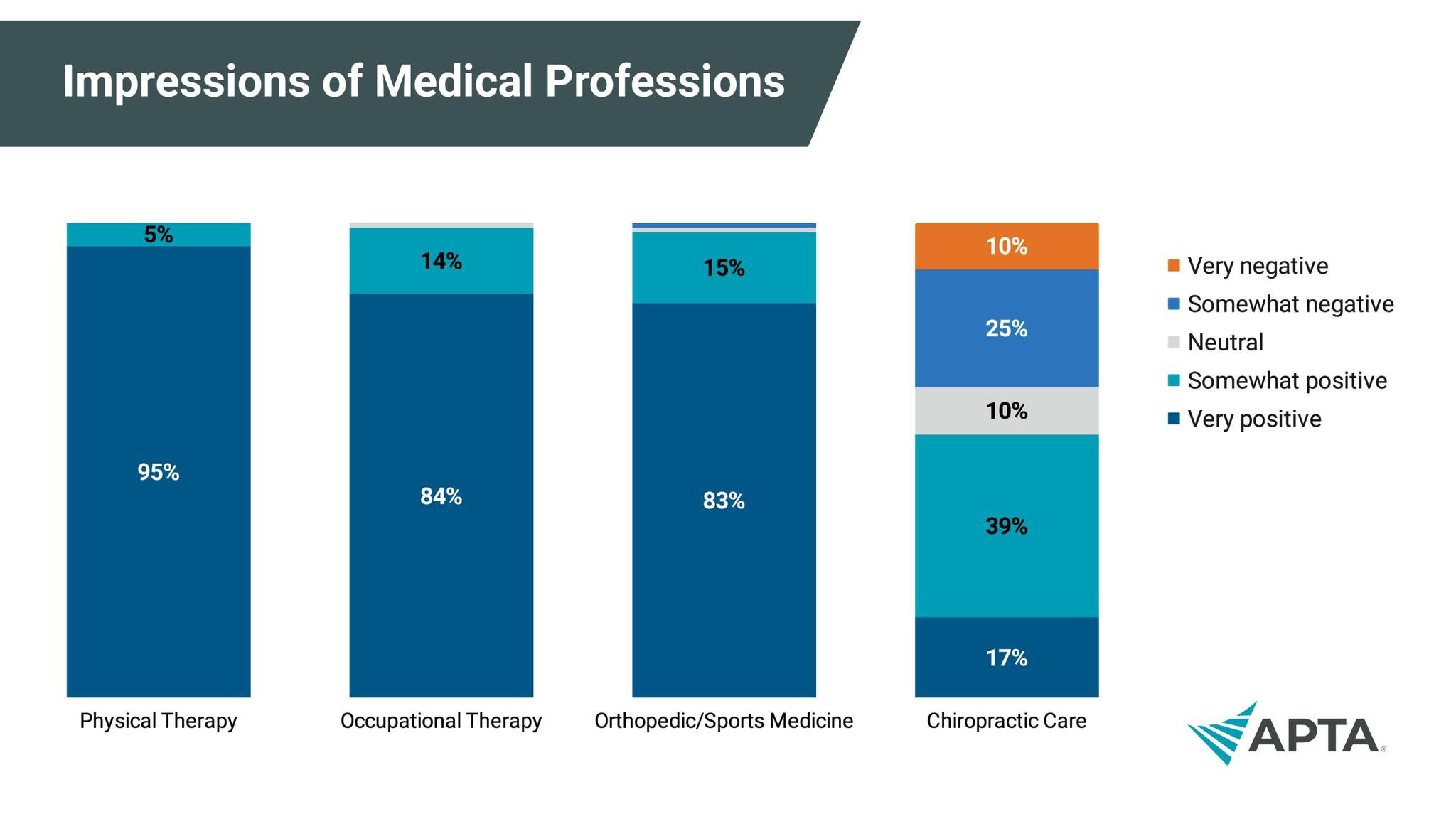
The "Impressions of Medical Professions" chart from APTA’s report reveals a sobering picture of how chiropractic care is viewed in comparison to other professions:
Physical Therapy: 95% of respondents had a “very positive” impression, with the remaining 5% expressing “somewhat positive” views.
Occupational Therapy: 84% had a “very positive” impression, and 14% viewed it “somewhat positively.”
Orthopedic/Sports Medicine: 83% expressed a “very positive” impression, with 15% “somewhat positive.”
Chiropractic Care: Only 17% had a “very positive” impression, and 39% viewed it “somewhat positively.” Alarmingly, 35% of respondents had a negative impression (25% “somewhat negative” and 10% “very negative”), and 10% were neutral.
While Physical Therapy, Occupational Therapy, and Orthopedic/Sports Medicine are viewed overwhelmingly positively, Chiropractic Care faces a significant perception gap, with a much higher share of neutral and negative impressions.
How a Cartel-Dominated Profession Lost Its Way
Chiropractic’s struggles with public perception are not accidental. For decades, the profession has been dominated by a Cartel of organizations and leadership factions that have consolidated power, marginalized dissenting voices, and watered down chiropractic’s unique strategic competitive advantage: its focus on the detection and correction of vertebral subluxation.
Rather than doubling down on this unique identity and educating the public about the importance of nervous system function, its role in overall health and wellness and how the subluxation interferes with that, the Cartel pursued a misguided strategy of aligning chiropractic with primary care. This shift has proven disastrous for the following reasons:
A Loss of Identity
Chiropractic care’s focus on vertebral subluxation—a powerful, distinct, and strategically advantageous concept—was abandoned in favor of trying to compete as a second-rate primary care profession. This decision diluted the profession’s unique value proposition, leaving the public confused about what chiropractors do and why they matter.The Realities of Primary Care
Primary care providers are among the least-paid yet most-burdened professionals in healthcare. By positioning chiropractors in this role, the Cartel inadvertently pushed the profession into a corner where it could not compete effectively, either financially or operationally. Chiropractors were neither equipped nor positioned to fulfill the comprehensive roles and responsibilities of primary care providers, further undermining their credibility.The Marginalization of Subluxation-Centered Practitioners
Those who remain loyal to chiropractic’s roots and its focus on vertebral subluxation are ostracized, marginalized, and excluded from leadership discussions. Secret meetings among Cartel-loyal factions ensure that dissenting voices are silenced and that the profession remains splintered.A Failure to Build Public Trust
Without a unified message and clear identity, chiropractic care has failed to build the same level of public trust and recognition achieved by professions like Physical Therapy. The infighting and lack of strategic direction have left chiropractors vulnerable to negative media narratives, skepticism from other healthcare professionals, and poor public understanding of their role.
Chiropractic’s Cultural Authority Deficit: A Barrier to Public Trust
One of the most significant obstacles facing the chiropractic profession is its lack of cultural authority. Unlike physical therapists, medical doctors, or even nurses—who are widely recognized and trusted as legitimate healthcare providers—chiropractors often operate outside the mainstream narrative of healthcare.
Cultural authority refers to the degree to which a profession is accepted, trusted, and seen as a legitimate voice in society. Health professions like physical therapy and medicine enjoy high levels of cultural authority, which allows them to influence public opinion, gain political support, and shape media narratives. Chiropractic, by contrast, lacks this cultural authority. Misconceptions about its scientific foundation, decades of internal division, and negative media coverage have left the profession struggling to gain the same level of public trust and legitimacy.
Because of this, the strategies successfully used by other health professions to build trust, engage the public, and drive behavior change often fail to “move the needle” for chiropractic. Chiropractors must recognize that they cannot simply copy the public health playbook used by professions with cultural authority; they must create a new playbook designed specifically to build credibility from the ground up.
The Need for Experts in Gaining Cultural Authority
To overcome this cultural authority deficit, the chiropractic profession must work with experts who specialize in transforming professions from the margins to the mainstream. Instead chiropractors take marketing direction from other chiropractors who have run a successful practice (and in many cases not even that). In effort after effort over the past 30 years that leadership has utterly failed yet they rise up a few years later with a new scheme and the only ones who benefit are the gurus.
The profession needs experts who understand the unique challenges of earning public trust without the inherent cultural authority enjoyed by other healthcare providers. Their expertise is critical in:
Developing a unified narrative that emphasizes chiropractic’s unique value while addressing common misconceptions.
Using grassroots campaigns, social media, and patient testimonials to build trust and credibility.
Building alliances outside of healthcare to broaden the profession’s influence and recognition.
Employing behavioral science to design campaigns that resonate with skeptical audiences.
Turning the Tide: Reclaiming Chiropractic’s Unique Identity
The chiropractic profession can still recover, but doing so will require bold action to dismantle the Cartel’s influence, unify the profession, and refocus on its unique value proposition. Chiropractors must:
Reclaim the Focus on Vertebral Subluxation
Develop a Unified, Research-Driven Messaging Strategy
Break Free from the Cartel’s Control
Differentiate Chiropractic from Primary Care
A Path Forward
Chiropractic has the potential to achieve cultural authority, but only if it acknowledges the unique challenges it faces and invests in the expertise needed to overcome them. Gaining cultural authority is not granted; it is earned. With the right strategy, chiropractic can rebuild trust, reclaim its unique position in healthcare, and take its rightful place as a trusted pillar of health and wellness.
The path forward is clear. The question is: Will chiropractic rise to the challenge?
