CMCC’s Admissions Primer on Denying Subluxation
Originally published: 2025-09-02
A recruitment document that narrows the profession
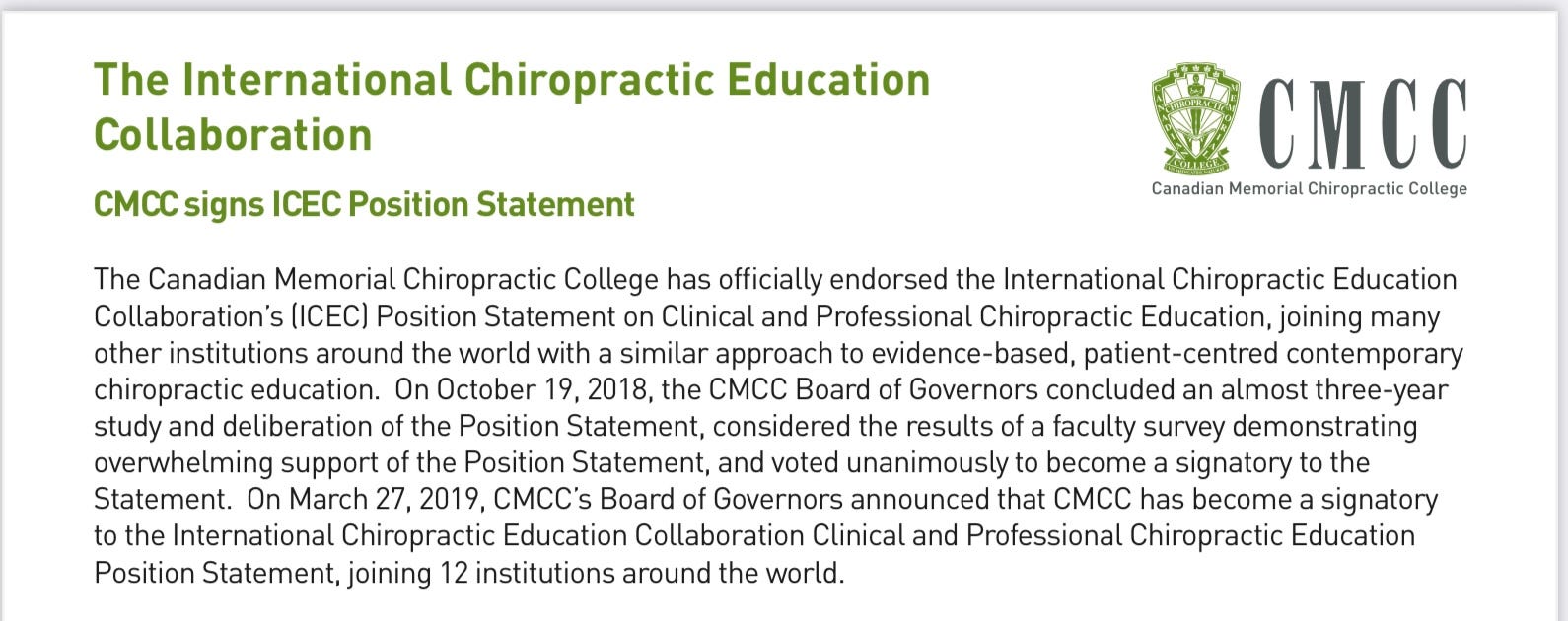
CMCC is not just a signatory to the International Chiropractic Education Collaboration Position Statement, it is packaging that stance for incoming students in a multi page Education Position Statement and FAQ included in admissions materials. The document boasts that CMCC’s Board voted to sign in 2019 and frames the Statement as aligning with its evidence based, patient centred model, public health priorities, and vaccination agenda, all before students take their first class. It spells out that the curriculum already conforms to the Statement and that external placements are selected to match it, effectively filtering out practices and mentors who do not toe the line.
“This will have no impact on the curriculum, Everything mentioned in the Position Statement conforms to what is currently taught.”
Subluxation, reduced to a historical footnote
The Position Statement CMCC elevates declares that teaching vertebral subluxation as a vitalistic construct and as the cause of disease is unsupported by evidence, and should appear, at most, in a historical context. It also casts routine x ray use for subluxation analysis and high volume or open plan models as unacceptable in undergraduate education. In other words, a broad, systems level chiropractic lens, spinal and neural function with body wide implications, is replaced by a narrow modality frame oriented to MSK symptom management. That is not evidence based, it is selective citation dressed as science, ignoring contemporary work on neurophysiology, adaptability, autonomic markers, and outcome based subluxation focused care.
“Subluxation as the cause of disease is unsupported by evidence, its inclusion in a modern curriculum is inappropriate and unnecessary.”
“Evidence based” that edits out the evidence
CMCC’s FAQ repeatedly invokes evidence based while endorsing the ICEC and WFC line on vaccination and discouraging practice models that do not match its preferred template. Yet it never engages the growing literature on neurologic effects of adjustments, sensorimotor integration, HRV, immune neuro crosstalk, or real world longitudinal outcomes from subluxation centered practices. Calling subluxation irrelevant while ignoring that body of work is not evidence based, it is dogma. The document even concedes the purpose is to signal to applicants what kind of chiropractic they should expect, and which kinds will not be welcome.
“The primary purpose is to clarify CMCC’s educational practices, and to promote widely accepted preventative and public health measures including vaccination.”
Modality, not profession
Taken as a whole, CMCC’s admissions packet presents chiropractic as a modality nested inside allopathic public health priorities, not as a distinct profession with a spine and nervous system focus and broad physiologic implications. It is a blueprint for producing technicians of short term MSK relief, not doctors grounded in the neurologic consequences of vertebral subluxation and the longitudinal care families seek beyond neck and back pain.
“We attempt to recruit clinics that are aligned with our model of care and that do not engage in practices discouraged by the Position Statement.”
Stop pretending pain lives in a vacuum
It looks foolish when groups and schools claim there is “no evidence” for subluxation beyond biomechanical dysfunction and pain, because pain itself is inseparable from inflammation, and inflammation is an immune process. Tissue insult triggers cytokines, chemokines, and neuropeptides, which alter nociception, dorsal horn processing, autonomic outflow, and hypothalamic pituitary adrenal activity. The vagal anti inflammatory reflex, sympathetic tone, and neuroimmune crosstalk are all part of the same loop. If a clinician reduces noxious input, improves segmental control, and normalizes afferent signaling, the downstream effects include changes in inflammatory tone and therefore in immune signaling. To pretend otherwise is to carve physiology into pieces that do not exist in real patients.
“If pain is inflammatory, and inflammation is immune, then subluxation management cannot be dismissed as ‘only for pain’ without ignoring basic physiology.”
Pandemic amnesia about physiology
During the pandemic, schools like CMCC embarrassed themselves by issuing blanket declarations that chiropractic had no role in supporting immune function. Support was treated as a claim to prevent or cure a viral disease, instead of what it actually is, a claim that improving spinal and neural function can influence the neuroimmune environment that governs resilience, recovery, and adaptation. You do not need to promise a cure to acknowledge that autonomic balance, stress load, sleep, movement, and segmental mechanics shape inflammatory set points. By collapsing everything into a narrow musculoskeletal modality frame, these institutions taught students to deny the very systems thinking that modern physiology requires.
Still flying ACC colors
Perhaps most telling, despite this posture, CMCC remains a member of the Association of Chiropractic Colleges, the same ACC that lobbied to protect the 200 to 300k price tag of a DC degree. If the ACC wants to claim the mantle of reform after the new federal loan caps, it can start by acknowledging that documents like CMCC’s are not neutral clarifications, but active gatekeeping against subluxation centered chiropractic, and that calling it evidence based while ignoring the evidence is an embarrassment the profession can no longer afford.
“By signing the Position Statement, CMCC has publicly emphasized its support for vaccination.”
