Fauci’s Reckoning Begins: State Criminal Filings Accuse Federal COVID Architects of Murder, Terrorism, and Medical Atrocities
Originally published: 2025-04-13
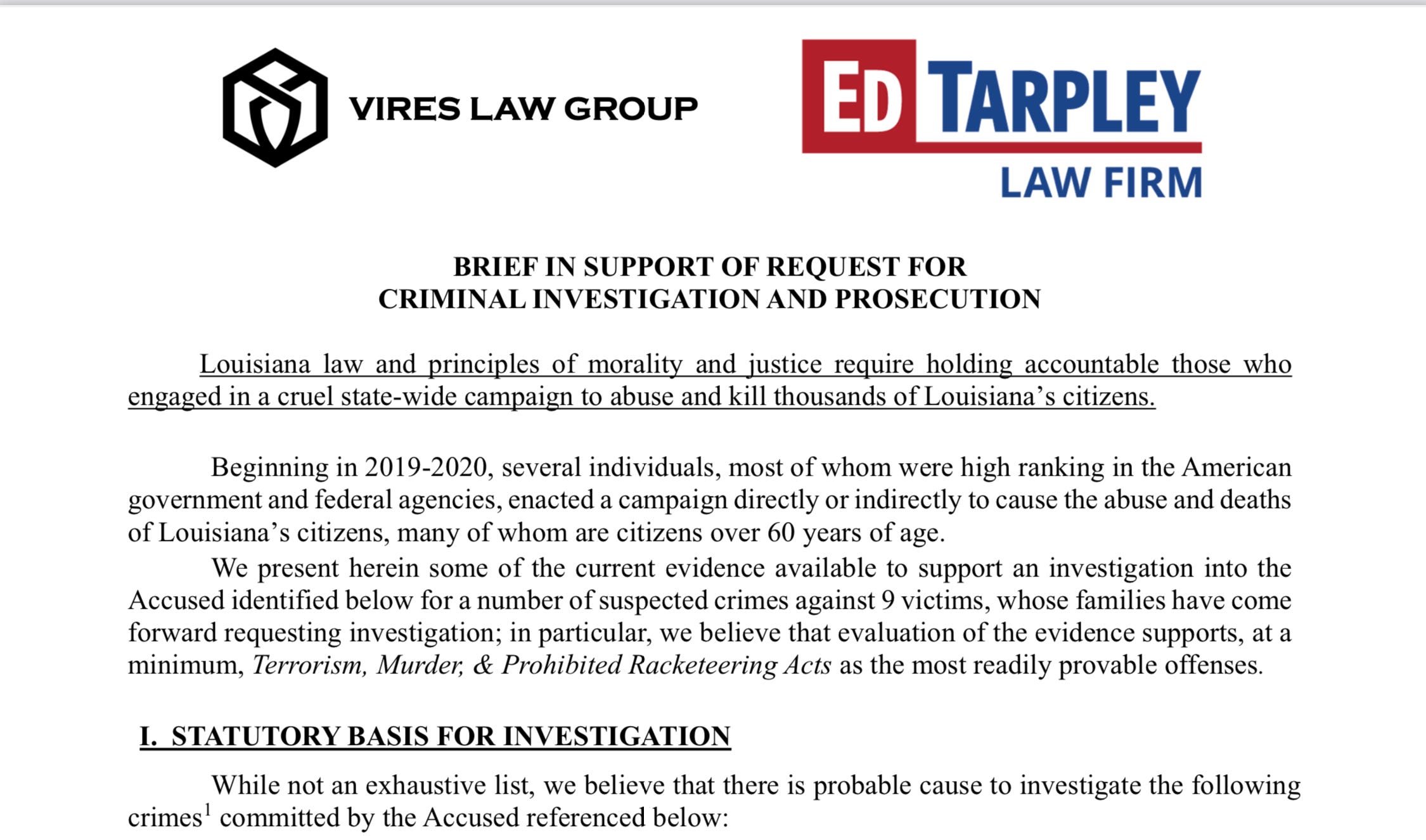
A coordinated legal offensive is now underway across the United States as citizens and their advocates seek criminal accountability for the actions of high-ranking federal health officials during the COVID-19 pandemic. In what may become one of the most consequential legal reckonings in modern American history, victims’ families and their legal representatives have filed criminal referrals in Louisiana, Florida, Texas, Missouri, Oklahoma, and most recently, Arizona and Pennsylvania. These filings accuse federal health leaders and institutional collaborators of murder, terrorism, assault, abuse of the infirm, and a series of medical crimes under state law.
The movement is led by legal teams such as the Vires Law Group, which submitted a detailed 86-page complaint in Louisiana that reads like an indictment not just of individuals, but of a system weaponized under the guise of public health. The brief demands investigations into what it calls a "coercive campaign" by a network of federal officials and corporate actors who enforced treatment protocols and vaccination mandates that plaintiffs argue were knowingly dangerous and ultimately fatal.
A Historic Accusation: Terrorism, Murder, and Racketeering
The Louisiana filing, submitted on behalf of nine families, accuses Dr. Anthony Fauci (former Director of NIAID), Dr. Deborah Birx (former White House COVID-19 Response Coordinator), Dr. Rochelle Walensky (former CDC Director), Dr. Francis Collins (former NIH Director), and other former federal officials and pharmaceutical collaborators of crimes typically associated with war crimes and organized crime rings.
According to the brief, these actors engaged in a coordinated “common scheme” that meets Louisiana’s statutory definition of terrorism — intentionally inflicting serious bodily harm, including death, to coerce the civilian population and influence government conduct through fear, medical coercion, and censorship.
Citing precedent in both international law and U.S. courts, including In re Yamashita and the Nuremberg Doctors' Trial, the complaint frames the COVID policy apparatus as a top-down command structure where responsibility for harm lies not only with implementers but with policy architects. Louisiana’s homicide and terrorism statutes — rarely invoked in such contexts — are leveraged to argue that the accused knowingly promoted fatal protocols such as the use of remdesivir and mass vaccination without informed consent.
Human Tragedy Meets Legal Doctrine
The brief is not limited to abstract accusations. It documents harrowing accounts from families across Louisiana who allege that their loved ones died alone, sedated, and isolated in hospitals after being denied alternative treatments and forced into protocols with remdesivir, ventilation, and COVID vaccines. Many were denied visitation, even as they died. The legal team argues these actions constitute not only medical malpractice but violations of criminal law, including false imprisonment, battery, and even second-degree kidnapping.
Patients were “tortured and killed by policy,” the brief asserts — not as a tragic consequence of overwhelmed systems, but as a result of deliberate policies “known to be dangerous and ineffective” by their creators.
The Evidence Trail: Whistleblowers, FOIA, and Censorship Allegations
The brief is rich with sourced material — hundreds of pages of FOIA emails, whistleblower declarations, Congressional testimony, and scientific studies. Among the most damning are:
FOIA-released communications showing early knowledge among federal officials that COVID-19 may have originated from gain-of-function research they funded — and their coordinated efforts to suppress that narrative.
Evidence that effective early treatments such as hydroxychloroquine and ivermectin were intentionally suppressed while remdesivir and mRNA vaccines were pushed despite known risks.
Testimony and public statements from insiders like Dr. Deborah Birx, who admitted that she and others knew the vaccines would not stop transmission.
Communications between FDA and intelligence-connected censorship networks that allegedly worked with social media companies to silence dissenting scientific voices, effectively controlling public discourse.
The Stakes: A Crisis of Trust and a Call for Grand Juries
The legal complaint does not simply seek symbolic accountability. It demands that Louisiana Attorney General Liz Murrill launch a full criminal investigation and convene grand juries to evaluate whether the accused should be charged under state law.
“The people of Louisiana have suffered irreparable harm,” the brief argues. “We are not asking for policy debates. We are asking for the rule of law.”
Should Louisiana proceed — or any other state following suit — it could establish the first legal precedent for holding federal health officials criminally accountable at the state level, possibly piercing longstanding federal immunity shields if courts find they acted “ultra vires,” beyond their lawful authority.
A Nationwide Movement Gaining Steam
While dismissed by critics as fringe or politically motivated, the multi-state effort has now entered mainstream awareness, particularly as House investigations uncover new evidence of censorship, data manipulation, and conflict of interest during the pandemic response. In Arizona and Pennsylvania, new filings echo the Louisiana brief’s structure and charges, suggesting coordinated strategy and legal alignment among advocacy networks.
If successful, this legal campaign could redefine the boundaries between federal authority and state sovereignty, especially in matters of public health.
Conclusion:
Whether these criminal referrals lead to indictments, trials, or simply increased transparency, they represent a seismic moment in post-COVID governance. For families who lost loved ones and believe justice has yet to be served, these filings are not just legal documents — they are cries for truth, accountability, and healing in the face of state-sanctioned medical devastation.
“This isn’t about politics,” said one family member. “It’s about life, death, and who gave the orders.”
CLICK HERE for a copy of the criminal complaint
