Final Reflections on a Landmark Event in Vertebral Subluxation Research and Advocacy
Originally published: 2025-08-15
Finishing Strong with Depth and Determination
As IRAPS 2025 came to a close, the final sessions delivered some of the most compelling work of the entire symposium. Presenters offered bold critiques, innovative clinical research, and practical applications of subluxation-centered care that reflect a profession not just defending its roots, but innovating its future.
In this last post of our four-part series, we highlight four presentations that challenged the profession to think deeper, act smarter, and never lose sight of its foundational purpose.
Chiropractic Care and Perinatal Quality of Life
Presented by John “Doc” Edwards, DC and Joel Alcantara, DC
This presentation explored the quality of life among women under chiropractic care during the perinatal period. The authors used validated patient-centered outcome tools and a rigorous observational methodology to draw connections between subluxation-centered care and overall well-being.
In a healthcare landscape where perinatal support is often fragmented, this study emphasized the potential for chiropractic to serve as a consistent and supportive component of care for expecting and new mothers.
“The perinatal journey should be one of empowerment and support. Chiropractic can offer both when practiced with purpose and evidence”
Subluxation, Objective Analysis, and Mechanical Cord Tension
Presented by Daniel Knowles, DC
Dr. Knowles delivered a data-rich session focused on the relationship between vertebral subluxation and adverse mechanical cord tension. Using objective metrics and imaging, his presentation argued for a measurable link between subluxation patterns and neural tension, adding scientific weight to the subluxation hypothesis.
His work reinforced the importance of using quantifiable tools in chiropractic analysis while staying grounded in vitalistic principles.
“This is the kind of research that helps us speak across disciplines without compromising our identity”
A Call to Reform Chiropractic Licensure
Presented by Matthew McCoy, DC, MPH
In one of the most anticipated sessions of the symposium, Dr. McCoy critiqued the National Board of Chiropractic Examiners (NBCE) Part IV licensure exam, questioning its necessity, cost, and potential misuse as a gatekeeping mechanism.
His presentation laid out a compelling case for reform, comparing chiropractic’s current testing structure with that of other health professions and highlighting the need for school-based competency assessment rather than external centralized exams.
“This is about protecting students, restoring institutional autonomy, and breaking up a system that no longer serves the profession,” McCoy said.
Upper Cervical Radiographic Outcomes in Focus
Presented by Scott Baker, DC and Joel Alcantara, DC
This research review evaluated radiological outcomes in patients receiving Blair upper cervical chiropractic care. The presenters documented changes in alignment and function, contributing important data to the small but growing body of research supporting upper cervical techniques.
Their work also illustrated how careful documentation and follow-up imaging can help validate the clinical effectiveness of subluxation correction.
“Upper cervical care is often misunderstood. Studies like this help bring it into clearer scientific view.”
The Profession’s Next Chapter is Being Written Now
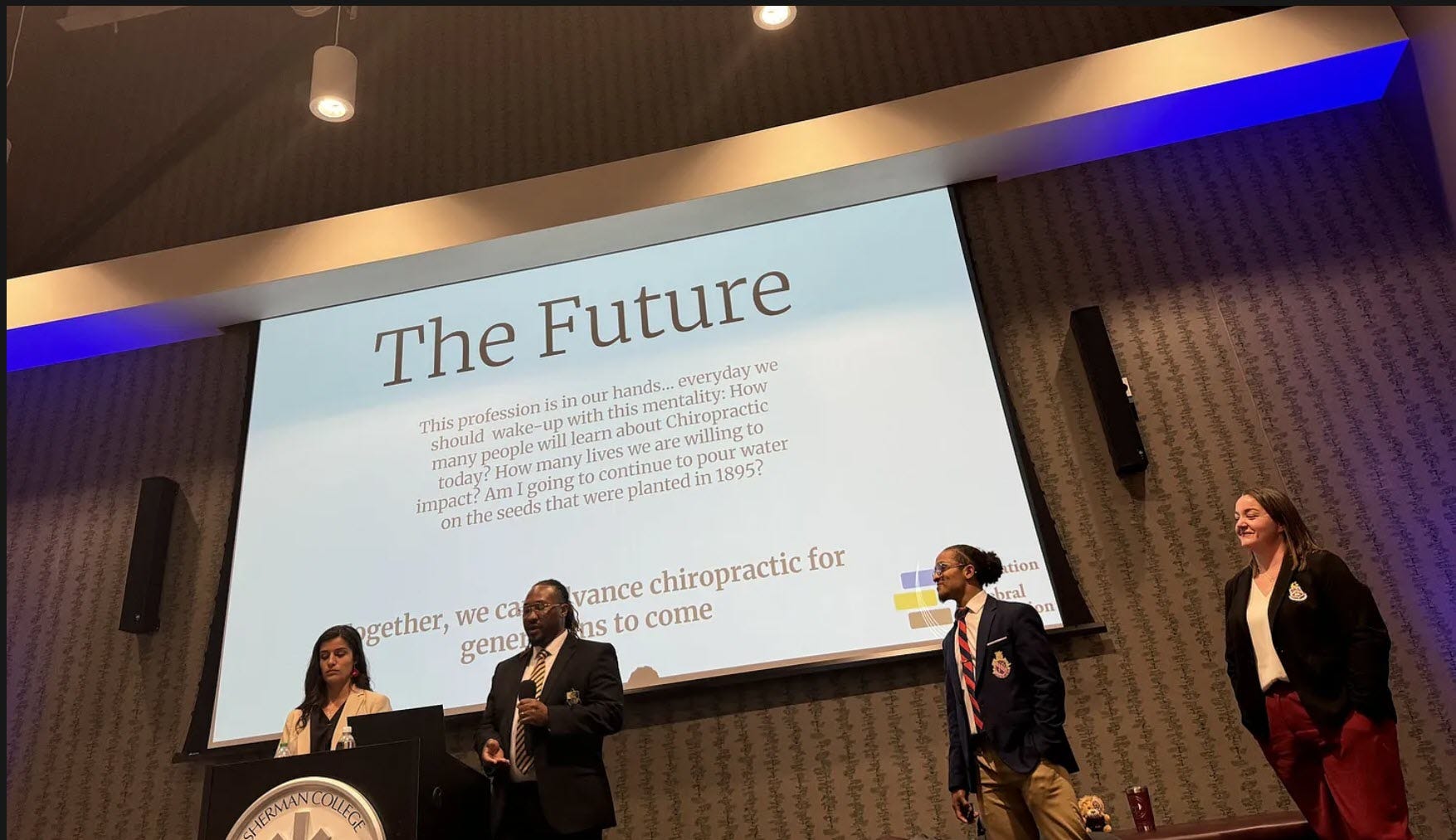
IRAPS 2025 was more than a conference. It was a manifestation of Sherman College’s strategic vision to support research and scholarship that defend, define, and advance vertebral subluxation-centered chiropractic. These final presentations are a testament to that mission, offering hope, data, and direction for the profession’s future.
“At IRAPS, we don’t just talk about the future of chiropractic. We build it, one paper at a time,” said a student fellow leaving the final session.
Thank you for following our four-part IRAPS 2025 review series. Together, these blog posts reflect a community of researchers, educators, and clinicians deeply committed to the principle of vertebral subluxation and the science that supports it.
CLICK HERE to review the Proceedings
