Florida Board of Chiropractic: “Approving Body” or Accountability Black Hole?
Originally published: 2025-09-16
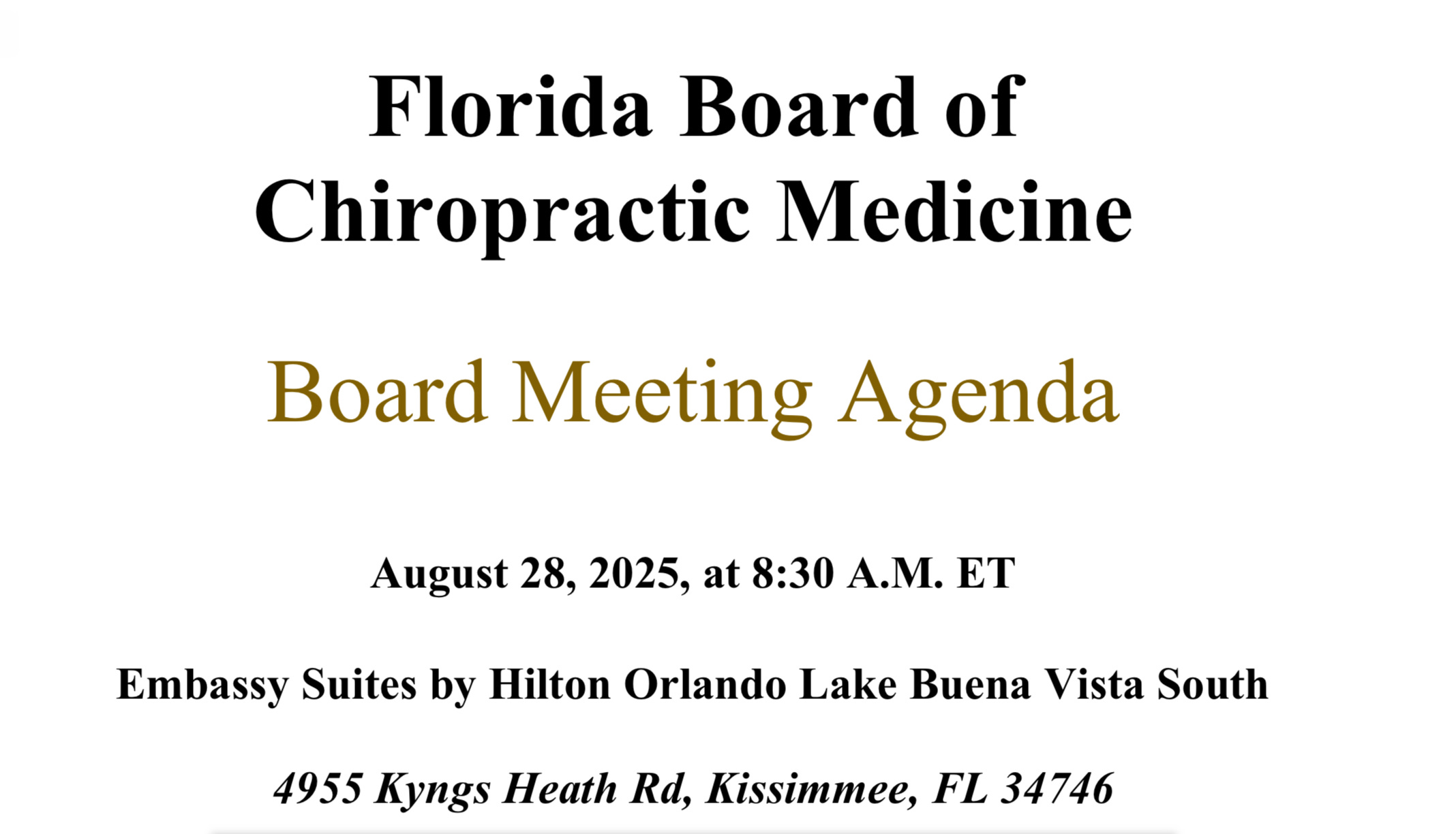
Florida’s August 28 board meeting gave us a rare, unfiltered look at how state regulators talk about NBCE Part IV centralization and accreditation power. The statements below are verbatim from the meeting. After each set, we add commentary that connects the dots, including what the Board says it cannot do versus what it actually can do, and why NBCE’s claims about “standardization” and costs demand real data, not talking points.
Comerford: Agreement on the problems, reluctance on the solutions
“Thank you. You know, I've read this and it does give me concern with the NBC being in Colorado. It was a surprise to me. ⁓ The hard part is as a board, we are approving body. We aren't somebody that can make that happen. That deals with FCS, FCPA, FCA. I will say just like we had talked about before, we're not making a declaratory statement, but I will say I would support, you know, making it easier for people to get to part four of the boards, whichever way that is.” (Dr. Jason Comerford)
“I don't necessarily think everybody going to Colorado the next year is going to make it easier. And then of course dealing with an accreditation monopoly, would succinctly say that needs to be reworked. But again, it's one of those things that at a state level and a board level, we're more of an approving body as opposed to the movement portion. But I can go on record and say that I agree and support both of those. And I hope that you guys continue to champion that. Yes, sir, Dr. Roberts.” (Dr. Jason Comerford)
Commentary: This is significant. Comerford goes on record supporting both a fix to Part IV access and reworking the accreditation monopoly. That aligns with recognizing alternative accreditors and acting to relieve the centralized testing burden. Yet the refrain is that the Board is only an “approving body.” As we documented in the original article, the Board can in fact lead by formally requesting a special session item, urging a proposed committee bill, asking DOH to carry an agency bill, and immediately starting APA rulemaking to keep state rules aligned while the statute is amended. Agreement without action is not stewardship, it is deferral.
Roberts: “Standardization” claims without evidence, cost promises without numbers
“I'm an examiner for the National Board of Chiropractic Examiners and we've been, every time we have a new board exam they talk about this, people from Greeley come out and talk about it. Believe me, I'm not a fan of going to Greeley, Colorado all the time, everybody go there to take tests, but there are couple reasons and mainly the main driver of this is so standardization.” (Dr. Michael Roberts)
“Everybody takes the test will get the same test every time no matter where you're at you come to Greeley You're gonna get the exact same test. They don't necessarily have that standardization There's a look there's a significant a bit of leeway on The hierarchy of who's running it. Let's say it ⁓ Palmer in Iowa, you know or or in California or wherever else are having the test” (Dr. Michael Roberts)
“And there's that variation. that's what one of the main drivers is trying to get rid of that differences in exam sites. ⁓ And supposedly, I haven't really seen the real numbers, but it's supposedly going to cost less, but less ultimately, for the students taking this test.” (Dr. Michael Roberts)
Commentary: Two huge flags. First, where is the psychometric evidence that centralization “fixes” prior validity and reliability issues. If today’s version is “standardized,” the implication is that the many years of decentralized Part IV were not standardized, which raises fairness and validity questions for past cohorts. Second, cost. Dr. Roberts says he “hasn’t really seen the real numbers.” Neither have we, and NBCE has not produced auditable data demonstrating lower total candidate cost once travel, lodging, time away from clinic, and re-test probabilities are included. Assertions are not evidence. Until NBCE publishes defensible psychometrics and a transparent cost model, the Board should not accept these claims at face value.
Melton: Delegates opposed centralization, and a telling PACE mistake
“A couple of things with the, so I live in Tallahassee, so I'm gonna go out to Greeley in end of September and I have to fly red-eye. My flight's in and out of there. It's egregious, it's bad. We know that they have their own board of directors that made this decision, but there's a lot of us, ⁓ Dr. Roberts and myself, who are delegates, who opposed it all along. ⁓” (Dr. Walter Melton)
“I think you have some support here from this board in terms of the accrediting agencies we use PACE as well so there are some alternatives of this board has been open to you so I think we've shown that were open to that as well:” (Dr. Walter Melton)
Commentary: Melton confirms what many candidates suspected, that a lot of NBCE delegates opposed centralization all along. That matters for accountability. If the field’s own delegates do not support the move, who exactly does NBCE answer to. Then the PACE remark. PACE is not an accrediting agency. PACE is a program operated by the Federation of Chiropractic Licensing Boards to vet continuing education providers. It does not accredit chiropractic degree programs. The fact that a sitting board member conflated PACE with accreditation should raise eyebrows. CE monopolies and accreditation monopolies are distinct issues, and both deserve sunlight.
Call-out quotes
“I agree and support both of those.” — Dr. Jason Comerford
“The main driver of this is so standardization.” — Dr. Michael Roberts
“I haven't really seen the real numbers.” — Dr. Michael Roberts
“There’s a lot of us, who are delegates, who opposed it all along.” — Dr. Walter Melton
The accountability gap: who holds NBCE to the public interest
In the original article we laid out specific, lawful paths the Board can take right now.
CLICK HERE for previous article
The statute sets the floor, yet the Board can request a narrow statutory fix for Part IV and CCE-only language in one clean bill, and it can start rule work immediately to prevent unadopted rule problems while the Legislature acts. If the Board insists it cannot act, then who will. NBCE does not answer to the public directly. It answers through state boards that enshrine its products in law and rule. That means the buck stops with the Board, or at least it should.
What leadership would look like, today
Ask the Governor and legislative leaders to add a targeted amendment to section 460.406 to decouple Florida from a single vendor practical and to replace CCE-only with accreditor-neutral criteria adopted by rule, with a clear transition clause for students in the pipeline.
Launch notice and comment rulemaking to align references, forms, and procedures, and to establish a transparent framework for recognizing any chiropractic accreditor that meets objective quality criteria.
Demand NBCE publish verifiable psychometric evidence that centralization materially improves validity and reliability, along with a full candidate cost model. No data, no deference.
Bottom line
Comerford signals support for reform, Melton confirms widespread delegate opposition to centralization, and Roberts assures us the new version is “standardized” and “going to cost less,” while admitting he has not seen the real numbers. That combination of concern, opposition, and unverified claims is exactly why the Board must step into leadership. Protect candidates, protect the public, and stop outsourcing Florida policy to private monopolies without evidence.
