From Radiographic Integrity to Educational Philosoph - IRAPS 2025 Review Part II
Originally published: 2025-08-09
The Heart of Subluxation-Centered Scholarship
IRAPS 2025 continued to deliver on its promise to provide the chiropractic profession with a venue where both research and philosophy are honored, explored, and critically examined. In Part II of our four-part review, we take a closer look at four compelling presentations that bridge technical rigor with meaningful reflection, further solidifying IRAPS as the profession’s intellectual proving ground.
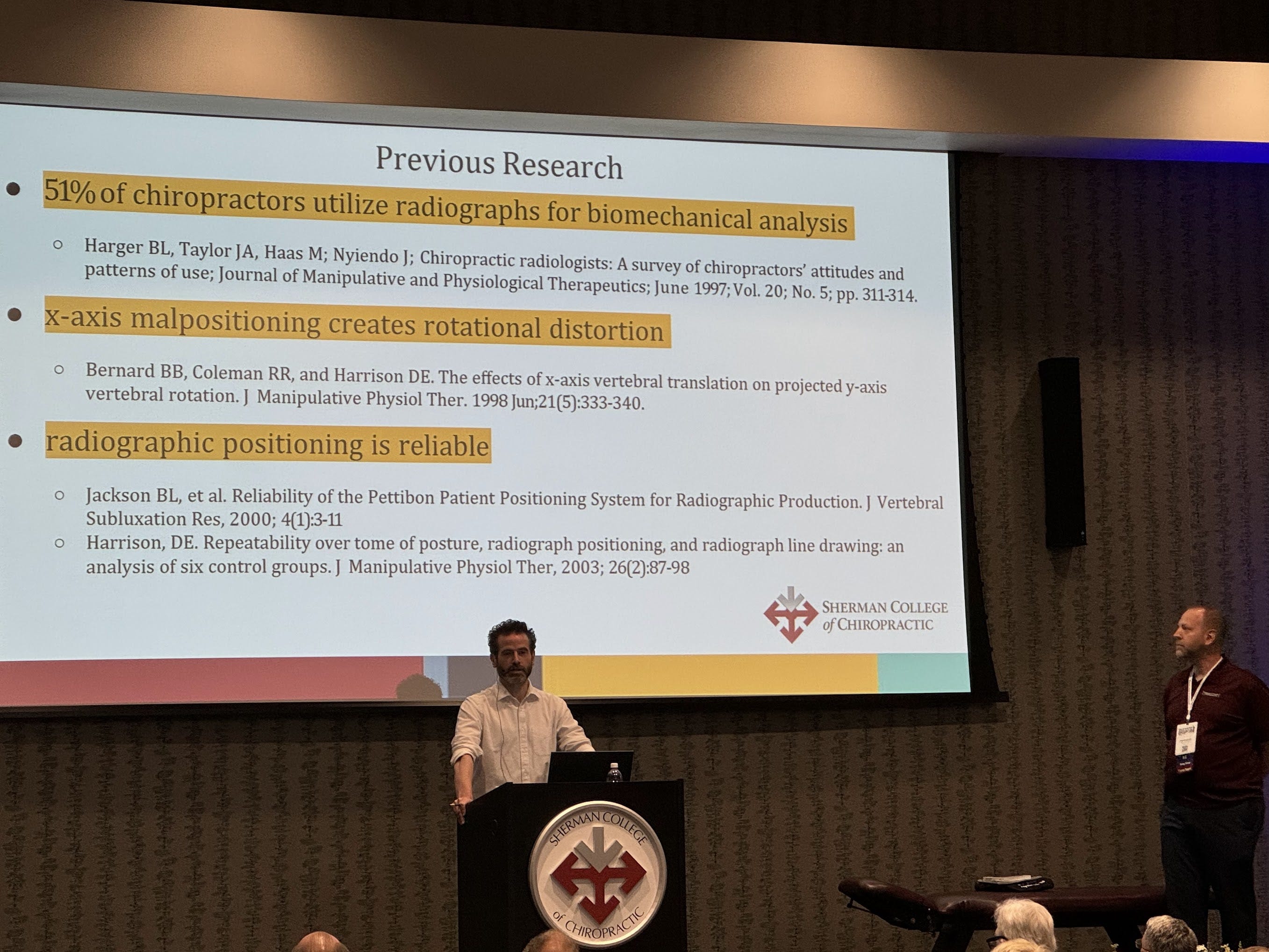
Visual Line Analysis and Radiographic Precision
Presented by Drs. Matthew Devlin & Daniel Becker (Sherman College Faculty)
This presentation tackled the reliability of visual analysis at the cervicothoracic junction by comparing AP Open Mouth (APOM) and thoracic sectional radiographs. As faculty at Sherman College, Drs. Devlin and Becker brought not only technical precision but a pedagogical perspective to the challenge of improving diagnostic consistency. Their study emphasized the need for continued refinement in radiographic interpretation techniques within chiropractic.
“Quality care depends on quality assessment. This kind of investigation strengthens both education and practice” IRAPS attendee.
Case Study: Subluxation Care Resolves Infant Constipation
Presented by Allie Hamstead, DC (Sherman Faculty)
In a moving case study, Dr. Hamstead detailed the resolution of chronic constipation in a two-month-old infant following subluxation-centered chiropractic care. Using a salutogenic framework, the presentation highlighted the potential of chiropractic to impact pediatric health outcomes in non-musculoskeletal areas. The presentation also reinforced Sherman’s strategic focus on integrating evidence-informed care for children into subluxation-based chiropractic models.
“It’s one thing to talk about theory, it’s another to see it change a child’s life,” a participant said during the Q&A.
Philosophy, Practice, and Education—A Necessary Unity
Presented by Joel Kinch, DC
Dr. Kinch challenged attendees to rethink the divide between chiropractic philosophy and education, arguing that any effort to professionalize chiropractic without rooting it in principle is ultimately hollow. His call to unify clinical education with philosophical depth was a reminder that competency is not just technical, it is conceptual.
“A principled chiropractor is a fully formed chiropractor,” Kinch stated. “And education must reflect that.”
Public Confusion and the Mixed Messages of Chiropractic
Presented by Carsten Reinhardt, DC
In his philosophical paper, Dr. Reinhardt dissected the communication failures that plague the chiropractic profession. Using examples from patient interactions and public campaigns, he argued that internal inconsistencies in language and branding contribute to widespread confusion about what chiropractic actually is.
“We confuse the public because we’re confused ourselves,” Reinhardt warned. “Until we fix that, we’ll always be chasing respect we haven’t earned.”
Sherman’s Strategy in Action
These presentations demonstrate the breadth and depth of IRAPS 2025, from radiographic methodology to infant outcomes, from unified education models to calls for clearer philosophical communication. All of it reflects Sherman College’s strategic emphasis on research and scholarship as the lifeblood of principled chiropractic.
“IRAPS shows us that excellence in chiropractic isn’t just possible, it’s happening now,” said one attendee.
“This is where the future of the profession is being written,” said another.
Stay tuned for Part III as we continue to explore more from IRAPS 2025, where purpose meets publication, and principle drives progress.
CLICK HERE to review the Proceedings
