Georgia Board Joins Growing Number of States Addressing the Monopoly on Chiropractic Accreditation
Originally published: 2025-09-13
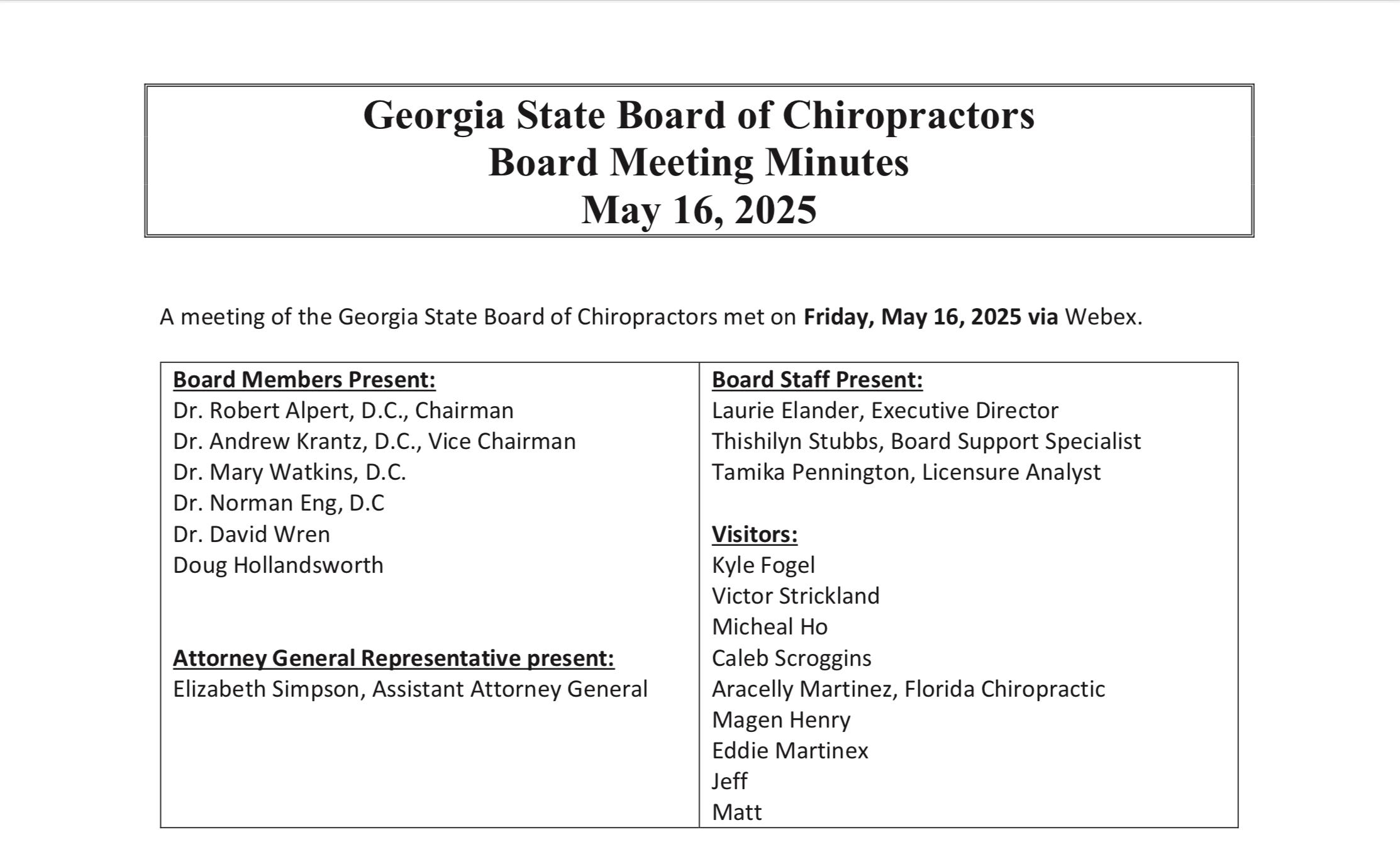
At its May 16, 2025 meeting, the Georgia Board of Chiropractic Examiners voted to revise its administrative rule governing acceptable chiropractic schools. The change added five simple words — “or an equivalent as determined by the Board” — to Rule 100-12-.01.
CLICK HERE for a copy of the minutes
This means that, at least on paper, the Board could now recognize graduates from chiropractic schools not accredited by the Council on Chiropractic Education (CCE), as long as the school is determined to be “equivalent.”
“The Board shall accept graduates of a Doctor of Chiropractic Program accredited by the Council on Chiropractic Education (CCE) or an equivalent as determined by the Board.”
– Official language adopted by the Board on May 16, 2025
While this may appear to open the door to competition and fairness in chiropractic accreditation, the statutory reality tells a different story.
Statute Still Names CCE as the Gatekeeper
The Georgia Chiropractic Practice Act, specifically O.C.G.A. § 43-9-7(d), still requires graduation from a chiropractic school accredited by the CCE or “a board-approved successor.” This effectively gives CCE a legislative monopoly and renders the new rule change practically toothless.
“Rules cannot override statutes. The law still mandates CCE. The rule change is symbolic at best.”
Under Georgia law, when a statute and a rule conflict, the statute always wins. So unless the legislature amends § 43-9-7(d) to remove the CCE mandate or broaden it meaningfully, the Board’s new “or equivalent” language will remain unenforceable.
What Does “Equivalent” Actually Mean?
Even if the statutory issue were resolved, the effectiveness of the Board’s new language depends entirely on how “equivalent” is defined and applied. The good news is that published criteria do exist, they were submitted to the Georgia Board by the Georgia Council of Chiropractic in advance of the May vote.
These Standards for Recognition of Chiropractic Accrediting Agencies are modeled on best practices from the U.S. Department of Education and provide a transparent, enforceable framework for evaluating accrediting bodies beyond the CCE.
These standards emerged from a collaborative workgroup formed in response to mounting concerns within the chiropractic profession over the monopolization of educational accreditation and the lack of transparent, accountable processes for recognizing accrediting agencies. The workgroup was composed of educators, regulatory experts, institutional leaders, and policy advisors committed to restoring state authority, protecting student rights, and encouraging diversity in chiropractic education. Motivated by the national shift toward decentralization of education and increasing scrutiny of private accrediting monopolies, the group set out to develop clear, objective, and constitutionally sound criteria that state boards could adopt to ensure fair and open recognition of accrediting bodies. These standards reflect a renewed commitment to federalism, public accountability, and professional excellence.
“The Board now has the tools to evaluate alternatives — the only question is whether it will use them.”
You can view the full standards here:
🔗 https://vertebralsubluxationresearch.com/2025/05/10/1866-standards-for-recognition-of-chiropractic-accrediting-agencies
Without formally adopting and applying these standards, however, the phrase “or equivalent” still risks being vague and subject to arbitrary or politically motivated decisions. The rule revision opens the door, but the Board must now walk through it with integrity and due process.
What About the NBCE Part IV Exam?
While the Board’s rule change focused on school accreditation, it did not address the other major monopoly in Georgia chiropractic licensure: the requirement to pass all four parts of the National Board of Chiropractic Examiners (NBCE) exams, including Part IV, an in-person OSCE exam now centralized in Greeley, Colorado.
This exam is expensive, logistically burdensome, and duplicative. All accredited chiropractic schools already assess and certify clinical competency as a condition of graduation. Other professions, including MDs and DOs, eliminated similar exams during COVID and never brought them back.
“No other licensed health profession in Georgia requires an in-person OSCE from a private vendor. Why are chiropractors still subject to this?”
If Georgia truly wants to modernize its chiropractic licensure framework, removing the NBCE Part IV requirement must be part of the conversation. But even though the Gerogia Council on Chiropractic has addressed this issue with the board they have not acted. And in the case of NBCE there is no Georgia sytstute mandating it so the baord could change it immediately. the question is - why won’t they?
Where We Go From Here
The Georgia Council of Chiropractic supports the spirit of the rule revision but without statutory reform and enforceable standards for recognizing alternative accrediting bodies, the change is more illusion than substance.
The next steps are clear:
Amend the statute to remove or generalize the CCE language
Publish clear standards for recognizing other accrediting agencies
End the requirement for NBCE Part IV, relying instead on school-based clinical certification
Only then will Georgia join the ranks of other health professions that prioritize fairness, competition, and meaningful oversight over monopoly and inertia.
