How Florida’s New Accreditor Signals Collapse for the Chiropractic Cartel
Originally published: 2025-07-11
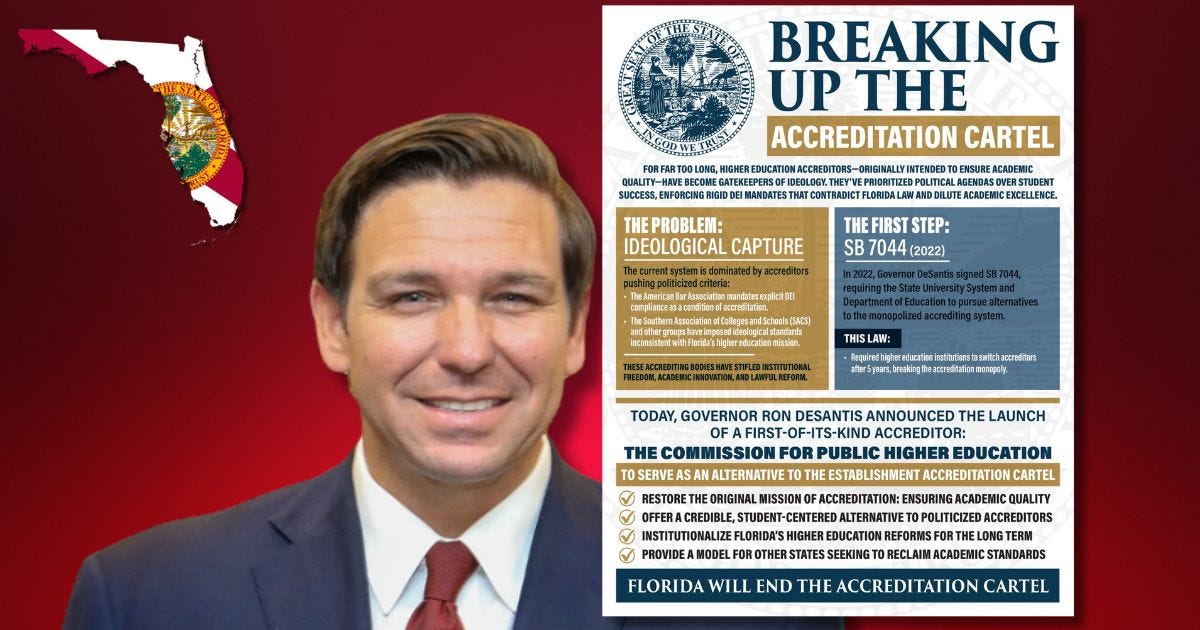
A Bold Break from Accreditation Orthodoxy
On July 12, 2025, the State University System of Florida is set to vote on launching a new institutional accreditor—the Commission for Public Higher Education (CPHE). This move, spearheaded by Governor Ron DeSantis and supported by five other major state university systems, is a direct challenge to the monopoly held by traditional regional accreditors like SACSCOC. The plan cites “growing dissatisfaction,” “bureaucratic bloat,” and a desire for a true system of peer review among public institutions as primary motivations for the move.
In DeSantis’s words, “What we’ve seen develop is an accreditation cartel.” It’s a powerful phrase—and one that chiropractors should recognize immediately.
“What we’ve seen develop is an accreditation cartel.” – Gov. Ron DeSantis
What CPHE Means for Chiropractic
What’s happening in Florida isn’t just about public universities. It’s about reclaiming public control over accreditation, dismantling monopoly power, and restoring transparency, competition, and outcomes-driven review. And that’s precisely what the chiropractic profession has been demanding for years.
The Council on Chiropractic Education (CCE), the National Board of Chiropractic Examiners (NBCE), and the Federation of Chiropractic Licensing Boards (FCLB) operate in exactly the way CPHE is challenging: as a self-reinforcing triad of private corporations that dictate who can be educated, tested, and licensed—all with no government oversight, no competition, and no accountability.
Just like the regional accreditors CPHE is challenging, these chiropractic gatekeepers have become bloated, unresponsive, and consumed with protecting their own authority rather than serving students or the public.
Life University and the Greeley Grift: A Case Study in Cartel Enforcement
Take Life University’s recent decision to require students to pass NBCE Part IV before graduation. This policy was not mandated by state law. It was adopted in response to CCE’s Policy 56, which ties graduation to success on NBCE’s licensure exams. Life’s decision effectively hands control of graduation over to NBCE—a private, unregulated corporation that just centralized all Part IV exams to its Greeley, Colorado headquarters, eliminating local access and driving up student costs.
This is precisely the kind of behavior CPHE is designed to eliminate: private testing mandates masquerading as educational policy, bureaucratic hurdles with no measurable benefit to student outcomes, and cartel-like coordination among entities that profit from restricting entry into a profession.
“Life University’s NBCE graduation mandate is not academic policy—it’s cartel enforcement.”
State-Sanctioned Alternatives Are Now on the Table
Florida’s accreditor is being created by state governments, not private foundations or trade groups. It will be publicly accountable, outcomes-focused, and free of the ideological and bureaucratic entanglements that characterize existing accreditors. And despite criticism from legacy stakeholders, the CPHE proposal is gaining traction—and funding. Florida has already pledged $4 million to launch the organization, with other states expected to contribute similar support.
Once federally recognized, CPHE will offer a viable pathway for institutions to opt out of monopoly accreditation models—something chiropractic programs have never been allowed to do under the CCE’s chokehold.
For chiropractic, this is a watershed moment. If CPHE can gain recognition, so can the International Agency for Chiropractic Evaluation (IACE). The IACE offers a modern, science-based, subluxation-inclusive accreditation model that prioritizes transparency and academic freedom—exactly the kind of innovation that the CCE has blocked for decades.
Breaking the Triangle: The End of NBCE, CCE, and FCLB Collusion?
The chiropractic cartel depends on three pillars:
CCE enforces curriculum and graduation standards.
NBCE controls licensure through mandatory exams.
FCLB hardwires these mandates into state regulations.
Together, these organizations dictate the entire professional pipeline—without ever being subject to competitive review. CPHE represents the kind of systemic challenge that could break that closed loop. If states begin to reassume authority over accreditation and licensure, they could reject CCE mandates, remove NBCE exam requirements, and ignore FCLB directives.
“Accreditation must serve the public—not entrench private power.”
Conclusion: The Beginning of the End
The Florida Board of Governors’ vote to form CPHE is not just a bureaucratic move. It is a statement of resistance—against monopoly power, regulatory capture, and the illusion that educational quality requires cartel control. What’s happening in public higher education today is precisely the opportunity the chiropractic profession needs to reclaim its future.
The time has come for chiropractic stakeholders—colleges, boards, associations, and students—to support alternative accreditation models, challenge the NBCE’s dominance, and demand that public licensure be based on competency, not compliance.
CPHE shows the way. Chiropractic just needs to follow.
Follow the movement for chiropractic freedom at:
www.chiropracticfreedom.org
