How the CCE Distorts Reality to Protect Its Monopoly: The Dark Side of Chiropractic Education
Originally published: 2025-03-11
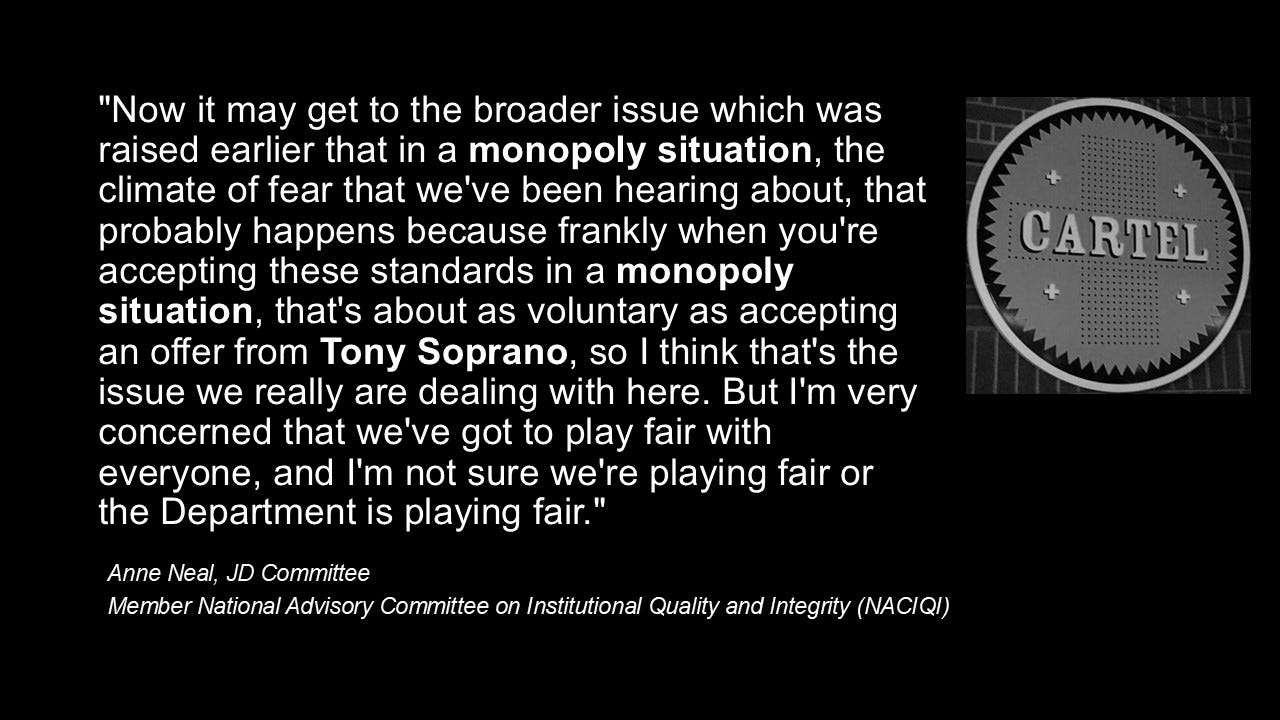
When it comes to the future of chiropractic education, the Council on Chiropractic Education (CCE) is playing a dangerous game—and it’s students and the profession who are paying the price. Behind closed doors, the CCE and its cozy relationship with the National Board of Chiropractic Examiners (NBCE) have created a system that’s not only monopolistic but also financially crippling for chiropractic graduates. A closer look at the CCE’s response to criticism from the Chiropractic Freedom Coalition (CFC) reveals a disturbing pattern of misdirection, censorship, and outright manipulation.
CLICK HERE for the Letter from the CCE
CLICK HERE for the response from the Coalition
The Illusion of Choice
The CCE’s February 5, 2025, letter to the CFC reads like a masterclass in gaslighting. In response to allegations that the CCE has handed control of chiropractic licensure to the NBCE, the CCE claims that schools can use other measures—like proof of licensure or Canadian board exam results—instead of NBCE exam scores. On the surface and for the uninitiated, that sounds like a fair and flexible system. But the CFC’s blistering response exposes the truth: this is a logistical impossibility.
Tracking licensure data from over 50 states and more than 120 countries is a bureaucratic nightmare. Most licensing boards don’t even share this data in a uniform format, and no centralized system exists to track it. The CCE’s claim that this is a “viable alternative” is nothing more than a smokescreen in an attempt to hide its requirement and reliance on NBCE exam scores. As the CFC puts it, if proof of licensure were truly a functional alternative, this would be one more reason the Part 4 exam is unnecessary.
But as far as the CCE and NBCE are concerned the Part 4 exam isn’t going anywhere—and that’s the whole point. Despite objections from schools which were ignored by the NBCE, they are moving forward. The NBCE stands to rake in enormous profits from this mandatory test, which will now require students—including international graduates—to travel to Colorado at their own expense to take this unnecessary exam. The CCE’s insistence that this isn’t their problem is laughable. They claim they have “no control” over licensing requirements while continuing to prop up the very system that enforces them.
The Secret Summit
The CCE’s cozy relationship with the NBCE and other chiropractic power players becomes even more suspect when you factor in the Chiropractic Summit—a secretive, closed-door meeting where decisions affecting the entire profession are made without input from an entre faction of the profession.
The CCE didn’t even bother addressing this concern in their response to the CFC. That’s because they can’t defend it. The Summit excludes many professional organizations, gives privileged access to the CCE, NBCE and the Federation of Chiropractic Licensing Boards (FCLB), and operates without any public record or accountability. If the CCE is just an independent accreditor—as they claim—why are they sitting at the table with the same organizations that control licensing and financial interests in the profession?
The Summit issue came to a head during the Vanterpool v. FCLB case and laid bare the consequences of an outsider attempting to get a “seat at the table” with the privileged few who control trade in the profession and don’t want that apple cart upset.
Even worse, the CCE has begun tightening its grip on the narrative. In January, they barred a journalist from The Chiropractic Chronicle from recording a public meeting, despite having previously assured that media access was allowed. This type of censorship directly contradicts the CCE’s public statements about transparency and open dialogue.
Then remarkably, despite submitting written comments and presenting oral testimony the CCE decided to completely leave out any mention of what representatives of the Coalition stated during the meeting - instead simply reporting: During the meeting the Council received oral comments from Dr. Michael Guinosso and Dr. Scott Kelly.
CLICK HERE for the notes from the CCE on that meeting
CLICK HERE to hear the testimony given and to understand why the CCE did not report on it.
If the CCE’s decisions are above board, why are they so afraid of the press? Given their constat claims of "transparency" why didn’t they report to the profession on what the Coalition representatives told the CCE?
Financial Crisis and Borrower’s Defense
The fallout from this corrupt system is already hitting students hard. Chiropractic graduates are filing a growing number of Borrower’s Defense claims—legal actions that allow students to seek loan forgiveness when they’ve been misled about job prospects or earning potential. And that’s exactly what’s happening.
CLICK HERE for more on Borrowers Defense
Students are being lured into expensive programs based on the illusion that a chiropractic career will be lucrative and stable. Instead, they’re graduating with six-figure debt and limited job opportunities—thanks, in part, to the CCE’s complicity in maintaining a licensing monopoly that makes it harder and more expensive to enter the profession.
Even the American Chiropractic Association sees the writing on the wall stating in a recent February 255, 2025 article on student debt:
"Many DCs are emerging with more than just a passion for patient care—they are stepping from the classroom to the curb with a mountain of student loan debt. Based on a recent study, many DC graduates report owing well over six-figures of debt. With interest quickly accruing on these mortgage-size balances, financial stress is a constant companion. Compounding the matter further, the numerous repayment plan options, abbreviations, and forgiveness opportunities often leave borrowers’ heads spinning, like stepping into anatomy lab for the first time all over again. For some, managing debt while an associate or building a practice can feel overwhelming, forcing them to delay important generational milestones like buying a home, starting a family, or saving for retirement. This burden is not simply a personal struggle; it is reshaping the entire chiropractic profession, limiting some clinicians’ ability to thrive and serve their communities effectively and ethically.(6) Further, insurmountable loan burdens substantially detract from a sense of professional and personal well-being, despite chiropractic frequently being touted as offering a positive work-life balance."
The CCE, predictably, claims this is not their problem. But as the accreditor overseeing these programs, they bear a direct responsibility for the quality of the education students receive and the accuracy of the career promises schools make. The fact that so many students are now seeking relief through Borrower’s Defense claims exposes the ugly truth: the CCE is more interested in preserving the NBCE’s monopoly than protecting students or the integrity of the profession.
Nowhere is this more apparent than in the scandal the CCE started called the "Alternative Admissions Track" which it has now abandoned and left a wake of destruction in students who basically bought a car they can't drive.
If the CCE really wanted transparency they would reveal how many tens of millions of dollars in student loan debt was accrued by students who never graduated under this scheme to keep the student pipeline moving along under.
CLICK HERE for more on that story
The CCE’s Logical Gymnastics
The CCE’s attempts to justify its position rely on a predictable series of logical fallacies:
The Red Herring Fallacy – The CCE points to the “licensure alternative” as proof that they’re not beholden to the NBCE's Part IV, despite knowing it’s an impossible solution and knowing the exams are unnecessary.
The Appeal to Tradition – The CCE insists that relying on NBCE scores is necessary because it’s “how it’s always been done,” ignoring the fact that the system is clearly failing students and the profession.
The False Dilemma – The CCE frames the debate as a choice between relying on NBCE exams or providing their own licensure rates.—conveniently ignoring the fact that the Part IV exam is unnecessary because the schools already certify competency.
This is not a good-faith argument—it’s a well-orchestrated attempt to protect a financial and political monopoly under the guise of professional standards.
The Way Forward
The CFC isn’t just complaining—they’re offering real solutions. They propose a decentralized, school-driven system for assessing clinical competence, similar to the way medical and osteopathic schools operate. Schools would be held accountable through a peer-review process and tracked licensing data—if the CCE and NBCE truly wanted to fix the system, they would support this.
Instead, they cling to a broken, monopolistic model that benefits a few power players at the expense of students and the profession’s future.
The CCE’s unwillingness to address these issues head-on is not a coincidence—it’s a strategy. As long as the current system remains intact, the NBCE and CCE maintain their financial and political dominance. That’s why they continue to hide behind logical fallacies, secret meetings, and censorship.
This isn’t about preserving educational standards—it’s about preserving power. And until the CCE and the profession as a whole is forced to confront this reality, the future of chiropractic education will remain in jeopardy.
CLICK HERE to listen to a podcast about this
