Indigenous Tribunal Declares COVID-19 Vaccines as Bioweapons
Originally published: 2025-10-31
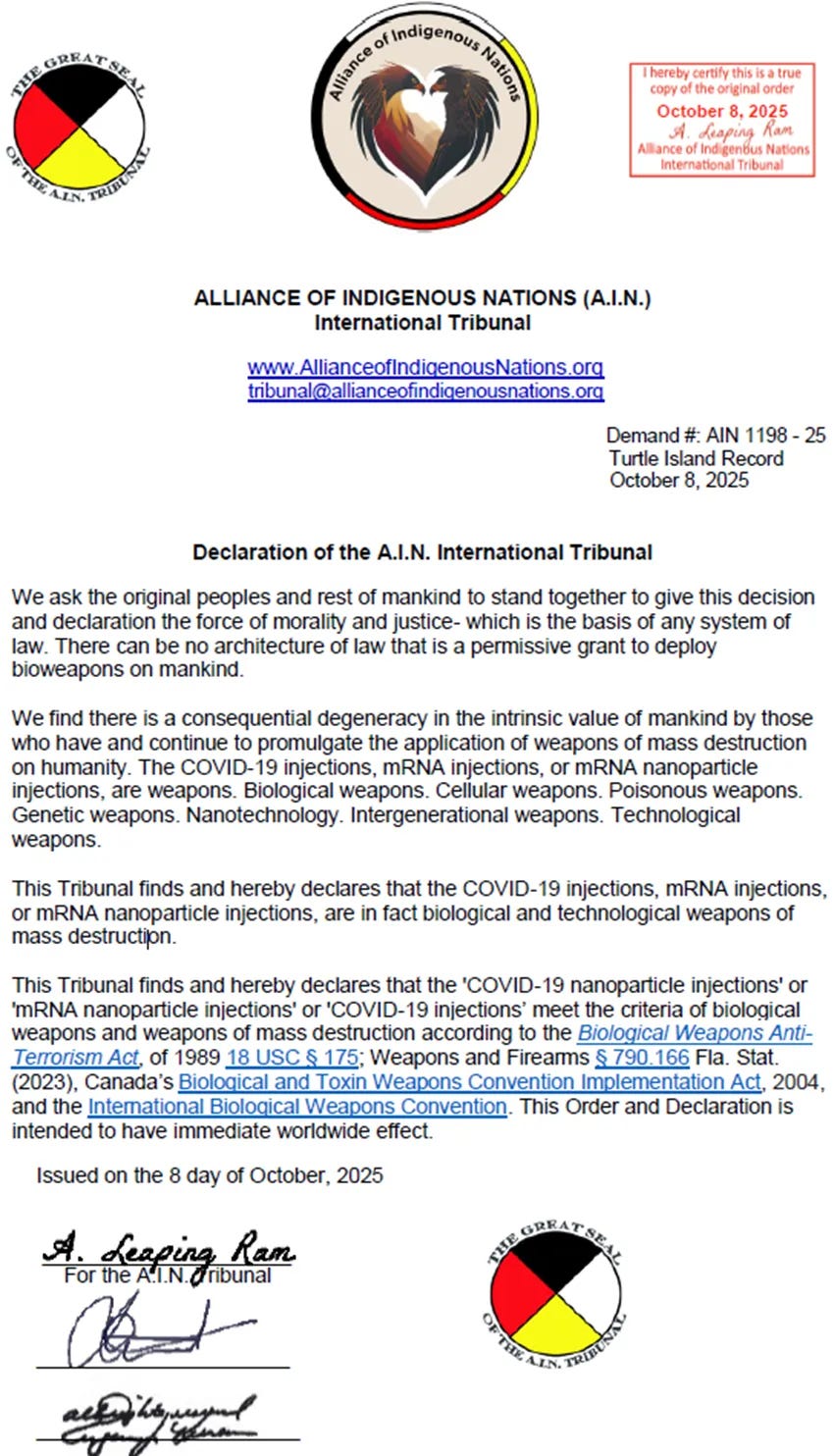
In a groundbreaking and highly controversial move, the Alliance of Indigenous Nations (A.I.N.) International Tribunal issued a declaration on October 8, 2025, classifying COVID-19 mRNA nanoparticle injections as biological and technological weapons of mass destruction. This ruling, rooted in Indigenous sovereignty and international law, has ignited discussions on vaccine safety, global health policies, and the boundaries of Indigenous judicial authority.
The Tribunal’s Declaration
The A.I.N. International Tribunal, established under the A.I.N. Treaty and International Peace Treaty, claims recognition on a nation-to-nation basis with entities like the Canadian government, as acknowledged by Canada’s Minister of Crown-Indigenous Relations and Northern Affairs on December 13, 2024. Comprising judges from every continent, the tribunal operates under Indigenous Common Law and draws on frameworks like the United Nations Declaration on the Rights of Indigenous Peoples (UNDRIP) and the Organization of American States’ American Declaration on the Rights of Indigenous Peoples (ADRIP).
The declaration asserts that the injections meet strict legal criteria for bioweapons, citing laws such as the U.S. Biological Weapons Anti-Terrorism Act of 1989, Florida Statutes, Canada’s Biological and Toxin Weapons Convention Implementation Act, and the International Biological Weapons Convention. It emphasizes Indigenous rights to self-determination and judicial independence, referencing Canadian Supreme Court precedents like R v. Desautel (2021) and Haida v. BC (2004).
“This Tribunal finds and hereby declares that the COVID-19 injections, mRNA injections, or mRNA nanoparticle injections, are in fact biological weapons and weapons of mass destruction.” – A.I.N. International Tribunal Declaration
Legal and Scientific Basis
The tribunal’s findings are presented as proven “beyond a reasonable doubt” through expert affidavits and peer-reviewed studies. They classify the injections as offensive biological agents with gain-of-function enhancements, including HIV-like DNA sequences that increase lethality and infectivity. Technological elements, such as self-assembling nanotechnology, hydrogel polymers, lipid nanoparticles, and heavy metal contaminants, are highlighted as enabling biosensors and transhumanist alterations.
DNA contamination is a central concern, with billions of fragments per dose, including the SV40 promoter-enhancer linked to cancer risks. A 2025 peer-reviewed study in Autoimmunity by Dr. David J. Speicher, Dr. Jessica Rose, and Dr. Kevin McKernan confirms these issues in Pfizer-BioNTech and Moderna products.
Key Findings and Health Concerns
The declaration links the injections to severe health impacts, including neurocognitive disorders, cardiovascular diseases, cancers, infertility, miscarriages, and multi-organ damage. It claims the vaccines produce harmful spike proteins causing autoimmune reactions, blood clots, and “shedding” to unvaccinated individuals. Global death estimates are cited at 17 million, with symptoms often misdiagnosed as long COVID.
The tribunal views these as part of a broader agenda, including depopulation efforts referenced in U.S. documents like Henry Kissinger’s 1974 National Security Study Memorandum. Intergenerational harm through genomic integration is emphasized, posing risks to future generations.
“I’ve witnessed the growth of hydrogel sheets in human blood, and how that growth results in a reduction of natural blood cells. This change in the body is nothing less than transhumanism, and affected people are unwittingly being transformed without their consent.” – Dr. Ana Maria Mihalcea
Expert Voices
The ruling draws on testimonies from prominent figures:
Dr. Francis Boyle, drafter of the U.S. Biological Weapons Anti-Terrorism Act, describes the injections as “an offensive biological warfare weapon with gain of function properties... [with] HIV, the precursor to AIDS DNA genetically engineered into that.”
Dr. Ana Maria Mihalcea details nanotechnology and hydrogel, noting their role in creating indestructible clots and accelerating deaths.
Dr. Paul Alexander warns of “no benefit, yet... harmful” effects, including genome risks and shedding.
Dr. Rima Laibow connects the injections to depopulation policies.
Other contributors include Dr. Andrew Zywiec and Tribal Practitioners, focusing on systemic diseases.
“The injections pose no benefit, yet are harmful and cause a wide range of diseases, including death.” – Dr. Paul Alexander
Broader Implications and Demands
The tribunal frames the injections as tools for transhumanism, genocide, and colonial injustice, particularly targeting Indigenous communities. It accuses governments and institutions of censorship to suppress evidence.
Demands include an immediate global ban, market removal, moratorium on use during pregnancy, and criminal investigations. The declaration calls for unity among Indigenous peoples and humanity to reject these “weapons” and pursue justice.
Questions of Legitimacy
While supporters hail the tribunal as a legitimate exercise of Indigenous sovereignty, critics question its authority. A Canadian court dismissed arguments based on an A.I.N. order as “pseudo-legal,” ruling it a “waste of resources.” Social media discussions label it unrecognized or potentially a “scam,” with some calling it a corporation posing as Indigenous nations. The A.I.N. defends its status, emphasizing nation-to-nation recognition. No major governments or health agencies have responded as of October 28, 2025.
Conclusion
This declaration challenges mainstream narratives on COVID-19 vaccines, blending Indigenous rights with scientific critique. Whether viewed as a pivotal call for accountability or a fringe claim, it underscores ongoing debates about vaccine safety, sovereignty, and global equity. As discussions evolve, it may inspire further scrutiny or dismissal in legal and public arenas.
