Landmark Vaccine Court Ruling: Family Wins Justice for Infant’s Death
Originally published: 2025-07-02
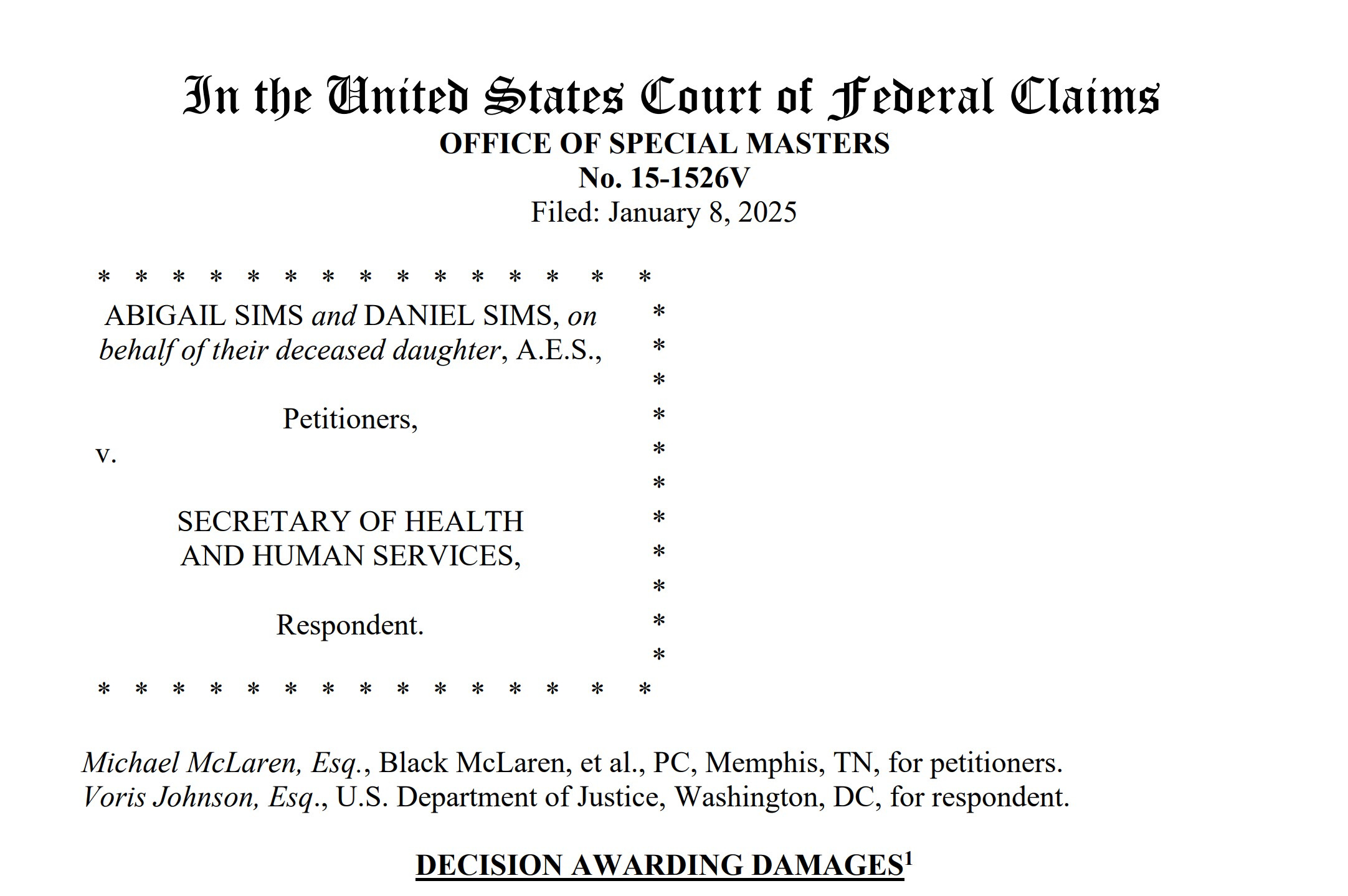
In a groundbreaking decision, the U.S. Court of Federal Claims has upheld a 2024 ruling that an 11-week-old infant’s death was caused by a vaccine-induced brain injury. The Sims v. HHS case, decided by Special Master Mindy Roth, marks a rare and significant victory for a family seeking justice through the National Vaccine Injury Compensation Program (NVICP). This ruling not only delivers closure for Abigail and Daniel Sims but also shines a spotlight on the need for transparency and accountability in vaccine safety. As the government faces a critical August 11, 2025, deadline to appeal, the case could set a powerful precedent for future claims.
A Family’s Fight for Truth
Abigail and Daniel Sims filed their petition in December 2015 after the tragic loss of their daughter, A.E.S., who passed away at just 11 weeks old. Unlike many cases dismissed as unexplained Sudden Infant Death Syndrome (SIDS), the Sims family presented compelling evidence that A.E.S.’s death resulted from vaccine-induced encephalopathy—a severe brain dysfunction. Special Master Mindy Roth’s 2024 ruling affirmed their claim, rejecting the government’s argument that the death was due to natural causes.
“This ruling is a beacon of hope for families who have long felt ignored by a system designed to protect vaccine manufacturers.”
On June 11, 2025, the U.S. Court of Federal Claims denied the government’s motion for review, solidifying the decision. Now, the Department of Health and Human Services (HHS) has until August 11, 2025, to decide whether to appeal to the Federal Circuit Court of Appeals or accept the judgment, which would finalize compensation for the Sims family.
Why This Case Matters
The Sims case is a rare triumph in the NVICP, a no-fault program created under the 1986 National Childhood Vaccine Injury Act to compensate rare vaccine injuries while shielding manufacturers from lawsuits. Proving causation in such cases is notoriously difficult, requiring petitioners to meet a three-prong test: a medical theory linking the vaccine to the injury, a logical sequence of cause and effect, and a temporal relationship. The Sims family’s success underscores the possibility of overcoming these hurdles with robust evidence.
“The Sims case proves that justice is possible when families refuse to back down and science supports their claims.”
Unlike prior cases, such as Boatmon v. HHS, where a vaccine-SIDS link was overturned on appeal, both parties in Sims agreed the cause was encephalopathy, not SIDS. This distinction strengthens the ruling’s potential to influence future claims involving similar injuries.
Breaking the Silence on Vaccine Risks
The NVICP has compensated thousands of claims since its inception, yet public awareness of vaccine injuries remains low. The Sims ruling challenges the narrative that vaccines are universally safe, highlighting that while adverse events are rare, they can be devastating. Large-scale studies consistently show no link between vaccines and widespread issues like SIDS, but cases like this remind us that rare outcomes deserve scrutiny.
The ruling has sparked discussions online, particularly among communities skeptical of vaccine safety. While misinformation risks exaggerating the case’s implications, the decision itself is a factual acknowledgment of a specific, tragic outcome. It calls for better public education about the NVICP and stronger safety monitoring to maintain trust in vaccination programs.
What’s Next for Vaccine Accountability?
As the August 11 deadline looms, all eyes are on HHS. An appeal could delay justice for the Sims family and signal resistance to acknowledging vaccine risks, while accepting the ruling could pave the way for more transparent handling of similar claims. Beyond this case, the NVICP faces criticism for its high evidentiary burdens and lack of public access to case details, prompting calls for reform.
“This is more than a legal victory—it’s a call to ensure no family’s suffering is dismissed or silenced.”
The Sims case is a testament to the power of perseverance and evidence-based advocacy. It honors A.E.S.’s memory and offers hope to others navigating the complex landscape of vaccine injury claims. As the deadline approaches, this ruling stands as a clarion call for accountability, urging policymakers, scientists, and the public to confront the rare but real risks of vaccines head-on.
