NBCE & LIFE U: Closing Ranks, Silencing Dissent
Originally published: 2025-10-09
Overview
Life University’s Alumni Association announced a campus “student engagement dinner” featuring NBCE CEO Norman E. Ouzts, D.C., to discuss “subjects surrounding the National Boards,” with alumni funded student seats and a paid VIP cocktail hour for the first doctors to register. Framed as mentorship, the format creates a curated room for a private licensure vendor that controls students’ path to practice, while signaling institutional endorsement by hosting it in a university facility during prime evening hours.
Compounding the optics, LIFE has now fed directly into the cartel’s hands by making passage of all four parts of the NBCE a condition of graduation starting Fall 2025. That decision outsources degree conferral to an external, monopoly vendor and converts an academic milestone into a private gatekeeping event. Instead of defending students from unnecessary cost, delay, and risk, LIFE has aligned student progression with NBCE’s calendar, policies, and scoring, precisely the dynamic critics identify as the hallmark of the accreditation, testing, licensure cartel.
The timing is not incidental. LIFE is under accreditation pressure tied to NBCE pass rate metrics, and the University’s new mandate conveniently boosts those numbers by preventing non passers from graduating. The question practically asks itself, why would LIFE’s leadership choose to tighten a private vendor’s grip over its own graduates rather than fight to protect its students. Does someone inside LIFE’s leadership benefit, politically, reputationally, or otherwise, from demonstrating fealty to the cartel’s metrics and methods?
“You do not model dialogue by centering a monopoly and excluding dissent, you model censorship, and students pay the price.”
What happened
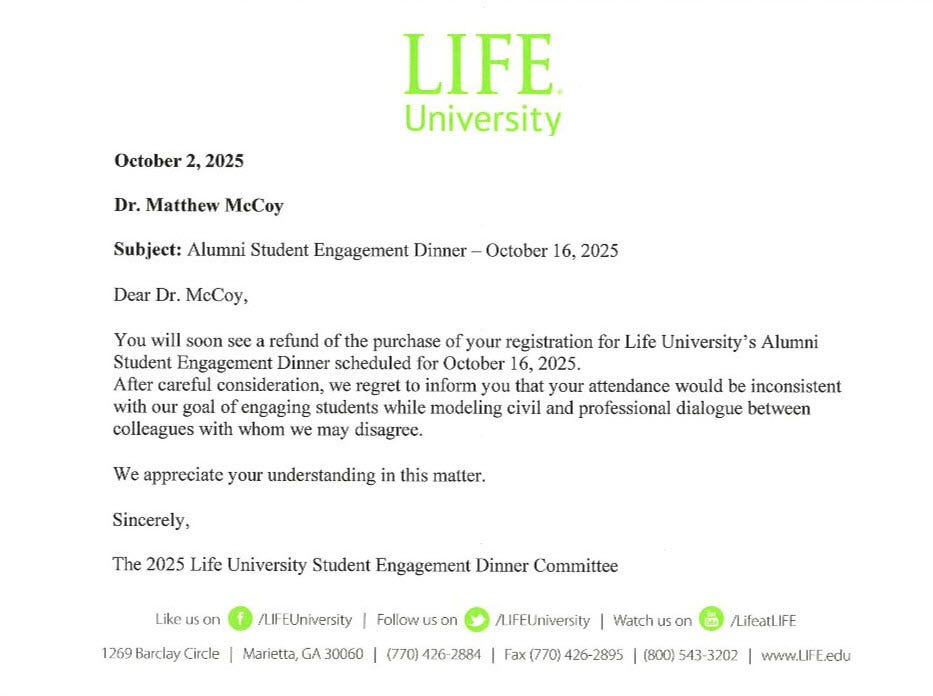
As a LIFE alumnus, I purchased a table to bring students to the dinner. After payment and confirmation, I received a refund notice and a disinvitation on the grounds that my presence was “inconsistent with our goal of engaging students while modeling civil and professional dialogue between colleagues with whom we may disagree.” The statement concedes disagreement, then excludes the dissenter. This is not dialogue, it is censorship dressed up as civility. The lesson to students is unmistakable, controversy will be quarantined from view, not confronted on the merits.
“When the gatekeeper controls the microphone, students get a monologue, not a conversation.”
Why this is censorship, not civility
The rationale is a performative contradiction. It claims an intent to model dialogue across disagreement, then removes the disagreeing voice. That is viewpoint based exclusion. It chills academic discourse, teaches students that dissent will be removed rather than rebutted, and reduces integrity from a value to a slogan. If LIFE intends to engage students and model professional dialogue, disagreement must be present, visible, and accountable in the room. If LIFE intends to present only one narrative, then it should say so plainly and stop claiming to model dialogue.
The NBCE problem, monopoly logic meets speech control
NBCE exerts de facto monopoly control over the licensure pathway. Monopolies suppress markets, censorship suppresses viewpoints. Platforming a monopoly while excluding critics eliminates both competitors and competing ideas. Students are forced to absorb a single, vendor approved narrative about the very exam system that dictates their time to practice, their costs, and their risk exposure. LIFE’s new graduation mandate tightens this loop by making NBCE outcomes the trigger for a university credential, which should be based on program level competencies and academic standards under the University’s control.
“Monopolies and censorship are cousins, one controls the market, the other controls the microphone.”
Part IV, wholly unnecessary, now made more harmful
NBCE’s Part IV practical is redundant and unnecessary. Chiropractic programs already assess clinical competence through rigorous, program based evaluations, clinic performance, case defenses, and faculty sign offs. All of that is overseen by the Council on Chiropractic Education and an additional regional accreditor such as SACS. States can rely on these demonstrated competencies, supported by external audits and outcomes data, instead of outsourcing hands on competence to a private vendor. Part IV adds an expensive, second hurdle that neither improves public safety nor reflects real clinical practice. Centralizing that unnecessary hurdle in Greeley multiplies the harm, more travel, higher costs, clinic disruption, and greater exposure to scheduling failures. An unnecessary exam made harder to access is not quality assurance, it is institutionalized delay.
Tone deaf at Greeley
The tone deafness is not hypothetical. Last week, a group of students went to NBCE headquarters in Greeley to request an in person conversation with leadership about Part IV. Instead of stepping out to talk, NBCE cited “safety and security” concerns and declined to meet. The pattern is consistent: control the message, avoid the questions, invoke civility or security as a pretext for silence.
“If the policy is sound, it can withstand questions, if it cannot, silencing the questioner is not the answer.”
The cartel pattern, and the secret summit’s playbook
This controversy is not about one dinner, it is about a system. Accreditation bodies tie program success to NBCE outcomes, the private testing vendor sells the exams and defines the pathway to practice, and licensing boards align enforcement with those exams. Around this structure sits a secretive summit culture that uses the same censorship tactics, closed door meetings, controlled agendas, and managed access designed to keep inconvenient questions off the record. Call it curated process, civility pretext, or managed speech, the effect is the same, exclude dissent, present the conclusion as consensus, and move on.
CFC’s growing coalition to dismantle the cartel
Against this backdrop, the Chiropractic Freedom Coalition is gaining support from students, alumni, educators, and practicing doctors who are aligning behind straightforward reforms. Replace Part IV with program based competency verification reviewed by independent auditors, require transparent, recorded public forums when policy changes affect cost, access, and licensure, and end reliance on a single private vendor for high stakes gatekeeping. The coalition’s growth reflects a widening recognition that competition, transparency, and academic freedom, not monopoly control, produce better outcomes for students and the public.
What accountability should look like
Real accountability is simple to implement and impossible to fake. LIFE should host balanced forums with equal footing for opposing views and uncensored Q and A, publish in plain language the total costs, retake rules, and accommodation pathways, state clearly whether NBCE passage is tied to graduation and, if so, provide alternatives and appeals, and record and release the events with written answers to written questions. If the goal is education, the remedies are structure and sunlight, not disinvitation and euphemism.
“Structure and sunlight are the tools of education, disinvitation is the tool of control.”
A call to alumni
Alumni should insist that LIFE practice the values it prints on brochures. Integrity requires hearing disagreement in the room, not removing it from the invitation list. Professional dialogue requires equal footing and transparent rules, not curated access and rhetorical cover. Students deserve to see contested ideas tested in public, not sanitized for optics. Until LIFE and NBCE are willing to meet questions with answers instead of disinvitations, what they are modeling is not dialogue, it is censorship.
Matthew McCoy DC, MPH
LIFE Alumnus - September 1989
