No Boards, No Degree: Life University’s New Policy Sparks Backlash and Raises Legal Alarms
Originally published: 2025-06-23
"When a university makes external licensure exams a condition of graduation, it's no longer in charge—it's under the control of a cartel."
Life University’s NBCE Graduation Policy: A Line in the Sand
In February 2025, Life University announced a dramatic new policy that could redefine the student experience—and not for the better. Starting in the Fall 2025 Quarter, no chiropractic student will be allowed to graduate unless they have passed all four parts of the National Board of Chiropractic Examiners (NBCE) exams.
CLICK HERE to view the Policy Announcement
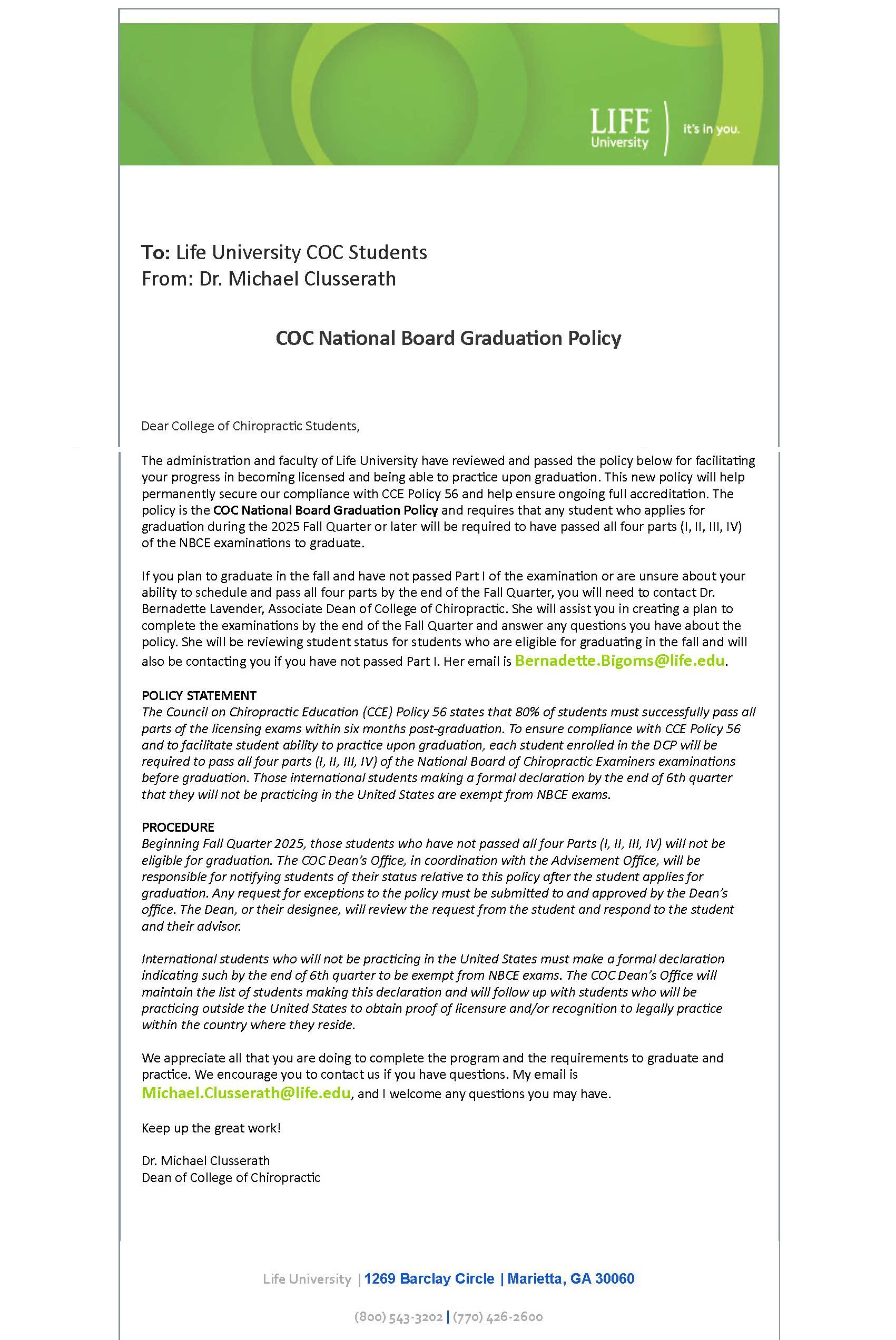
Yes, you read that right: complete the coursework, finish clinic, pass every internal exam and every clinical competency—and you still can’t graduate unless you clear an external licensing hurdle that isn’t even controlled by the university.
The justification for this policy? CCE Policy 56, which requires chiropractic programs to maintain an 80% four-year NBCE pass rate within six months of graduation. Life University is currently on probation for failing to meet that threshold—and with a critical review by the Council on Chiropractic Education (CCE) looming in July 2025, the administration appears willing to do whatever it takes to bring the numbers up.
But in trying to save the school, they may be violating the rights of their own students—and handing new legal ammunition to critics of the chiropractic accreditation cartel.
The Student Impact: Risk Without Recourse
The policy shift is monumental for students. Under this new framework:
A student who completes all academic and clinical requirements can still be denied their degree if they haven’t passed all four NBCE parts.
Students who fail or delay even one part could be stuck in academic limbo—potentially incurring more tuition debt, delaying licensure, and facing visa complications (for international students).
Students have no control over NBCE scheduling, scoring, or appeals—meaning a private, external testing organization answerable to no one now has more control over graduation than the university itself.
What makes this worse is timing. The policy was announced in February 2025, leaving students aiming to graduate just months later scrambling to find a way forward. There was no grandfathering, no student consultation, and no clear path for those already deep into their final year.
“This policy has nothing to do with academic quality—it’s about controlling the statistics to appease accreditors.”
A New Metric That Undermines the Old Rules
Buried beneath the headlines and policy statements, Life University has quietly introduced a telling new performance metric on its Student Achievement page—a second NBCE tracking table labeled: “Life University also tracks licensing success after 6 months.” It’s a subtle but significant admission.
This table shows the number of students who passed all four parts of the NBCE exam after the six-month post-graduation window required by CCE Policy 56. For example, in 2021 alone, additional students passed the exams outside the official reporting window. These students, while not counted for accreditation purposes, ultimately achieved licensure—meaning they were, in fact, competent and qualified.
This metric tells a very different story than the one CCE uses to justify probation. It suggests that the rigid 6-month window imposed by Policy 56 is arbitrary and punitive, punishing schools not for failing to educate students, but for failing to meet a bureaucratic timetable based on a monopoly-controlled exam process.
More importantly, this additional tracking data—published by Life itself—may become a critical piece of evidence in future regulatory or legal challenges. It demonstrates that:
Students do achieve competency, even if not on CCE’s timeline.
Schools are being sanctioned for a statistic, not a failure of education.
The standard being enforced is misaligned with actual student success.
In trying to defend itself, Life has inadvertently exposed the deeper flaw in the accreditation regime: real success doesn’t matter—only timed performance on NBCE and CCE terms does. And that makes the entire system ripe for scrutiny.
CCE Pressure, NBCE Monopoly: The Hidden Forces Behind the Policy
Life University’s February policy cannot be viewed in a vacuum. It must be understood in the context of CCE’s enforcement of Policy 56—and NBCE’s monopoly over chiropractic licensure exams.
The CIC Annual Report for 2023–2024 shows that Life has made changes to curriculum, clinical requirements, and course design, all in an effort to improve NBCE scores. But despite marginal improvements in quarterly pass rates, the university’s four-year average remains stuck at 76%, below the required 80%.
And so, facing the potential loss of accreditation, Life has resorted to manipulating the denominator: only allow students to graduate if they’ve already passed NBCE, thereby removing low scorers from the reporting pool.
But this action—while perhaps strategic—lays bare the coercive system the CCE and NBCE have constructed:
CCE enforces a pass-rate standard it doesn’t directly control.
NBCE controls the only pathway to licensure, and now, through Life’s policy, effectively controls graduation too.
Life is left as the enforcer, forced to restrict student advancement to avoid institutional death.
“This is what cartel enforcement looks like—when a university must deny degrees to save itself.”
Legal Exposure: The Cartel May Have Gone Too Far
In a recent blog post (“Boiling Point”), we laid out how this escalating scenario may ultimately turn into a legal and regulatory crisis for the CCE and NBCE, not just for Life University.
Here’s how:
Students harmed by this policy may file claims, but if their attorneys trace the real source of the injury, it points not to Life, but to the CCE’s coercive enforcement of Policy 56 and the NBCE’s monopoly over exams.
By conditioning graduation on NBCE performance, Life has effectively transferred academic authority to an unregulated private testing company.
This could violate U.S. Department of Education recognition standards, which require accreditors to base decisions on academic quality—not external tests they don’t control.
It may also expose the NBCE and CCE to antitrust scrutiny and due process claims, particularly as students become unwilling pawns in a metrics war.
If students can show that they were academically eligible to graduate but were blocked due to NBCE performance—especially when exam access, availability, or fairness are questionable—they may have standing in federal court, or in borrower defense claims, against the entire CCE-NBCE framework.
July 2025: The Tipping Point?
Life University’s future will be decided in July 2025, when the CCE reviews its probation status. If Life can show that it has regained compliance—thanks in part to its controversial graduation policy—it may have a temporary reprieve.
But make no mistake: the deeper the school is forced into compliance, the more glaring the evidence of coercion becomes. And that may be the very evidence needed to finally expose the cartel’s chokehold on chiropractic education.
This moment represents a critical inflection point: Will schools be allowed to reclaim their academic independence—or will the cartel’s grip tighten even further?
