Policy Memorandum: Opposition to the Federation of Chiropractic Licensing Boards’ Recognized Chiropractic Specialties Program (RCSP)
Originally published: 2025-08-21
Policy Memorandum
Subject: Opposition to the Federation of Chiropractic Licensing Boards’ Recognized Chiropractic Specialties Program (RCSP)
From: Chiropractic Freedom Coalition (CFC)
To: All U.S. State Chiropractic Regulatory Boards
Date: August 17, 2025
Introduction
On behalf of the Chiropractic Freedom Coalition (CFC) and its supporters across the United States, we submit this policy memorandum to express grave concerns about the growing adoption of the Federation of Chiropractic Licensing Boards’ (FCLB) Recognized Chiropractic Specialties Program (RCSP) by state regulatory boards.
We urge all state boards to reject this program as a dangerous and unethical delegation of state authority to a private corporation. Adoption of RCSP poses broad legal, ethical, and policy risks and undermines the public’s trust in independent, state-based regulation.
1. Unlawful Delegation of Regulatory Authority
RCSP is structured as a voluntary registry, but its implementation by states effectively transfers regulatory power from state boards to the FCLB, a private 501(c)(3) corporation which receives the bulk of its funding from the National Board of Chiropractic Examiners. While state boards have discretion to recognize specialty credentials, that discretion cannot be surrendered in advance by deferring to a standing list created and controlled by a third party.
RCSP does not evaluate individual chiropractors or programs. It merely affirms that credentialing bodies meet certain internal processes, without meaningful academic or clinical oversight. Recognizing RCSP as authoritative constitutes an unconstitutional sub-delegation of power and exposes state boards to legal liability under administrative law and non-delegation principles.
2. Lack of Transparency and Public Oversight
RCSP undermines the public’s ability to ensure that chiropractic specialty recognition reflects meaningful, independent review. It creates a two-tiered system, where programs affiliated with RCSP gain pre-approval without direct board evaluation, while all others are excluded or disadvantaged.
RCSP provides no assurance of academic quality, clinical rigor, or relevance to state-specific practice standards. Its criteria are opaque, and its review process is inaccessible to the public. Credentialing becomes pay-to-play, with access restricted to organizations able or willing to pay RCSP’s fees.
3. Deep Conflicts of Interest and Regulatory Capture
The FCLB receives most of its funding from the National Board of Chiropractic Examiners (NBCE), which is funded by student loan money used to pay for mandatory licensure exams. These financial entanglements create a closed-loop ecosystem, in which:
Students fund NBCE,
NBCE funds FCLB,
FCLB influences regulatory boards via RCSP and other programs.
Worse, many RCSP and FCLB leaders currently hold or have recently held seats on state boards, further eroding the boundary between public regulation and private interest. For example:
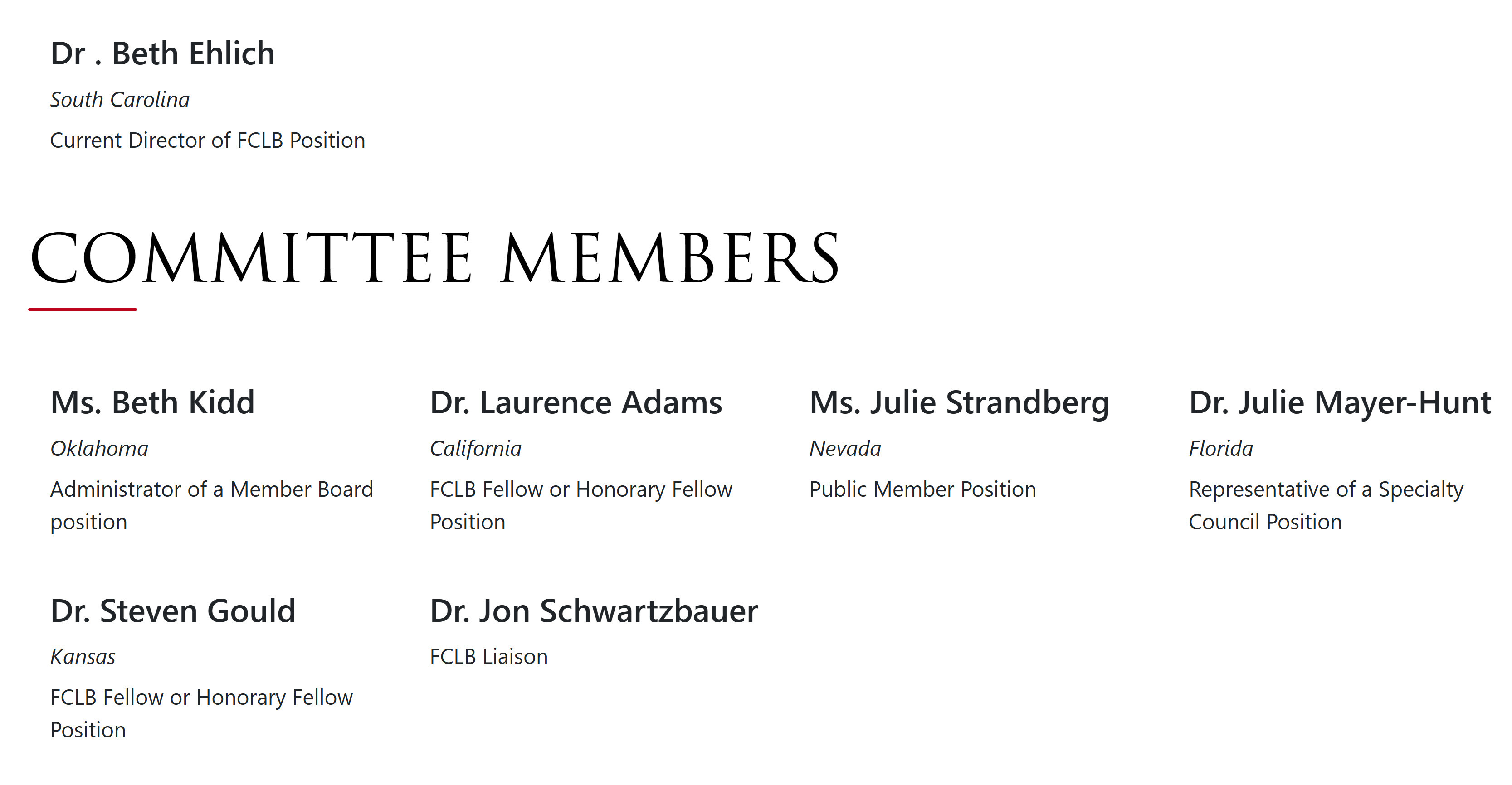
In Oklahoma, RCSP was adopted into state regulation while Beth Kidd, Executive Director of the state board, simultaneously served in RCSP leadership.
In Connecticut, the Board adopted RCSP while Dr. Karlos Boghosian—current NBCE President and past FCLB President—sat on the board.
This incestuous structure compromises the independence of regulatory boards, violates basic ethical standards, and raises serious questions of conflict of interest.
4. Anticompetitive and Exclusionary Effects
RCSP's approval mechanism favors large, politically aligned credentialing groups—while marginalizing independent, innovative, or philosophically diverse specialty programs.
Organizations like the International Chiropractic Pediatric Association (ICPA) and Sherman College of Chiropractic, both of which have testified against RCSP, would find their credentials excluded unless they submit to RCSP’s costly and narrow review process. The result is the homogenization of chiropractic specialty education, driven by monopoly, not merit.
5. Financial Exploitation of the Profession
RCSP imposes annual fees, application fees, and renewal costs on credentialing bodies, all of which are ultimately passed down to chiropractors and students. These fees fund a private credentialing bureaucracy whose regulatory power has been self-created and self-ratified. Chiropractors are now being asked to pay for the privilege of being regulated by organizations they never elected and cannot hold accountable.
Conclusion and Recommendations
The Chiropractic Freedom Coalition strongly urges state boards to:
Reject RCSP recognition in any form, by policy, rule, or statute.
Reassert board authority over credentialing decisions, ensuring full public accountability.
Prohibit dual service on credentialing organizations and state regulatory boards to eliminate conflicts of interest.
Investigate FCLB and NBCE funding flows and their impact on regulatory independence.
Preserve professional diversity by allowing multiple credentialing pathways, not only those pre-approved by RCSP.
The RCSP is not a tool for regulatory streamlining, it is a blueprint for regulatory capture. We urge every chiropractic board to take a stand for transparency, autonomy, and ethical public service.
Respectfully submitted,
Chiropractic Freedom Coalition
