Restoring Religious Freedom: PIC’s Amicus Brief in the Fight Against Vaccine Mandates
Originally published: 2025-10-20
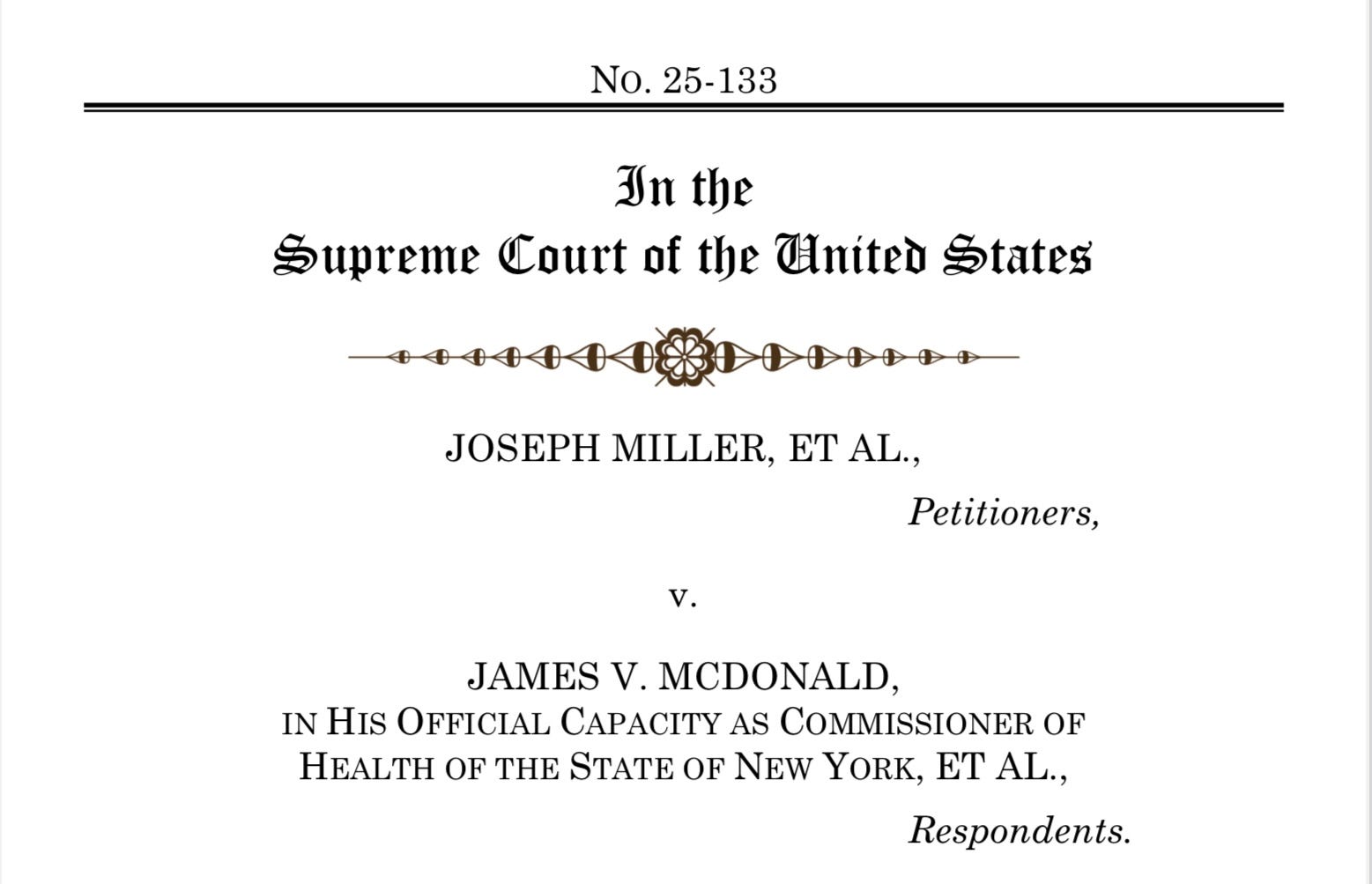
In an era where public health policies often clash with individual liberties, a pivotal case is making its way to the U.S. Supreme Court. Physicians for Informed Consent (PIC), a nonprofit dedicated to educating the public on vaccine risks and benefits, has thrown its weight behind Amish families in New York challenging mandatory school vaccinations without religious exemptions. Their amicus curiae brief, filed earlier this month, could reshape how states balance religious freedoms with health mandates.
The Case at Hand: Miller v. McDonald
At the heart of Miller v. McDonald (Case No. 25-133) are Amish families and schools in rural New York fighting for the right to exempt their children from vaccines based on deeply held religious beliefs. The petitioners, including Joseph Miller, Ezra Wengerd, and several Amish schools like Dygert Road School and Pleasant View School, argue that New York’s 2019 elimination of religious exemptions violates their constitutional rights. These schools, situated on private Amish land and serving only Amish children, have faced hefty fines, up to $118,000, for non-compliance.
The case originated in the Second Circuit Court of Appeals, where a decision in March 2025 upheld the mandate. Now, with a petition for writ of certiorari filed on July 31, 2025, the Supreme Court is considering whether to hear it. Responses from New York officials are due by November 3, 2025, following extensions, and numerous amicus briefs from groups like the Parental Rights Foundation and America’s Frontline Doctors have already been submitted in support of the petitioners.
New York stands as an outlier: while 46 other states and the District of Columbia allow religious exemptions for school vaccines, New York only permits medical ones, forcing families to vaccinate, homeschool, or relocate.
“This case satisfies all the necessary criteria for certiorari, and the lower court plainly violated the Supreme Court’s free exercise jurisprudence since at least 2018.”
— Greg Glaser, PIC General Counsel
PIC’s Role and the Amicus Brief
Founded in 2015 amid California’s push to eliminate vaccine exemptions, PIC is a 501(c)(3) educational organization focused on providing science-based data for informed decision-making. On September 4, 2025, PIC filed its amicus brief, urging the Supreme Court to grant certiorari and restore religious exemptions.
The brief supports the Amish petitioners by blending scientific analysis with legal arguments, emphasizing that mandates without religious accommodations infringe on First Amendment rights. PIC highlights how such policies create unequal treatment, allowing secular (medical) exemptions while denying religious ones, a disparity recently deemed unlawful in a Mississippi court ruling.
Scientific Perspectives: Questioning Vaccine Safety Data
Central to PIC’s argument is their “Silver Booklet,” a reference work compiling data on infectious diseases and vaccines. The brief asserts that for normal-risk U.S. children, vaccine safety data remains inconclusive, potentially causing more harm, through death or permanent disability, than the diseases they target.
This challenges the mainstream public health narrative, arguing that mandated vaccines for school attendance haven’t been proven safer than natural infections. PIC’s stance raises ethical questions about coercive policies, especially when exemptions exist for non-students or out-of-school activities.
“Scientific data currently available demonstrate that vaccines mandated for school attendance have not been proven safer than the infections they were designed to prevent.”
— Excerpt from PIC’s Amicus Brief
Legal Precedents: Free Exercise and Equal Protection
Legally, PIC contends that the lower court’s ruling contradicts Supreme Court precedents on the Free Exercise Clause. They reference a 2022 Supreme Court decision upholding a Medicare worker vaccine mandate, but notably one that included religious exemptions. This, they argue, sets a standard for equal treatment.
The brief also points to a circuit split: federal courts have issued conflicting rulings on religious vs. medical exemptions, underscoring the need for Supreme Court clarification to ensure consistent application of constitutional protections.
Broader Implications for Religious Freedom and Public Health
If the Supreme Court takes up Miller v. McDonald, it could have far-reaching effects beyond New York. A favorable ruling for the petitioners might compel states to reinstate religious exemptions, protecting minority faiths like the Amish from what PIC calls “medical bullying by proxy.”
This case sits at the intersection of religious liberty, parental rights, and public health. As debates over vaccine mandates intensify, especially post-COVID, it highlights ongoing tensions between collective safety and individual conscience. PIC’s involvement underscores a growing movement for informed consent, part of a broader Coalition for Informed Consent comprising over 300 organizations.
“Federal courts in different parts of the country have been reaching different conclusions on the issue of religious and medical exemptions to vaccine mandates for school attendance.”
— Greg Glaser, PIC General Counsel
Looking Ahead
As the Supreme Court weighs whether to grant certiorari, all eyes are on this case. For Amish families, it’s about preserving their way of life; for PIC, it’s about ensuring policies are grounded in solid science and respect for rights. Stay tuned for updates, religious freedom in the classroom may soon get its day in the highest court. For more details, check out PIC’s resources or the Supreme Court’s docket.
