Rob Scott Steps Down as President of LIFE University Amid Longstanding Concerns About Life’s Future
Originally published: 2025-01-08
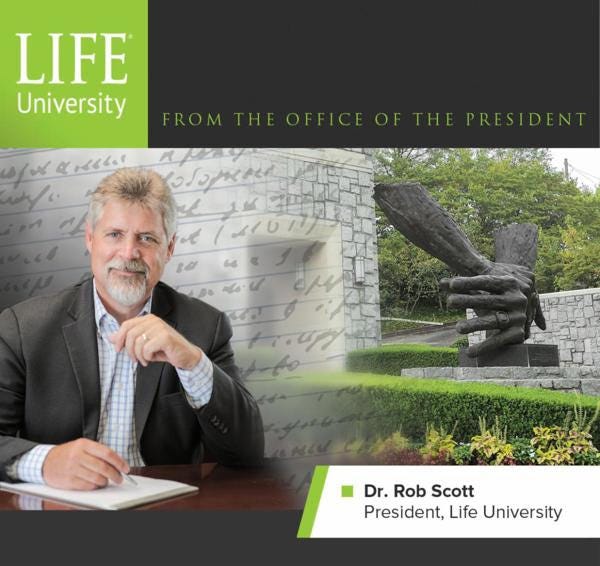
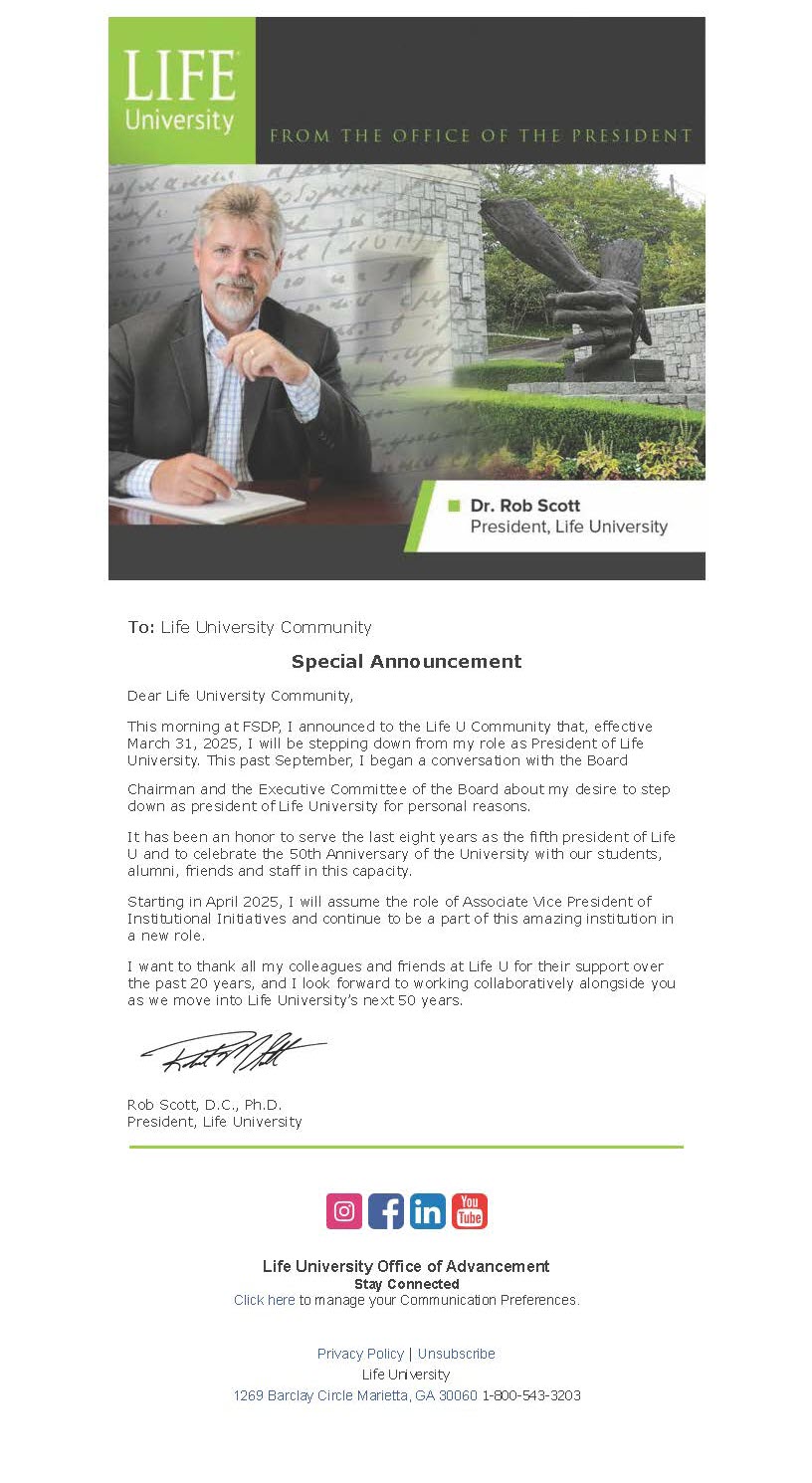
Life University’s President, Rob Scott DC, Ph.D, has announced his resignation, effective March 31, 2025, after serving eight years in the role. While Dr. Scott cites personal reasons for stepping down, his departure comes at a critical time for the institution, which continues to face unresolved accreditation and financial challenges. Adding to the uncertainty is Life University’s mounting debt and ongoing concerns among supporters about the institution’s management and direction.
CLICK HERE to see the announcement
LIFE’s Board of Trustees Chair Kevin Fogarty in a follow up announcement stated that Brian McAulay DC, Ph.D has been recruited to serve as Interim President, effective April 1, 2025. According to Fogarty, McAulay has been serving as a consultant to the Board since August 2024 on issues specifically related to the University’s accreditation problems with the Council on Chiropractic Education (CCE). Fogarty stated that beginning January 1, 2025, Dr. McAulay will be on campus to prepare for the formal April 1 transition.
CLICK HERE for the announcement from Fogarty
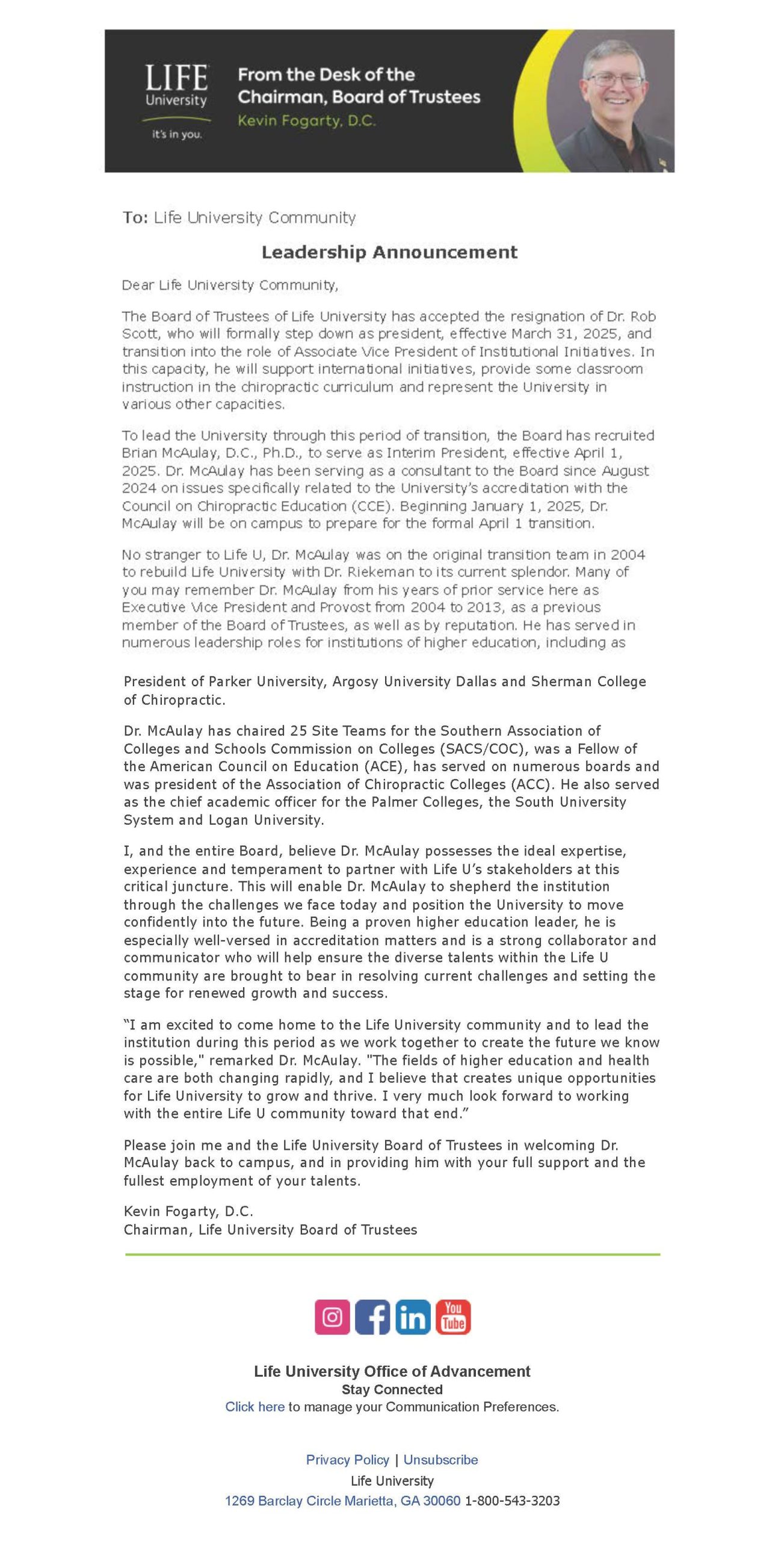
Fogarty attempts to paint McAulay as the savior who will lead LIFE out of its quagmire stating:
“No stranger to Life U, Dr. McAulay was on the original transition team in 2004 to rebuild Life University with Dr. Riekeman to its current splendor.”
However, according to sources McAulay is just as responsible for the shape LIFE is currently in since he came with Reikeman from Palmer after the Board ousted Ben DeSpain who rescued LIFE from its loss of accreditation back in 2001. McAulay who served as the VP for Academic Affairs was widely seen as just going along with Reikeman’s schemes and not speaking out about his mismanagement.
Persistent Accreditation Issues
The College of Chiropractic (LUCC) at LIFE remains on probation following a decision by the Council on Chiropractic Education (CCE) on July 18, 2024. Despite the university’s appeal of the probation decision, an appeals panel upheld the CCE’s findings on November 1, 2024, affirming that LUCC remains in significant noncompliance with accreditation standards. Specifically, the program’s four-year weighted average licensing exam success rate is 77%, falling below the required 80% threshold set by the CCE.
CLICK HERE for a copy of the Accreditation Announcement from CCE
The probation status highlights at least a decade-long struggle with accreditation issues, some of which date back to the tenure of former president Dr. Guy Riekeman. These concerns have raised questions about the university's ability to maintain academic standards and its accountability to students and stakeholders.
Borrowers Defense Claims and Student Fallout
Adding to the controversy, dozens of Life University students have applied for Borrower Defense to Repayment, a federal program that allows students to request loan forgiveness if they believe they were misled by their educational institution. Borrower Defense claims against Life University include allegations that go back to the Riekeman and McAulay’s administration and encompass concerns about accreditation instability, inflated promises about career prospects, and inadequate preparation for licensure exams.
These claims, coupled with LUCC’s probation status, have left current and prospective students grappling with uncertainty about the value of their education and the university’s future standing.
Financial Challenges: A Growing Debt Burden
Under Dr. Scott and Reikeman’s leadership, Life University refinanced $67 million in bond obligations to fund new student housing aimed at bolstering the struggling undergraduate program. To make this project feasible, Life took on an additional $30 million in debt, bringing the university’s total obligations to nearly $100 million.
This bold financial maneuver was rooted in a strategy to diversify Life’s income streams by expanding undergraduate enrollment to offset losses from its chiropractic program. However, this plan has yet to yield the hoped-for results, raising concerns about whether the university has overextended itself financially.
Mounting Concerns About Management and Direction
The combination of accreditation struggles, Borrower Defense claims, and mounting debt has led many supporters of Life University to question its management and direction. Critics argue that the administration has been reactive rather than proactive in addressing systemic issues, leaving the university vulnerable to external pressures and internal instability.
The ongoing probation status of LUCC, coupled with financial challenges, undermines confidence among students, alumni, and stakeholders in the university’s ability to sustain its mission and meet its obligations.
Commentary: A Time for Transparency and Leadership
As Life University transitions to a new chapter of leadership, it faces an urgent need for transparency, accountability, and decisive action. Addressing the root causes of its accreditation and financial challenges will require collaborative efforts and a willingness to prioritize long-term stability over short-term gains.
Fogarty attempts to paint McAulay as the savior who will lead LIFE out of its quagmire stating:
“No stranger to Life U, Dr. McAulay was on the original transition team in 2004 to rebuild Life University with Dr. Riekeman to its current splendor.”
However, according to sources, McAulay is just as responsible for the dismal shape LIFE is currently in since he came with Reikeman from Palmer along with several other Palmer administrators following Reikeman’s resignation as Chancellor following a great deal of controversy between him and the Board of Trustees there. This was after the LIFE Board ousted Ben DeSpain who rescued LIFE from its loss of accreditation with CCE and accreditation problems with the Southern Association of Colleges and Schools back in 2001. Despite the glowing reports from Fogarty, McAulay was widely seen as just going along with Reikeman’s schemes and not speaking out about his mismanagement.
Fogarty, for his part has been on LIFE’s Board of Trustees for 16 years and has been Board Chair for 10 of those years having taken over after former Board Chair Deborah Pogrelis DC was ousted as Chair. As Chair Fogarty has presided over a continued downslide of the institution.
CLICK HERE for more on that story
Pogrelis had been outspoken about many of the grandiose initiatives that Reikeman was pushing with McAulay by his side. Riekeman was accused by many of placing the institution at risk by engaging in initiatives and other behavior not consistent with the University mission. These include a failed curriculum restructuring, failed expansion of programs internationally, a prison education program, increasing pressure on faculty to graduate students and expansion of their clinics.
Many of these initiatives, including the creation of a "Chancellor" position for Riekeman, had been blocked by former Board Chair Deborah Pogrelis. But following a campaign to clear the Board of the "no votes" Pogrelis was replaced by Fogarty.
While McAulay has served in various roles within higher education he has never lasted long as President at any of them. Fogarty refers to McAulay’s presidency at Argosy University from 2016-2018 to buttress his bonafides. Argosy University closed in March 2019 after the US Department of Education discovered that the school had misused $13 million in student loan funds. The university was accused of fraud and misrepresenting itself to students.
The incoming administration at LIFE must restore trust by implementing clear strategies to resolve accreditation issues, address student and Alumni concerns, and stabilize the university’s financial outlook. Failure to act decisively risks further erosion of Life University’s reputation and jeopardizes its standing.
In the months ahead, all eyes will be on Life University as it navigates these pivotal challenges.
CLICK HERE for more about LIFE’s troubles
