The Acetaminophen-Autism Lawsuit: Stalled by Judicial Scientism?
Originally published: 2025-09-29
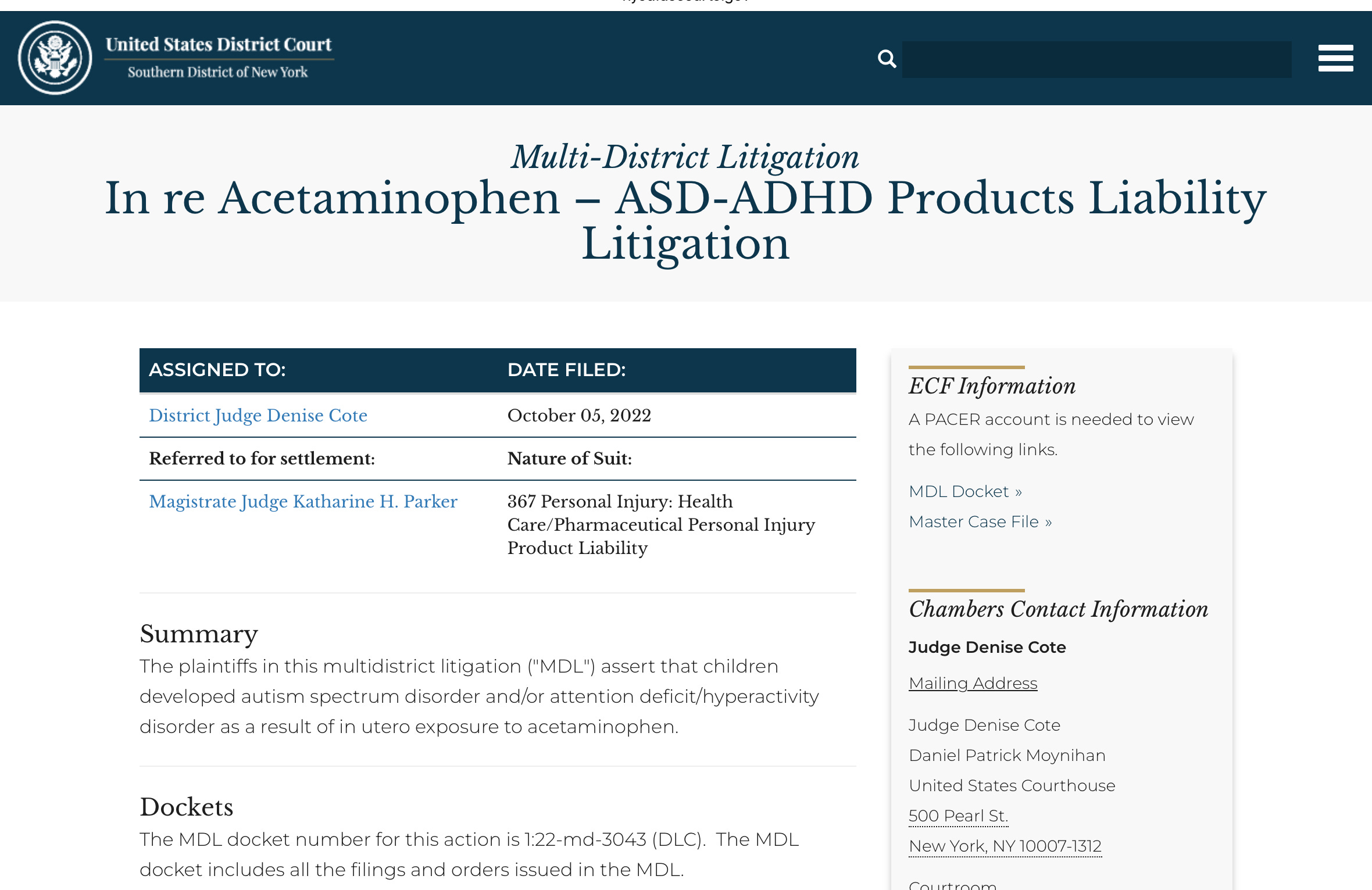
In the landmark multidistrict litigation In Re: Acetaminophen – ASD-ADHD Products Liability Litigation (MDL No. 3043), over 500 families alleged that prenatal exposure to acetaminophen (the active ingredient in Tylenol) caused autism spectrum disorder (ASD) and ADHD in their children, due to manufacturers’ failure to warn of these risks. Despite compelling associations from large-scale observational studies, U.S. District Judge Denise Cote’s 148-page Daubert ruling on December 18, 2023, excluded all plaintiffs’ expert testimonies, effectively dismissing the federal cases. This decision, now on appeal in the Second Circuit as of September 23, 2025, highlights a troubling trend: the elevation of randomized controlled trials (RCTs) as the ultimate arbiter of causation, sidelining ethical, real-world observational data in a form of scientism that prioritizes methodological purity over accessible evidence.
Unpacking the Case: Allegations and Evidence
The lawsuits, consolidated in New York, claimed Johnson & Johnson and retailers like Walmart knew of risks from studies showing 20-30% increased odds of ASD/ADHD with prenatal acetaminophen use but failed to update labels. Plaintiffs relied on epidemiological evidence from cohorts like the Norwegian Mother and Child Cohort Study (MoBa) and Boston Birth Cohort, involving tens of thousands of participants, demonstrating dose-response relationships and temporal links.
CLICK here to access the lawsuit documents
“The plaintiffs in this MDL assert that the defendants violated their state law duties to warn consumers of the risk that children may develop autism spectrum disorder and/or attention-deficit/hyperactivity disorder as a result of in utero exposure to acetaminophen.”
These studies, while observational, adjusted for confounders like maternal illness and genetics, providing strong correlations that, under Bradford Hill criteria, suggest causation.
The Daubert Ruling: Excluding Experts Under Strict Standards
Judge Cote evaluated five plaintiffs’ experts—epidemiologists, teratologists, and psychiatrists, under the Daubert standard, which requires reliable, relevant scientific methods. She excluded them for “cherry-picking” data, ignoring inconsistencies, and failing to rigorously apply frameworks like Bradford Hill.
“Defendants contend that he improperly applied a ‘transdiagnostic’ approach... He cherry-picked and misrepresented study results and refused to acknowledge the role of genetics... They are correct.”
“Dr. Pearson’s expert testimony is thus inadmissible... There is simply too great an analytical gap between the data and the opinion proffered.”
The ruling emphasized inconsistencies in observational data and the lack of definitive causation proof, leading to summary judgment for defendants in 2024.
The Power of Observational Studies: Ethical Alternatives to RCTs
Observational studies, like those cited, are essential when RCTs are unethical, randomly exposing pregnant women to potential harms is impossible. These large, prospective designs offer real-world insights, with adjustments for confounders yielding robust associations.
“Many of the studies that Dr. Baccarelli collected... acknowledge the need for more work to account for the confounding by indication and genetics.”
Yet, the court demanded near-perfect rigor, effectively requiring RCT-like certainty from non-experimental data, ignoring how evidence-based medicine integrates all study types.
Critiques and the Broader Debate: A Call for Balanced Science
Legal analysts have noted the ruling’s thoroughness but question its stringency. Some argue it protects against junk science, while others see it as overly dismissive of peer-reviewed epidemiology.
“Such a ‘result-driven analysis’ does not reflect a reliable application of scientific methods under Rule 702 and Daubert.”
“Judge Cote’s ruling exemplifies why courts, rather than juries, are tasked with evaluating scientific methodology.”
The Shadow of Scientism: Prioritizing Ideals Over Reality
Ultimately, Judge Cote’s insistence on unachievable standards, dismissing strong correlations from observational studies for lacking RCT-level proof, exemplifies scientism: a dogmatic faith in narrow scientific methods that ignores practical, ethical realities. This “worship” of RCTs stalls justice for families, protects industry, and undermines holistic evidence evaluation. As the appeal unfolds, it’s a reminder that true science embraces diverse data, not just the unattainable ideal.
