The Association of Chiropractic Colleges $300,000.00 Degree
Originally published: 2025-06-04
Introduction: A Rallying Cry to Save Unlimited Borrowing
On May 30, 2025 the Association of Chiropractic Colleges (ACC) blasted out a “Budget Reconciliation Status” alert urging Chiropractic College presidents, lobbyists, and other “key stakeholders” to lobby the Senate against proposed Grad PLUS borrowing caps of $150,000. The memo warns that the cap “falls significantly below the actual cost of chiropractic education ($200,000-$300,000),” calls the next “2-3 weeks … a critical window,” and provides boiler-plate letters for rapid deployment. Yet the ACC never asks the obvious question: Why does a DC degree cost more than many MD programs in the first place?
CLICK HERE for a copy of the letter
CLICK HERE for a podcast about this story
Sticker Shock, Courtesy of the Cartel
“The proposed borrowing caps of $150,000 fall significantly below the actual cost of chiropractic education ($200,000-$300,000), making programs financially unsustainable.”
Rather than examine why tuition is out of control, the ACC treats the $200-300 k price tag as a fact of nature—and blames Congress for limiting the credit card.
Borrowing Caps Aren’t the Villain
Median chiropractor pay hovers around $79,000, barely one-quarter of the ACC’s stated cost of attendance.
A 2024 survey found the average student-loan balance for practicing chiropractors is ≈ $249,000, with a median income of $75 k leaving new grads underwater from day one. The math is brutal: graduates carry debt 3-4 × their earnings. A higher borrowing limit only deepens the hole.
Cartel Economics 101
Tuition soars while salaries stagnate because a closed loop of private corporations—the CCE, NBCE, FCLB, and ACC—controls education, accreditation, testing, and licensure. They meet behind secret Summit-Group doors that only a privileged few can attend, siphon NBCE exam fees and related student debt and funnel to their “friends” who support the vicious cycle, then cry “unsustainable” when Congress threatens their subsidy. Prices rise unchecked because the cartel uses their monopoly to block lower-cost and innovative competitors from entering the market.
Bloated Curricula & the ‘Primary Care’ Mirage
In their letter the ACC insists chiropractors “serve as primary-care providers in rural areas.” Reality check: only a sliver of DCs practice in federally designated shortage zones, and state scopes bar them from full primary-care duties. The push to mimic medical schools—layering on pharmacology, broad body diagnosis and treatment and on and on bloats tuition while adding little value to spinal-health practice.
The whole push that began in the 80’s to position chiropractor as primary care physicians has collapsed. It was a pipe dream that never materialized. Now many of the things that chiropractors spend 8 years in school for and rack up hundreds of thousands of dollars in unpayable debt can be done by personal trainers, massage therapists, physical therapists and even lay people.
So now the rank and file trying to survive under crushing loan debt resort to adding prescription drugs to their state scope in under the guise of helping patients in order to keep their business afloat. Meanwhile the chiropractic brand has been diluted beyond recognition.
“When your business model runs on taxpayer-backed debt, every reform looks like a threat.”
Borrower’s Defense Claims Add Further Evidence
The ACC stayed silent when thousands of graduates filed Borrower-Defense claims alleging they were misled on earnings potential. But the moment Grad PLUS cash is at risk, it rallies the profession to “save” it. Student hardship is acceptable collateral damage—cutting an institutional revenue stream is not.
Adding to the growing scrutiny of chiropractic education is a surge in Borrower’s Defense claims submitted by former chiropractic students who allege they were manipulated by aggressive and misleading recruitment practices.
Borrower's Defense to Repayment is a federal program allowing student loan borrowers to request loan forgiveness if their school misled them or engaged in fraudulent practices. Claims are typically based on false advertising, misrepresentation of job placement rates, accreditation, or program quality. Borrowers must provide evidence of the school's misconduct and how it impacted their decision to enroll. If approved, the borrower may receive loan discharge, refunds for amounts paid, and removal of negative credit reports related to the loan. This program aims to protect students from predatory educational institutions and ensure fairness in the student loan system.
These claims have gained traction on social media platforms such as Facebook and Reddit, where students and graduates are sharing their outrage about their experiences with chiropractic schools and the profession as a whole in addition to sharing evidence. Common allegations include:
Aggressive Recruitment: Misleading tactics used to attract students, often overselling the benefits of a chiropractic career.
Misrepresentation: False claims about income potential and career prospects that fail to align with reality.
Omission: Schools failing to disclose critical information about financial and career outcomes, leaving students unprepared for the realities of their profession.
Breach of Contract: Potential legal cases stemming from unfulfilled promises made during recruitment.
The lack of transparency in educational, recruiting and accreditation processes forms the very foundation of these complaints. Many graduates argue that had there been greater accountability and honest disclosure by schools and accrediting bodies they might have made more informed decisions about their education and career paths.
Who Sits on the ACC Board?
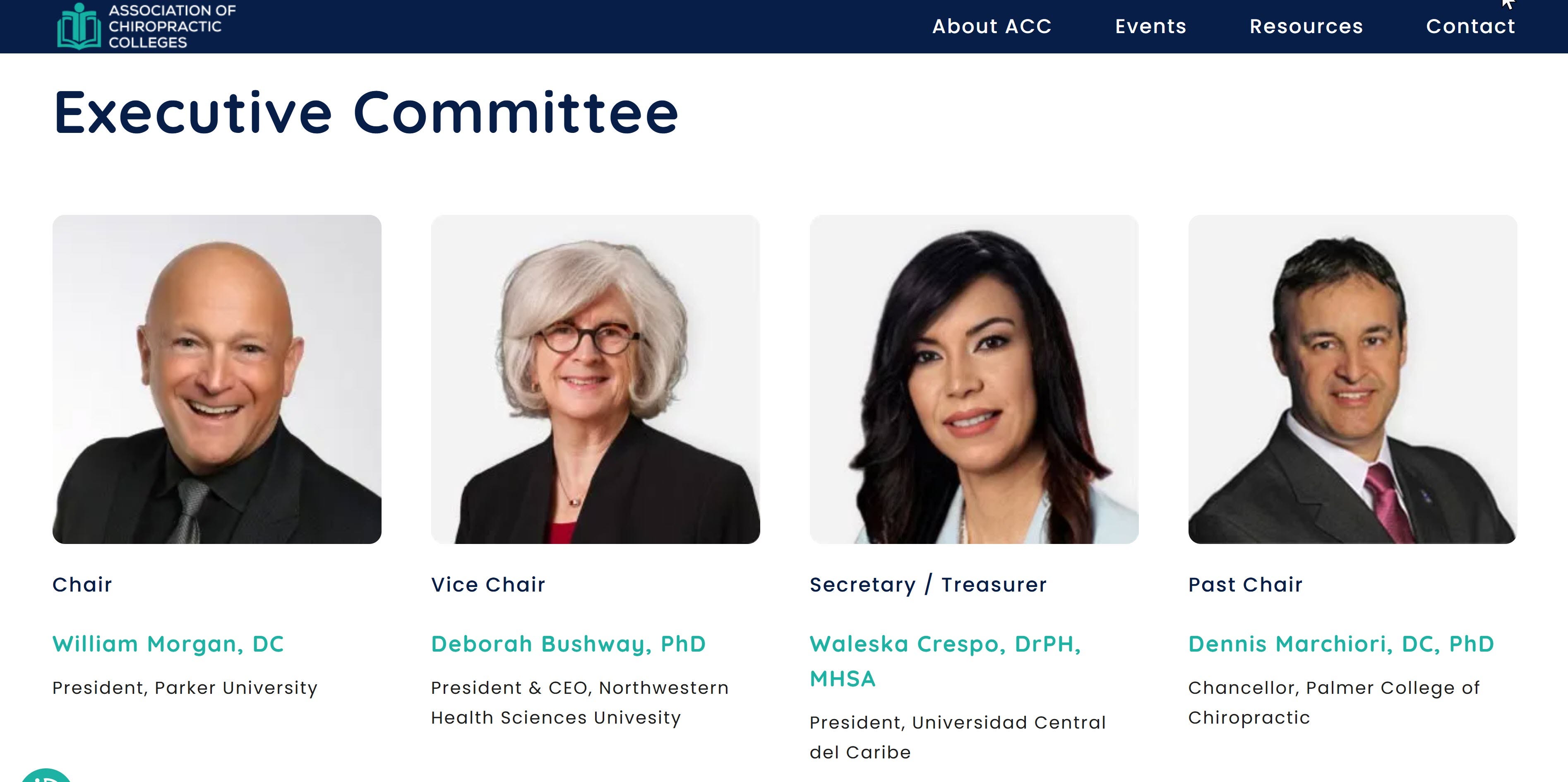
Below is the current roster of the Association of Chiropractic Colleges—a who’s-who of presidents, chancellors, deans, and vice-presidents who have watched the cost of borrowing for a chiropractic education climb to a staggering $200,000–$300,000 while doing nothing to dismantle the monopolies and cartel structures that make those price hikes possible. For decades these leaders have sat on their hands—or, worse, served on the very boards and “Summit” committees that lock accreditation, testing, and licensure inside a closed loop—leaving students to bankroll an ever-growing administrative empire with federal loans they can never realistically repay.
Chair: William Morgan, DC — President, Parker University
Vice Chair: Deborah Bushway, PhD — President & CEO, Northwestern Health Sciences University
Secretary / Treasurer: Waleska Crespo, DrPH, MHSA — President, Universidad Central del Caribe
Past Chair: Dennis Marchiori, DC, PhD — Chancellor, Palmer College of Chiropractic
Directors
Patrick Battaglia, DC, DACBR — Assistant Vice President, University of Western States
Christine Bradaric-Baus, PhD — President, Canadian Memorial Chiropractic College
Michael A. Ciolfi, DC, DBA — Dean, University of Bridgeport
Carl S. Cleveland III, DC — President, Cleveland University–Kansas City
Vince DeBono, DC, DHPE — Vice President, College of Chiropractic Medicine, Keiser University
Rachel Ersing, DC, MBA, MAOL — Executive Director, Chiropractic Department, D’Youville College
David Hayes, DC — Professor & Director, Department of Chiropractic, Université du Québec à Trois-Rivières (UQTR)
Sandra Hughes, DC, MEd, FICC — President, Texas Chiropractic College
Brian McAulay, DC, PhD — President, Life University
Michael Mestan, DC, EdD — President, Northeast College of Health Sciences
Ron Oberstein, DC — President, Life Chiropractic College West
Nic Poirier, DC, EdD — Executive Dean, Southern California University of Health Sciences
William Sherrier, DC, MA — Campus President, Palmer College of Chiropractic (Florida Campus)
Garrett Thompson, DC, PhD — President, Logan University
Executive Director
Anne Marie Munson, MA — ACC Headquarters
Sherman College of Chiropractic is not an ACC member—See next section for why.
Anti-Subluxation Manifesto: ACC Schools Double Down on Denial
Four ACC-board institutions—Canadian Memorial Chiropractic College (CMCC), the University of Bridgeport, Keiser University College of Chiropractic Medicine, and Université du Québec à Trois-Rivières (UQTR)—are signatories to the International Chiropractic Education Collaboration Clinical and Professional Chiropractic Education Position Statement (ICEC). That statement, grounded in the World Federation of Chiropractic’s 2014 Educational Declaration, openly renounces vertebral subluxation, high-volume practice models, and anything short of full compliance with World Health Organization vaccination policy.
CLICK HERE to see all the signatories
“The teaching of vertebral subluxation complex as a vitalistic construct that claims that it is the cause of disease is unsupported by evidence. Its inclusion in a modern chiropractic curriculum in anything other than an historical context is therefore inappropriate and unnecessary.”
“Practice styles which may contribute to inappropriate patient dependence, compromise patient confidentiality, or require repeated exposure to ionising radiation are not part of an undergraduate chiropractic curriculum.”
“The signatories support the World Health Organization’s Vision & Mission in Immunization 2015-2030.”
The organizations define "Practice styles" as referring:
". . . to routine ‘high volume’ chiropractic care models, ‘open plan’ chiropractic care models and the delivery of unsubstantiated ‘treatment packages’ or clinical techniques."
Far from fringe, these positions are now embedded in mainstream chiropractic academia:
CMCC announced its endorsement in 2019, joining a dozen global institutions.
The University of Bridgeport appears on the ICEC’s official signatory list.
Keiser University is listed among signatories in the 2020 update of the Position Statement.
UQTR is likewise a signatory and named in scholarly reviews of the ICEC statement.
University of Western States zeal for scope-creep is mirrored by its Board of Trustees member Jennifer Forbes, DC, who also sits on the College of Chiropractors of British Columbia (CCBC). In 2021 Forbes used that regulatory perch to ram through a ban on spinal X-rays for vertebral-subluxation assessment—an action engineered with fellow UWS alumni and backed by a hastily produced “rapid review” that erased any evidence contrary to the anti-subluxation narrative. The same administrator who votes to strip basic diagnostic tools from subluxation-based practitioners simultaneously markets “shockwave therapy” on her clinic website—flouting the very evidence standards she imposes on others. The ACC’s refusal to police such conflicts underscores the core complaint: its member schools champion policies that inflate tuition and restrict traditional chiropractic practice, yet the association pretends none of this has anything to do with the debt crisis strangling new graduates.
This escalating anti-subluxation campaign—championed by the World Federation of Chiropractic and echoed by ACC leadership—is a key reason Sherman College is not a member of the ACC. Sherman refuses to abandon the core subluxation paradigm that the ICEC, and the ACC by default, dismisses as “inappropriate.”
The Ties that Bind
Several ACC Members were recently quick to jump in and further support the WFC’s efforts to control chiropractic internationally. The World Federation of Chiropractic (WFC) has unveiled its latest initiative: the International Chiropractic Education Alliance (ICEA). While marketed as a unifying platform to advance chiropractic education globally, the ICEA is being criticized as a thinly veiled attempt to centralize control over chiropractic education and further marginalize subluxation-focused practitioners. Critics allege this is another step in expanding a monopoly already dominated by a few powerful entities.
Life Chiropractic College West, Logan University, Northeast College of Health Sciences, Northwestern Health Sciences University, Parker University —and, as associate founders, both the National Board of Chiropractic Examiners and the Council on Chiropractic Education—sit at the heart of the new ICEA charter. Every one of these U.S. schools is already an ACC member, so their decision to help launch yet another WFC-hosted “alliance” effectively grafts the ICEA onto the same cartel infrastructure that dictates accreditation (CCE), testing (NBCE), and policy messaging (ACC). By locking arms under the ICEA banner, these institutions double-down on a model in which the very bodies that set licensure exams and accredit programs also steer the global “consensus” about what chiropractic should—and should not—be, ensuring tuition dollars, exam fees, and regulatory power remain inside a closed, self-reinforcing loop.
Follow the Money
William Morgan and research chief Katie Pohlman used the pandemic to threaten chiropractors who mentioned immune benefits—while pocketing student loan money and supporting the World Federation of Chiropractic’s crackdown.
Former chair David Wickes compared subluxation-focused DCs to a “gangrenous arm” needing amputation—yet presided over record-high tuition.
Several ACC schools rebranded as “universities,” exploiting bachelor’s-degree mandates the cartel itself imposed to pad enrollment (and federal loan volume).
Please Let us Vaccinate
During the pandemic, Michele Maiers, DC, MPH, PhD—Executive Director of Research & Innovation at Northwestern Health Sciences University (an ACC member) and then-president of the American Chiropractic Association—personally lobbied the White House and HHS to add chiropractors to the list of providers authorized to inject COVID-19 vaccines, claiming (falsely) to represent “70,000 chiropractors.” Her plea linked Northwestern’s leadership directly to the ACA’s federal policy agenda and showcased how ACC institutions quietly serve cartel interests: they funnel student-loan dollars into automatic ACA memberships, promote anti-subluxation narratives through WFC “immunity” papers, and leverage their administrative clout to expand medicalized scope—while doing nothing to curb tuition inflation that burdens their own graduates.
At the University of Western States (UWS)—another proud ACC member—administrators went so far as to tell the Oregon Board of Chiropractic Examiners that the school would “encourage and support whatever is necessary” to let chiropractors and even chiropractic students inject the experimental COVID vaccine. Bill Moreau, DC, the school’s “Chief Medical Officer,” assured regulators that only a bit of “extra training” was needed because the skill was “certainly in the knowledge base.” That move aligned perfectly with ACC ally Northwestern Health Sciences University, whose Michele Maiers simultaneously lobbied the Biden White House to grant nationwide vaccination authority to DCs. Together, these schools showcased the ACC’s true north: expanding medicalized scope—drugs one day, vaccines the next—while the college presidents sitting on the ACC board stay silent about the crushing debt their own students already carry.
“If a degree really costs $300 k, the problem isn’t the loan cap—it’s the cartel-sized elephant in the classroom.”
They Even Got to The Fountainhead
Palmer’s Florida campus made the cartel’s playbook crystal-clear in 2019 when it joined Keiser and National’s “Chiropractic Medicine” programs to testify against a Florida bill that would strike “CCE Only” language from state law. Before the House Health Quality Sub-Committee, Martin warned that alternative accreditation would plunge chiropractic into “disarray.” In reality, federal officials—including NACIQI members Arthur Keiser and Arthur Rothkopf—had explicitly invited the profession to create a second accrediting body after thousands of complaints about the CCE. Palmer’s stance—“we’re happy with things the way they are”—underscored its willingness to protect monopoly control even at the cost of higher tuition, fewer choices, and perpetual debt for students and practitioners.
Real Reform: Break the Cartel, Slash Tuition
End accreditation monopoly—let states recognize alternative accrediting bodies like IACE.
Unplug licensure exams from NBCE’s fee pipeline—leave competency to the schools and their accreditors.
Trim bloated curricula—teach evidence-based chiropractic essentials, not a medical-school wish list.
Tie federal aid to value, not sticker price—reward programs with reasonable debt-to-income ratios.
“Chiropractic colleges don’t need a bigger credit limit; they need a reckoning with value.”
Until the ACC helps dismantle the structures that keep prices high—rather than lobbying to preserve unlimited borrowing—its doom-and-gloom messaging rings hollow. Chiropractors, students, and the public deserve real reform, not another plea to prop up a broken business model.
