The Dangers of FCLB's Attempt to Control Chiropractic Specialty Training: 2025 Update
Originally published: 2025-05-19
The Federation of Chiropractic Licensing Boards (FCLB) is pressing ahead with its efforts to consolidate control over chiropractic postgraduate education through its Recognized Chiropractic Specialties Program (RCSP). Despite mounting concerns from state boards, chiropractic schools, professional associations, and educators, the FCLB has shown no signs of slowing. Recent developments in Oklahoma, Connecticut and South Carolina highlight how the RCSP is being positioned as a gatekeeper for specialty recognition in a manner that is both ethically suspect and legally precarious.
Leadership Shift Reveals Deeper Conflicts of Interest
A recent leadership transition placed Beth Ehlich DC, an individual who formerly served on the South Carolina state chiropractic board into the role of Chair of both the FCLB and its RCSP committee. This revolving-door dynamic underscores the deep entanglements between state regulators and the private organizations that fund and steer them. FCLB and RCSP’s leadership includes multiple individuals who hold—or have held—positions of authority within state licensing boards, raising serious questions about impartiality and accountability.
RCSP in Action: The South Carolina Example
At a recent meeting of the South Carolina Board of Chiropractic Examiners, the RCSP was presented by its current chair. Although no formal vote was taken, the discussion revealed that the board is considering adopting RCSP as a pre-approved credentialing mechanism. Doing so would amount to a de facto delegation of the board's statutory authority to a private, unelected body—a violation of foundational principles of administrative law.
A Spreading Problem: Connecticut and Oklahoma Fall in Line
The FCLB recently celebrated RCSP endorsements from the Connecticut and Oklahoma chiropractic boards—developments that further illustrate the ethical problems and regulatory capture surrounding this initiative.
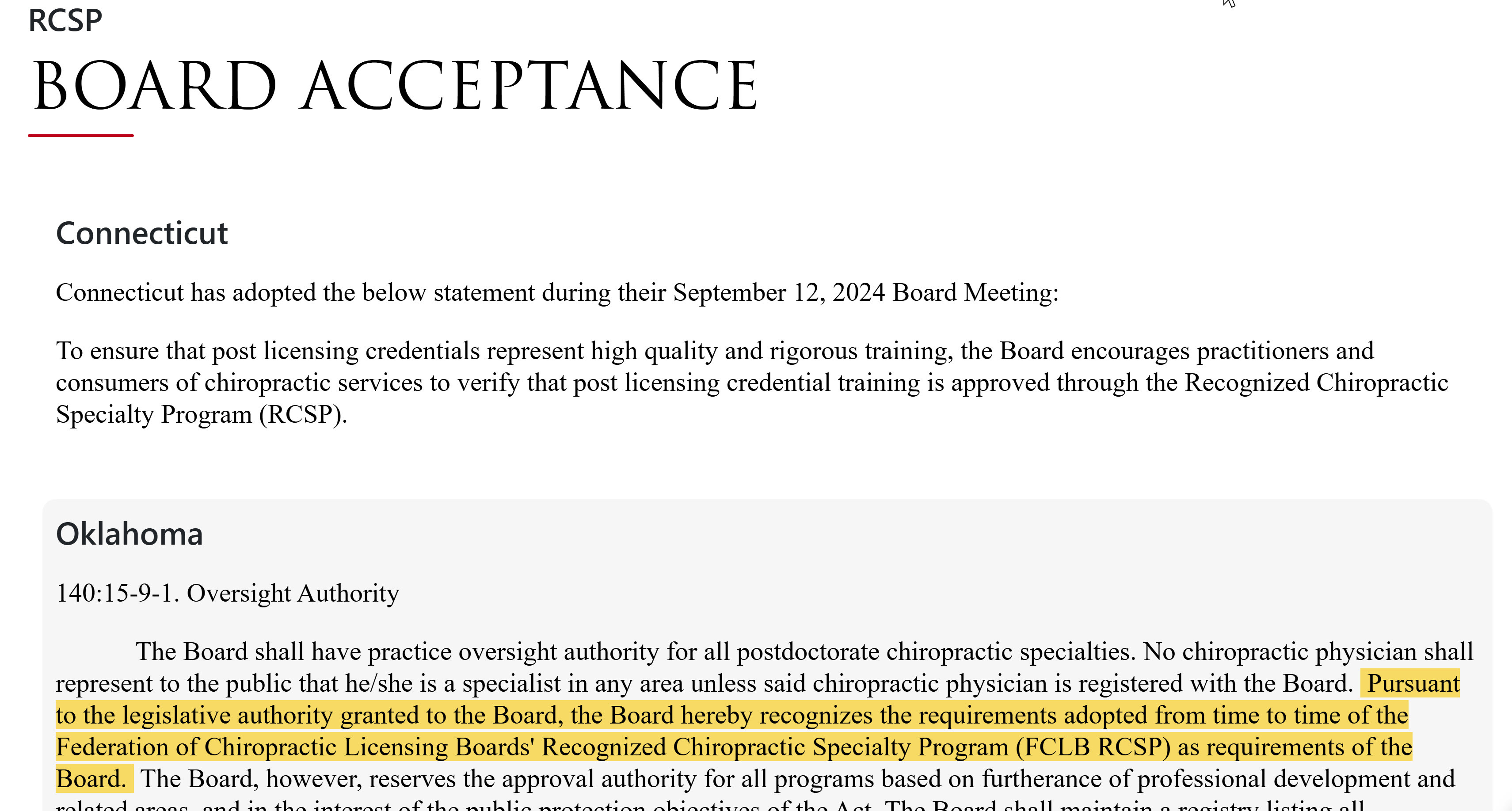
In Connecticut, the board adopted language encouraging verification of post-licensing credentials through RCSP during its September 12, 2024, meeting. This endorsement effectively steers chiropractors and consumers to accept RCSP as a hallmark of legitimacy, bypassing independent evaluation.
In Oklahoma, the board embedded RCSP recognition directly into its administrative code (140:15-9-1), stating:
"Pursuant to the legislative authority granted to the Board, the Board hereby recognizes the requirements adopted from time to time of the Federation of Chiropractic Licensing Boards' Recognized Chiropractic Specialty Program (FCLB RCSP) as requirements of the Board."
This is a stunning example of institutional self-dealing, especially given that Beth Kidd, the Executive Director of the Oklahoma Board of Chiropractic Examiners, also holds a leadership role on the RCSP committee. This direct overlap of regulatory authority and private credentialing advocacy embodies the very definition of regulatory capture and highlights the incestuous dynamics that plague the chiropractic regulatory landscape.
Connecticut’s Endorsement Adds to the Pattern of Regulatory Capture
In Connecticut, the September 2024 endorsement of RCSP was made under the oversight of Dr. Karlos Boghosian, a current member of the Connecticut Board of Chiropractic Examiners who also serves as the President of the National Board of Chiropractic Examiners (NBCE) and sits on its Board of Directors. Dr. Boghosian is also a past President of the FCLB, further illustrating the deeply intertwined nature of these national organizations and their influence over state regulatory action. His simultaneous involvement in the NBCE, FCLB, and a state licensing board exemplifies the ongoing pattern of regulatory incest, where decision-making authority is concentrated in the hands of a few individuals with overlapping institutional loyalties—eroding public trust and compromising the independence of state oversight.
When state officials who participate in shaping national credentialing frameworks return to their own boards and adopt those frameworks as binding policy, the profession loses the critical firewall between public oversight and private interest.
Why States and the Profession Should Be Alarmed
1. Unlawful Delegation of Regulatory Authority The RCSP is structured to allow state boards to outsource their responsibility for vetting chiropractic specialty programs. While the FCLB claims that boards retain final authority, the RCSP functions by offering pre-approved programs that boards can choose to accept wholesale. This undermines the legal requirement that state agencies exercise independent judgment and avoid sub-delegating regulatory decisions to outside private parties.
2. Erosion of Public Oversight and Due Process The RCSP does not evaluate individual chiropractors or the content of specialty programs—it only approves the process used by credentialing organizations. This model fails to ensure educational quality or relevance and removes critical oversight from state regulators who are accountable to the public.
3. Financial and Ethical Conflicts of Interest The FCLB is funded primarily by the National Board of Chiropractic Examiners (NBCE), which itself is funded by federally backed student loans. State boards pay dues to the FCLB using taxpayer funds, and often cover travel expenses for board members to attend FCLB and NBCE events. This creates a self-reinforcing financial network where the profession is essentially funding its own overregulation.
4. Barriers to Innovation and Educational Diversity RCSP’s approval process imposes steep financial costs on specialty program providers: application fees, annual recognition costs, and renewal charges. These fees will disproportionately affect smaller or emerging programs, reducing educational diversity and innovation. Specialty programs developed by chiropractic schools—already accredited and vetted by multiple agencies—will be forced to submit to redundant, external approval processes.
5. Conflicts of Interest in RCSP Leadership Many members of the RCSP committee also hold roles in state boards or chiropractic trade organizations. This concentration of influence creates an environment where regulatory decisions risk being shaped by institutional loyalty rather than public interest. The leadership structure blurs the line between governance and lobbying, enabling a small group of insiders to dictate the future of chiropractic specialty education. The recent example of Oklahoma's administrative adoption of RCSP criteria—while one of RCSP’s own leaders, Beth Kidd, oversees the same board—is a case study in how improper influence manifests in policy.
6. National Consequences for State Autonomy The RCSP is not just a South Carolina issue. The FCLB is seeking nationwide adoption, attempting to convince all 50 state boards to rubber-stamp its credentialing program. Should this occur, the chiropractic profession will see a dramatic centralization of regulatory authority—with national entities funded by student debt and shielded from public accountability controlling who gets to teach what in chiropractic postgraduate education.
Recommendations
Reject RCSP Recognition: State boards must preserve their statutory autonomy by rejecting any attempt to cede authority to the FCLB or its RCSP. Credentialing programs should be reviewed on a case-by-case basis by each board.
Protect the Independence of Chiropractic Schools: Institutions that already meet rigorous accreditation standards should not be subjected to a duplicative, fee-based approval system that serves a private organization’s interests.
Promote Transparency and Accountability: Any program evaluating chiropractic education must disclose funding sources, conflicts of interest, and the identities and qualifications of decision-makers.
Demand Legislative Oversight: State legislatures and attorneys general should investigate the extent of regulatory capture within chiropractic boards and the financial entanglements between NBCE, FCLB, and state agencies.
Conclusion
The FCLB’s Recognized Chiropractic Specialties Program is an aggressive attempt to monopolize control over chiropractic postgraduate education. It threatens institutional independence, undermines public oversight, and imposes unnecessary financial burdens on educators and clinicians. State boards, chiropractic schools, and professional associations must act decisively to protect the integrity of chiropractic education and regulation before it is subsumed by an unaccountable national apparatus masquerading as reform.
