The Globalization of Chiropractic Coup & Jaeger’s WFC Appointment
Originally published: 2025-11-18
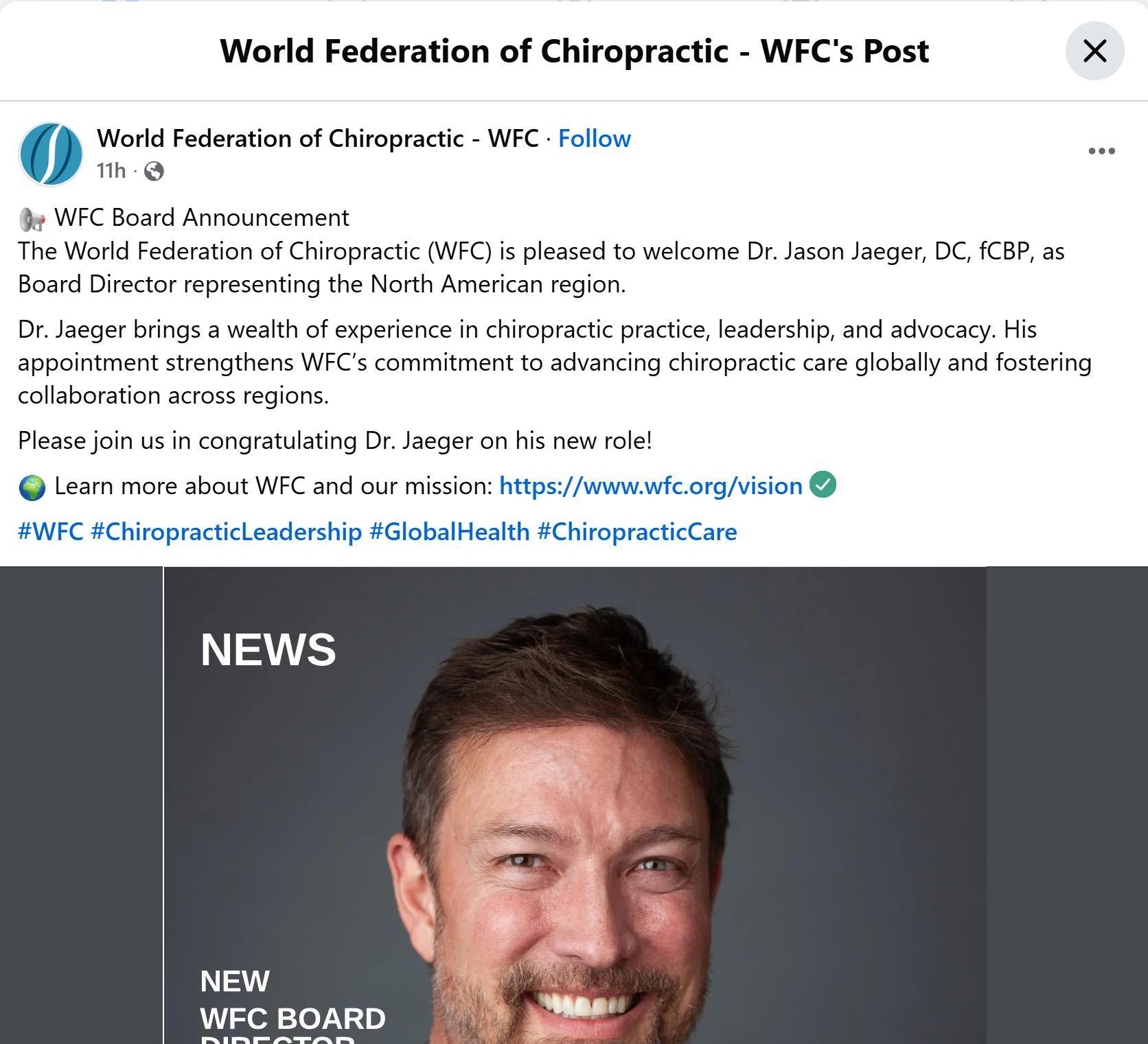
The World Federation of Chiropractic has announced that Dr. Jason Jaeger has been appointed to its Board of Directors, representing North America, filling the vacancy left when John Maltby moved into the Interim Secretary General role.
On paper, it looks like a routine leadership shuffle. In reality, for anyone who has been following the ICA implosion, the Georgia election scandal, NBCE Part IV centralization, and the rise of the International Chiropractic Education Alliance, Jaeger’s appointment looks less like coincidence and more like the next chess move in a long running globalization project.
“This is not a random appointment, it is consolidation of power in plain sight.”
Who Is Jason Jaeger And Why Does It Matter?
Jason Jaeger is not just another chiropractor volunteering his time on an international committee. He sits at the intersection of nearly every institutional pressure point in the profession.
According to public reports and investigations, Jaeger has simultaneously held or recently held roles that include:
Officer on the Nevada State Board of Chiropractic Physicians
Vice President of the National Board of Chiropractic Examiners (NBCE)
Leader within the International Chiropractors Association, including Secretary and key Governance roles
Now, Board Director for the World Federation of Chiropractic (WFC), representing North America
Each of those institutions, on its own, wields enormous influence over licensure, testing, discipline, education, and global policy. When the same individual is embedded in several of them at once, the potential for conflicts of interest is obvious to anyone who is paying attention.
“When the same names appear on every board and every letterhead, that is not leadership, that is control.”
From Nevada To NBCE: A Web Of Conflicts
Public records and FOIA based reporting have documented Jaeger’s overlapping roles in Nevada and at the NBCE, especially around exam policy and enforcement.
On one side, you have a state board that disciplines chiropractors, interprets scope of practice, and often defers to NBCE examinations as the de facto standard for competence. On the other side, you have the NBCE board, designing and defending those same exams, including the controversial move to centralize Part IV testing.
Put the same person in both positions and you create a structural conflict that no amount of “fiduciary” rhetoric can wish away. Decisions that should be tested in the open marketplace of ideas are instead made by a small circle of insiders whose careers and reputations are tied to the very systems they are supposed to oversee.
Yet rather than treating this as a problem, the remaining ICA leadership has either shrugged or actively promoted Jaeger into more responsibility. There has been no public acknowledgment of the conflicts, no transparent recusal framework, and certainly no move to unwind the concentration of power.

CLICK HERE for more about Jaeger and his conflicts of interest
Welsh, Jaeger, And The ICA’s Governance Meltdown
None of this is happening in a vacuum. For years, the International Chiropractors Association has been sliding away from its founding purpose, and every major turn in that slide has the same fingerprints: Stephen Welsh and a tight inner circle that now includes Jason Jaeger.
Under Welsh’s leadership:
The ICA pushed through bylaw changes that stripped democratic voting rights from the membership and neutered the Representative Assembly.
The Governance Committee was turned into a closed door gatekeeper, controlling nominations, slates, and who even gets to run for leadership.
The CEO position was created and used long before the bylaws explicitly allowed for it, raising serious questions about the legality of decisions made during that period.
Georgia’s RA election was thrown into chaos by interference, eligibility manipulation, and behind the scenes pressure, prompting multiple formal complaints that remain unresolved.
Jaeger was not a bystander in this environment, he was one of the primary beneficiaries of the new governance model, which shifted power away from members and toward committee rooms where only a handful of insiders had a vote.
“In the ICA’s new model, the Governance Committee sets the slate and the Board votes, the membership does not even get through the door.”
The result is an ICA that, in structure and function, has become indistinguishable from the very organizations it was created to counter, particularly the ACA and its network of affiliated bodies.
The WFC, ICEA And The Global Education Project
Jaeger’s move to the WFC board is not just about one seat, it plugs him directly into the emerging global architecture that is trying to globalize and homogenize chiropractic education and practice far beyond North American borders.
The WFC already enjoys “official relations” with the World Health Organization and positions itself as the global voice of chiropractic. Its priorities, publicly and consistently, lean toward pain management, primary spine care, and integration into medical systems where vertebral subluxation is, at best, an afterthought.
Layered on top of that is the International Chiropractic Education Alliance, which is being framed as a neutral forum for global education standards but in practice functions as an extension of the same cartel that has captured North American chiropractic through the NBCE, CCE, FCLB, and their allied institutions. The message is simple, if you want your program, your graduates, and eventually your license recognized, you will play by our rules.
Jaeger, with one foot in the WFC and another in the NBCE and state regulation, is perfectly positioned to ensure that those rules are aligned, enforced, and exported.
“Global education standards sound benign, until you realize who is writing them and what philosophy they exclude.”
The Global Agenda: UN Alignment, WHO Influence, ESG Enforcement And The Abandonment Of Chiropractic Autonomy
The WFC has long promoted its “official relations” status with the World Health Organization as evidence of its legitimacy. But for anyone familiar with the WHO’s direction over the past decade, that relationship raises serious red flags. The WHO is no longer a neutral public health body. It increasingly functions as a centralized authority that pushes globalized health standards, suppresses dissenting views, and prioritizes policy uniformity over individual autonomy and informed consent.
In recent years, the WHO has advanced policies that include support for mandatory vaccination, digital health passports, restrictions on dissenting scientific viewpoints, and frameworks for limiting “misinformation” that amount to de facto censorship. These policies are not speculative. They have been adopted, enforced, and defended publicly by WHO leadership. Yet the WFC aligns itself with these same institutions, promotes them, and integrates their language into position statements about chiropractic’s place in global health systems.
The alignment goes even deeper. The WFC openly supports the United Nations Sustainable Development Goals, which may sound benign to the casual observer but increasingly function as a vehicle for ESG scoring, centralized regulatory control, data-driven surveillance of health practitioners, and the expansion of government and NGO influence into private healthcare decisions. These frameworks have already been adopted by multiple international health bodies and are being used to shape accreditation standards, institutional reporting, and curriculum development.

Once you understand this, Jaeger’s appointment takes on even more gravity. The WFC does not hide its intention to integrate chiropractic into the global public health machinery that prizes compliance, standardization, and medicalization. And the institutions tied into this framework, including the NBCE, CCE, and emerging ICEA educational apparatus, all feed into a model where chiropractic is no longer autonomous but subordinated to global health policy mandates.
“You cannot claim to defend chiropractic autonomy while aligning with institutions that reject autonomy at their core.”
Historically, the ICA stood as the profession’s firewall against this exact trend. Its founders and early leaders were explicit. Chiropractic was distinct, drugless, centered on vertebral subluxation and the body’s innate intelligence, and grounded in patient choice and self-responsibility, not medical conformity.
The ICA existed for decades explicitly to resist the very forces the WFC, WHO, UN SDGs, and ESG-driven frameworks now represent. BJ Palmer would have recoiled at the idea of attaching chiropractic to global agencies that promote forced vaccination, restrict speech, and demand compliance with centralized health policy. Sid Williams spent his life opposing exactly this kind of medicalized entanglement and bureaucratic control.
Yet under Welsh, Jaeger, Betz and the rest of the ICA’s current inner circle, the association that once defended autonomy is now marching in lockstep with organizations that undermine autonomy.
Despite the ICA now putting out videos in support of MAHA, the ICA has not condemned the WHO’s censorship policies. It has not objected to UN-aligned ESG scorecarding. It has not warned members about forced vaccination policies or global frameworks that strip away consent rights. It has not rejected integration into systems that require conformity rather than chiropractic distinctiveness. And it certainly has not confronted the WFC’s increasingly aggressive anti-subluxation posture.
Instead, the ICA has continued paying dues, sending speakers, promoting WFC initiatives, and now celebrating Jason Jaeger’s appointment to the very board that is advancing this agenda.
“The ICA once stood for autonomy, consent and subluxation centered care. Now it stands silent while the WFC aligns chiropractic with institutions that reject all three.”
This is why practitioners across the country are stunned, why the exodus from the ICA has accelerated and this is why its leadership vacuum has grown.
Because while the ICA used to be the profession’s bulwark against control from the outside, it has now become one of the tools used to impose that control.
And Jaeger’s appointment to the WFC board is not a coincidence. It is a confirmation.
The ICA’s Abandonment Of Its Own Distinctiveness
Historically, the ICA billed itself as the principled alternative to mechanistic, pain based chiropractic. It stood for vertebral subluxation, autonomy, and resistance to medicalization.
Yet under the Welsh Jaeger era, the ICA:
Embraced affiliate relationships with ACA aligned state associations that promote drug privileges and expanded scope.
Sent leaders to speak on WFC stages where subluxation was openly mocked and X ray based analysis labeled “rubbish,” while continuing to pay dues and support the very organizations attacking its supposed core values.
Supported or refused to oppose ACA initiatives such as Medicare scope expansion that would embed “chiropractic physician” language, add drugs to the scope and further blur the line between chiropractic and medicine.
All of this was justified under the familiar slogan of having “a seat at the table.” In reality, that seat has been at the kids table, while the real decisions were made elsewhere, often by the same people now rotating through WFC, NBCE, CCE, FCLB, and state boards.
“The ICA did not lose its identity overnight, it outsourced it, one committee seat and one merger conversation at a time.”
Jaeger At The WFC: The Globalization Puzzle Comes Together
From a cartel perspective, Jaeger’s appointment to the WFC board is elegant. In one move, you:
Reward someone who has proven willing to push governance changes that favor centralization, globalization and weaken member control.
Align WFC policy discussions with NBCE testing priorities and state regulatory enforcement under one set of eyes.
Signal to the remaining ICA leadership that the path forward is not resistance, but deeper integration into the global structure already being built.
For practitioners who still believe chiropractic should be centered on vertebral subluxation, patient choice, and professional independence, this is not a promotion, it is a warning.
“When you see the same names in Nevada, NBCE, ICA and now WFC, you are not watching representation, you are watching consolidation.”
The Incredulity That No One In ICA Leadership Seems To Care
Perhaps the most stunning part of this entire story is not that Jaeger has these ethical conflicts of interest that violate Nevada ethics rules and that he was appointed to the WFC board. It is that, as far as the public record shows, no one in current ICA leadership has raised even the mildest objection.
No public statement about conflicts of interest. No motion to distance the ICA from WFC while this consolidation occurs. No acknowledgment to members that their association’s Secretary and power broker is now helping direct global policy in a forum openly allied with WHO, the UN and hostile to subluxation centered practice.
Silence is not neutrality. In this context, silence is consent.
What Comes Next
Jaeger taking a WFC board seat tells you which way the wind is blowing inside the institutions that currently control exams, accreditation, and international recognition.
If the profession does not confront the pattern now, it will wake up to a world where:
Education standards are written by committees that reject vertebral subluxation as “old hat” and “rubbish.”
Only techniques and methods with RCTs will be allowed
Licensure and discipline are controlled by boards populated with the same small circle of insiders.
Trade associations that once claimed to defend principled chiropractic have become pipelines feeding practitioners into a global system that no longer resembles what they were taught.
“The question is no longer whether there is a cartel, the question is how much more power we are willing to hand it.”
For those who still care about the distinctiveness of chiropractic, about the right to practice without being forced into a medicalized, drug centered model, Jaeger’s appointment to the WFC is not background noise. It is the latest alarm bell.
