The Greeley Trap: How NBCE's Part IV Centralization Exposes the Chiropractic Cartel’s Legal Vulnerabilities
Originally published: 2025-06-22
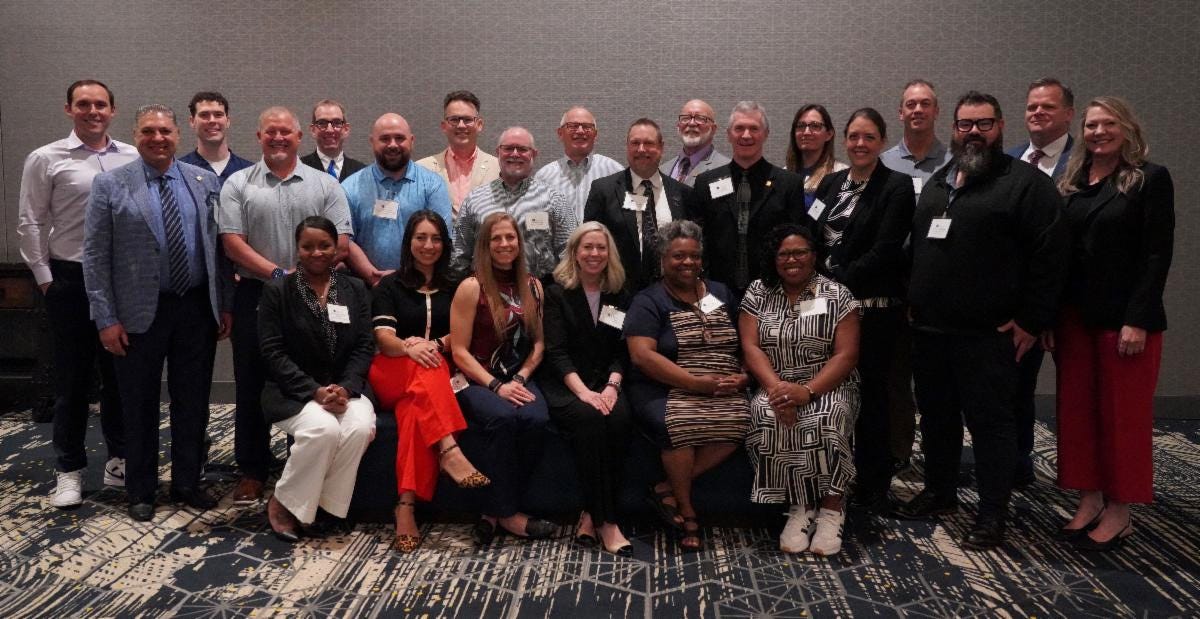
(NBCE Part IV Centralization State Board Representatives: Karen Baranick, DC (OR), Rusty Arrington, DC (ID), Scott D. Misek, DC, CHCQM (NE), Jeff Askew, DC (ND), Dana Cavell Clum, DC (WA), Mary Huffman, DC, DACO, CCSP (IL), Shannon Johnson, DC (KY), M. Douglas Lynes, DC (MI), Mark Rich, DC (OH), Andrew Riddle, DC, MBA, BSN (DE), Paul Abosh, DC (MD), George Khoury, DACRB, PSP (PA), Stephanie Johnson, DC (DC), Wayne Bennett, DC, DABCO (AZ), Rachel Klein, ND, DC, DACNB, FIBFN-CND (HI), Darcy Wyatt, DC, APC, CACCP (NM), Jason E. Drake, DC, DAAMLP (OK), Zachary Manwaring, DC (UT), Lori Ann McMillian, DC (AL), Felicia King, DC (MS), Jason Hulme, DC, Dipl. Med. Ac, CCSP (TN), Martia Lea Creighton Thigpen, DC (SC).)
The Wall is Cracking
The decision by the National Board of Chiropractic Examiners (NBCE) to force every licensure candidate from anywhere in the world to travel to its headquarters in Greeley, Colorado to take Part IV of its exam in order to get licensed in the United States is more than just a logistical or financial inconvenience. It is a legal landmine, and one that is now triggering international scrutiny.
Students, schools, and reform advocates are beginning to push back—and for good reason. The centralized administration of Part IV is not only arbitrary and protectionist, but also part of a broader, long-standing scheme of monopoly control over chiropractic education, accreditation, and licensure. The Chiropractic Cartel, led by NBCE, the Council on Chiropractic Education (CCE), the Federation of Chiropractic Licensing Boards (FCLB) and their co-conspirators in the Association of Chiropractic Colleges (ACC), is finally facing legal and public pressure that may prove insurmountable.
“No public hearings. No accountability. No alternatives. Just a cartel-backed demand that every chiropractic graduate pay to kneel at the altar in Greeley.”
Legal Fault Lines Are Emerging
Attorneys, legal scholars, and regulatory observers are now identifying serious constitutional and legal vulnerabilities in the way Part IV has been changed and is being implemented and enforced:
1. Violation of Economic Liberty (Substantive Due Process – 14th Amendment)
Requiring students to travel across the country to take an exam from a private corporation with no public oversight is not a legitimate exercise of state power. There is no public safety rationale for the centralization—only NBCE’s private interest in entrenching its monopoly and minimizing its operational costs.
This arbitrary mandate can be struck down by the courts as a violation of economic liberty, a fundamental right under the Constitution.
2. Procedural Due Process Violation
Students and other stakeholders had no opportunity to weigh in on the policy. State boards didn’t hold hearings, publish draft rules, or consult with the public on these changes so they effectively have not endorsed or codified it.
Courts can enjoin the implementation of centralized Part IV on the grounds that there was no fair process or opportunity on the state level to challenge the implementation before it took effect.
3. Equal Protection Violation
The centralized test site imposes disproportionate burdens on students from rural areas, lower-income backgrounds, and those with disabilities. There are no regional options, no school-based alternatives, and no virtual accommodations.
Courts can compel state boards to provide equal access to licensure by invalidating Greeley-only mandates or requiring alternate testing pathways.
4. Improper Delegation of State Authority
State licensure power cannot be handed over to a private nonprofit with no oversight. But that’s exactly what has happened. NBCE now controls entry into the chiropractic profession in nearly every state—and its decisions are enforced as if they were laws, without any of the protections required of governmental rulemaking.
Courts can rule that this delegation is unconstitutional and enjoin the use of NBCE’s exams as a condition of licensure unless meaningful state oversight is restored.
“State boards were never meant to serve as enforcers for a private nonprofit testing cartel—but that’s exactly what they’ve become.”
The Role of the CCE: Complicit by Design
This legal crisis doesn’t exist in a vacuum. The Council on Chiropractic Education (CCE) plays an essential enabling role through Policy 56, which ties a school’s accreditation to its students’ success on NBCE exams—especially Part IV.
While CCE technically allows schools to report licensure data in lieu of test scores, it is a hollow option. States require NBCE Part IV for licensure, and no centralized licensure database exists to track such outcomes. In effect, CCE forces schools to rely on NBCE data, creating a circular dependency that upholds NBCE’s testing monopoly.
Meanwhile, CCE recently announced it would not permit virtual access or recordings of its July 2025 meeting—further proving that transparency and public accountability are not part of the cartel’s business model.
“CCE’s refusal to allow even virtual attendance at its meeting tells you everything you need to know: this isn’t about education—it’s about control.”
Golden Shovels and Golden Handcuffs
NBCE has spent the last year celebrating its centralization with golden shovel ceremonies and symbolic groundbreakings to entrench its power further. Behind the scenes, the Association of Chiropractic Colleges (ACC) has lobbied to protect the existing structure.
On May 30, 2025 the Association of Chiropractic Colleges (ACC) blasted out a “Budget Reconciliation Status” alert urging Chiropractic College presidents, lobbyists, and other “key stakeholders” to lobby the Senate against proposed Grad PLUS borrowing caps of $150,000. The memo warns that the cap “falls significantly below the actual cost of chiropractic education ($200,000-$300,000),” calls the next “2-3 weeks … a critical window,” and provides boiler-plate letters for rapid deployment. Yet the ACC never asks the obvious question: Why does a DC degree cost more than many MD programs in the first place?
It’s a racket. And it’s one students are increasingly seeking to escape—some even filing Borrower Defense to Repayment claims with the Department of Education on the grounds that they were misled into a closed-loop system that served a private cartel rather than the public interest.
Secret Summits and the Illusion of Consensus
All of this is compounded by the secretive Chiropractic Summit group, where NBCE, CCE, FCLB, ACC, and others meet behind closed doors under so-called “Fight Club rules.” No minutes. No transparency. No dissent allowed.
Yet these are the groups dictating the future of chiropractic licensure, education, and practice—without input from the people most affected: students, patients, and independent chiropractors.
The Exam No One Needs—Except the Cartel
What’s often lost in the debate over Part IV centralization is a simple truth: Part IV is wholly unnecessary. Every accredited chiropractic program already conducts its own clinical competency evaluations before awarding a degree. These internal assessments are thorough, supervised by licensed faculty, and tailored to the educational standards approved by the same accrediting body—CCE—that later insists on NBCE scores as proof of competency.
So why does Part IV still exist? Because of CCE Policy 56, which mandates public reporting of licensing exam success rates. And since most states require Part IV for licensure—and there is no functional system for verifying licensure status—schools are forced to rely on NBCE results. This creates a manufactured dependency, not grounded in educational necessity, but in a self-reinforcing monopoly that benefits NBCE and protects its position.
Without Policy 56 propping it up, Part IV would collapse under its own redundancy. It is not a public safety measure. It is a cartel tool.
The Path Forward
The legal arguments are compelling. The facts are damning. The public support is building. And the narrative is shifting—from one of resignation to one of resistance.
Part IV centralization is not just bad policy. It is likely illegal. And it is now the flashpoint for a much larger reckoning with the Chiropractic Cartel and the systems that have protected it for decades.
“Licensure should never be a toll booth controlled by a private nonprofit. The law—and the people—are catching up to that truth.”