The Illusion of Consent: How NBCE Is Using State Board Names to Push Part IV Centralization
Originally published: 2025-06-23

The Greeley Maneuver
State Licensing Boards Have Not Signed Off On This
“The NBCE appears to be laundering its private corporate decisions through the names of public officials.”
The announcement lists 25 individuals under the banner of “State Board Representatives,” implying that these people—by virtue of their participation—represent the formal position of their respective licensing boards on the centralization of Part IV.
The LIST:
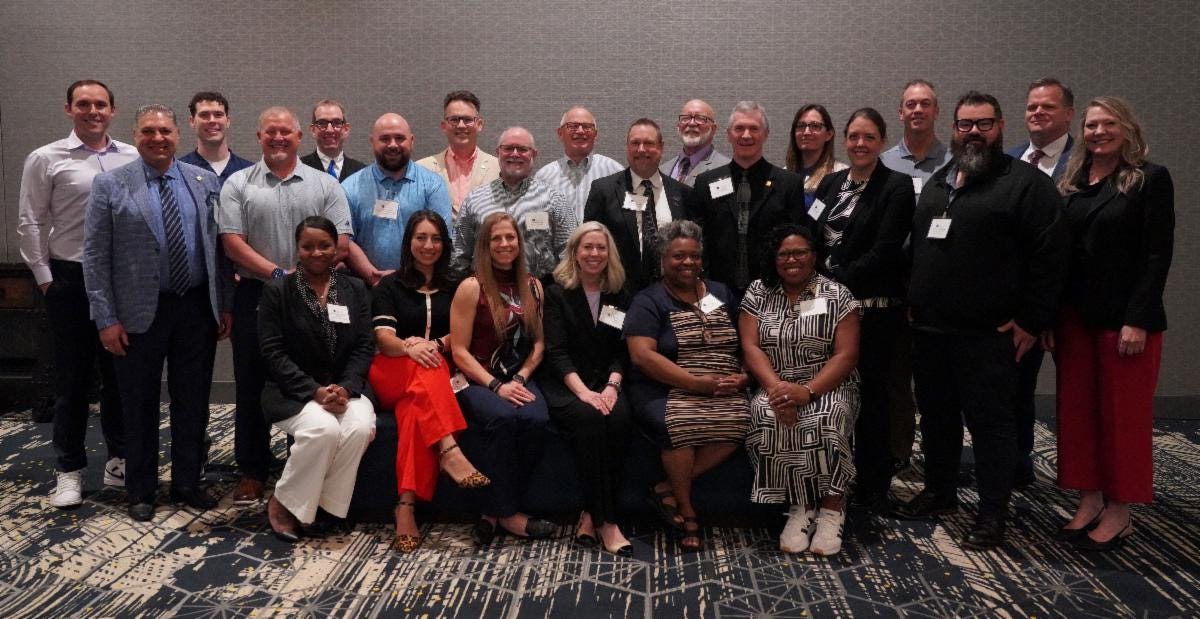
State Board Representatives: Karen Baranick, DC (OR), Rusty Arrington, DC (ID), Scott D. Misek, DC, CHCQM (NE), Jeff Askew, DC (ND), Dana Cavell Clum, DC (WA), Mary Huffman, DC, DACO, CCSP (IL), Shannon Johnson, DC (KY), M. Douglas Lynes, DC (MI), Mark Rich, DC (OH), Andrew Riddle, DC, MBA, BSN (DE), Paul Abosh, DC (MD), George Khoury, DACRB, PSP (PA), Stephanie Johnson, DC (DC), Wayne Bennett, DC, DABCO (AZ), Rachel Klein, ND, DC, DACNB, FIBFN-CND (HI), Darcy Wyatt, DC, APC, CACCP (NM), Jason E. Drake, DC, DAAMLP (OK), Zachary Manwaring, DC (UT), Lori Ann McMillian, DC (AL), Felicia King, DC (MS), Jason Hulme, DC, Dipl. Med. Ac, CCSP (TN), Martia Lea Creighton Thigpen, DC (SC).
Let’s be clear:
There has been no record of public deliberation, formal board votes, or state rulemaking procedures affirming support for centralization. The inclusion of these state board members gives the illusion of consensus—a sleight of hand that confuses individual participation with institutional (state) endorsement and codification.
The NBCE’s Corporate Mask
The NBCE is not a governmental entity. It is a private testing company, and like any private corporation, it has a vested interest in controlling the marketplace for its products. By invoking the names and titles of state officials, the NBCE is engaging in brand co-optation—borrowing the authority of the state to lend legitimacy to a decision that has not undergone state-level scrutiny.
“This blurs the line between regulatory authority and corporate capture.”
No Statutory Authority for Centralization
“Generic participation does not equal formal state approval of a major policy shift.”
Yes, state boards designate liaisons or representatives to interact with the NBCE. But the centralization of the Part IV examination to a single test site in Greeley, Colorado is a major departure from past practice—and a change that was never codified in statute, regulation, or policy when NBCE was first memorialized in state law, rules and regs.
There is no transparency on:
Whether the centralized model of Part IV has been formally adopted by any state board through a public vote;
Whether participation in the June Test Development Committee meeting constituted board-approved representation for this specific policy change;
Whether this policy shift has been discussed in open meetings, documented in board minutes, or subjected to public notice and comment;
Whether the NBCE has disclosed any financial arrangements or compensation provided to participating state board members;
Whether states have conducted a regulatory review to assess whether this significant logistical and financial burden complies with their own licensure standards or administrative procedures acts.
The fact remains: state boards approved NBCE as a testing partner under prior conditions—not as a centralized gatekeeper controlling access to licensure from a single geographic location.
“This isn’t just a logistical tweak—it’s a structural overhaul, implemented without public oversight or lawful process.”
Until such changes are formally proposed, vetted, and adopted by each state under its own laws, the NBCE’s centralized Part IV is operating in a legal and regulatory vacuum. And using state board representatives to suggest otherwise is a misuse of public trust.
The End Run Around State Law
“States are being bypassed while still bearing the responsibility of enforcement.”
While states require NBCE exams for licensure, they also have Administrative Procedure Acts that protect the public interest by requiring formal review and notice before changes to licensing standards are enacted. The shift to a single, centralized testing site in Greeley—with added costs and access barriers—is a material change to the exam process. Yet it’s being implemented without:
Cost-benefit analysis;
Public comment;
Consideration of local or school-based alternatives;
Formal votes by the licensing boards themselves.
This is not how a public licensing system is supposed to operate.
Final Thought
State officials and regulators should be asking hard questions:
Were these board members authorized to endorse this new model on behalf of the state and if so where is the documentation?
Did their endorsement reflect an official board action?
Has the public been given a chance to weigh in on state actions related to this?
What precedent does this set for private vendors controlling public licensure?
The NBCE’s announcement may look like a routine update, but it’s a masterclass in regulatory illusion. One that state boards and AGs must now confront.
“If decisions that affect the livelihoods of thousands of chiropractors can be made behind closed doors, with no public comment and the names of public officials used as cover, then we no longer have a licensing system—we have a cartel.”
