The NBCE Controls Chiropractic Licensure. How State Boards Handed Power to a Private Corporation, and Why It Could Be Unconstitutional
Originally published: 2025-10-23
A System Hiding in Plain Sight
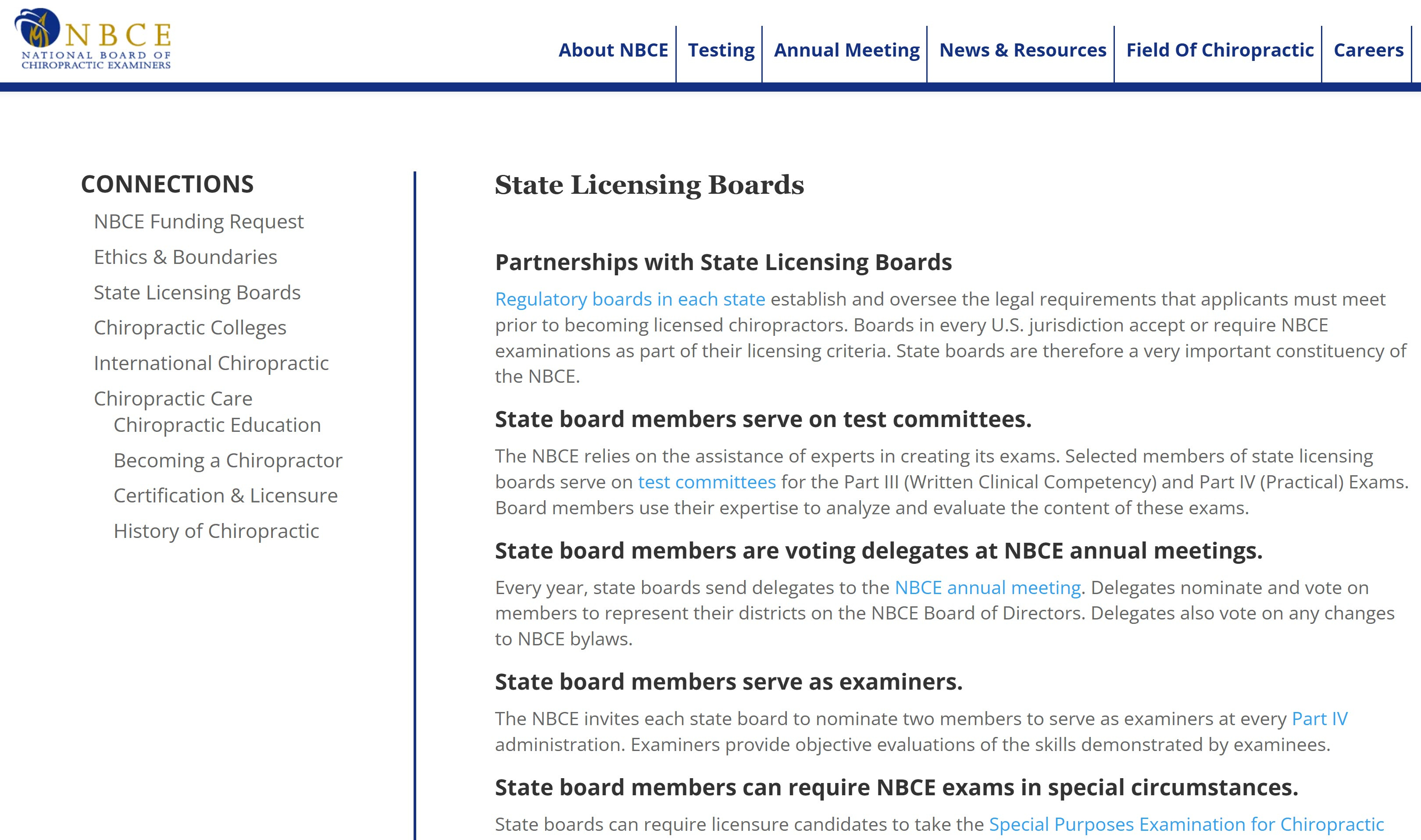
Every chiropractor in America must pass the National Board of Chiropractic Examiners (NBCE) tests to get a license. That is not a rumor, it is written plainly on the NBCE’s own website.
“Boards in every U.S. jurisdiction accept or require NBCE examinations,” the NBCE boasts.
“State board members serve on test committees, vote for NBCE directors, and act as NBCE examiners.”
What sounds like routine cooperation between regulators and a testing company is, in fact, a deeply troubling picture of regulatory capture where the regulated industry and its supposed watchdog merge into one.
This arrangement raises fundamental legal questions: Who is actually in charge of chiropractic licensure, the state or the NBCE? And if it is the latter, is that even legal?
The Delegation Problem: When Regulators Give Away Their Power
Every state has a chiropractic licensing board, a government agency created by statute to protect the public. These boards are responsible for determining who is competent to practice.
But over time, instead of developing or supervising their own competency measures, boards have outsourced that duty to the NBCE, a private nonprofit corporation based in Greeley, Colorado.
Some boards cite their rulemaking authority, claiming they lawfully incorporated the NBCE exams through administrative rules. Others have written NBCE directly into state law. Either way, the result is the same, a private company now controls access to a public license.
“It’s one thing to reference an external exam,” said one attorney familiar with state administrative law, “but it’s another to hand over the power to define, deliver, and grade that exam without any oversight. That’s not regulation, that’s abdication.”
When Rulemaking Becomes Rubber-Stamping
In many states, chiropractic boards adopted NBCE exams by “incorporation by reference.” That means instead of publishing exam standards in their own rules, they simply cited NBCE as the required exam.
The problem is that NBCE frequently changes its exams, their content, scoring, and even delivery model, without any formal state review or public notice. When a private entity can unilaterally change the conditions of licensure, the rule of law is replaced by rule by corporation.
Legal precedent is clear, an agency cannot incorporate private standards by reference if those standards are subject to change outside of the state’s control. The D.C. Circuit Court in General Electric Co. v. EPA (1995) and other cases held such delegation to be unconstitutional or ultra vires.
So even if a state once properly referenced NBCE, any subsequent change by NBCE, like the controversial centralization of Part IV to Greeley, may now be unlawful since no state has re-adopted those changes through public rulemaking.
“If NBCE decides tomorrow to double the cost, change the content, or fail half the candidates, no state board has the authority or process in place to stop them. That’s the definition of unchecked power.”
When Legislatures Do It, It’s Even Worse
In a few states, the legislature itself has written NBCE into statute. At first glance, this might seem more legitimate since a law passed by elected officials carries authority.
But legally, it is even more problematic. Legislatures can set standards for licensure, but they cannot delegate coercive power, such as the power to determine who gets a professional license, to a private, self-interested entity.
The U.S. Supreme Court has repeatedly struck down such arrangements. In Carter v. Carter Coal Co. (1936), the Court ruled that delegating regulatory power to private parties was unconstitutional because it vested “governmental authority in those whose interests may be adverse to others.”
That is exactly what is happening here. The NBCE decides who passes, who fails, and what constitutes competency, and it profits from every exam given.
“This is legislative outsourcing on autopilot,” said a policy analyst who reviewed several state chiropractic statutes. “Lawmakers essentially handed a monopoly to NBCE and walked away. That’s not oversight, that’s surrender.”
No Supervision, No Accountability
Even if the NBCE arrangement were considered “state action,” the Supreme Court’s North Carolina State Board of Dental Examiners v. FTC (2015) decision requires active state supervision to qualify for antitrust immunity.
The Dental Board case involved a state board dominated by dentists that excluded competitors from offering teeth-whitening services. The Court ruled that because the board lacked active supervision, it was not immune from federal antitrust law.
The parallels are striking. Chiropractic boards are dominated by chiropractors who collaborate with the NBCE, the only approved exam provider. Yet no state actively reviews NBCE’s pricing, content, or operational decisions. That absence of supervision makes the NBCE–board relationship legally indefensible and potentially a violation of the Sherman Antitrust Act.
“State-action immunity doesn’t apply when the state simply looks the other way,” said an antitrust attorney. “That’s exactly what’s happening with the NBCE.”
A Closed Market Masquerading as Regulation
The consequences are real. Chiropractic graduates pay thousands of dollars for mandatory NBCE exams, often incurring student debt for tests that determine their livelihood. Meanwhile, alternative assessment models or state-based competency evaluations are barred from the marketplace.
In effect, the NBCE operates as a private monopoly, protected by government mandate but beyond government control.
Applicants have no due process, no transparency, and no alternative path to licensure, a clear violation of both constitutional and economic fairness principles.
“The NBCE controls entry to the profession. If that doesn’t make it a cartel, what does?”
Reclaiming State Sovereignty
Reform begins with a simple premise, the power to license a profession belongs to the state, not to a private corporation. States must reassert sovereignty by reviewing and rewriting their chiropractic licensure statutes and rules to:
Replace NBCE references with state-defined competency measures verified through accredited programs.
Conduct legislative oversight hearings on NBCE’s influence and compliance with state law.
Allow alternative pathways to licensure that reflect modern, program-based competency assessment.
Establish active supervision protocols for any continued NBCE involvement to satisfy NC Dental Board requirements.
Support development of independent accrediting and evaluation bodies, such as the International Agency for Chiropractic Evaluation (IACE), to restore competition and accountability.
The Stakes for Chiropractic’s Future
Whether embedded in rules or statutes, the NBCE’s control over licensure represents a systemic failure of governance. What began as a testing service has become a de facto regulator, immune from transparency and insulated from oversight.
The integrity of chiropractic regulation depends on reclaiming control from private hands. Otherwise, the NBCE’s monopoly will continue to define who can practice, what it costs to qualify, and how the profession evolves, all without the consent of the governed.
“The NBCE’s dominance is not a sign of stability, it’s a symptom of capture. The longer states wait to act, the deeper this private control becomes.”
