The NBCE's Latest Power Grab: The Chiropractic Education Readiness Assessment (CERA)
Originally published: 2025-01-17
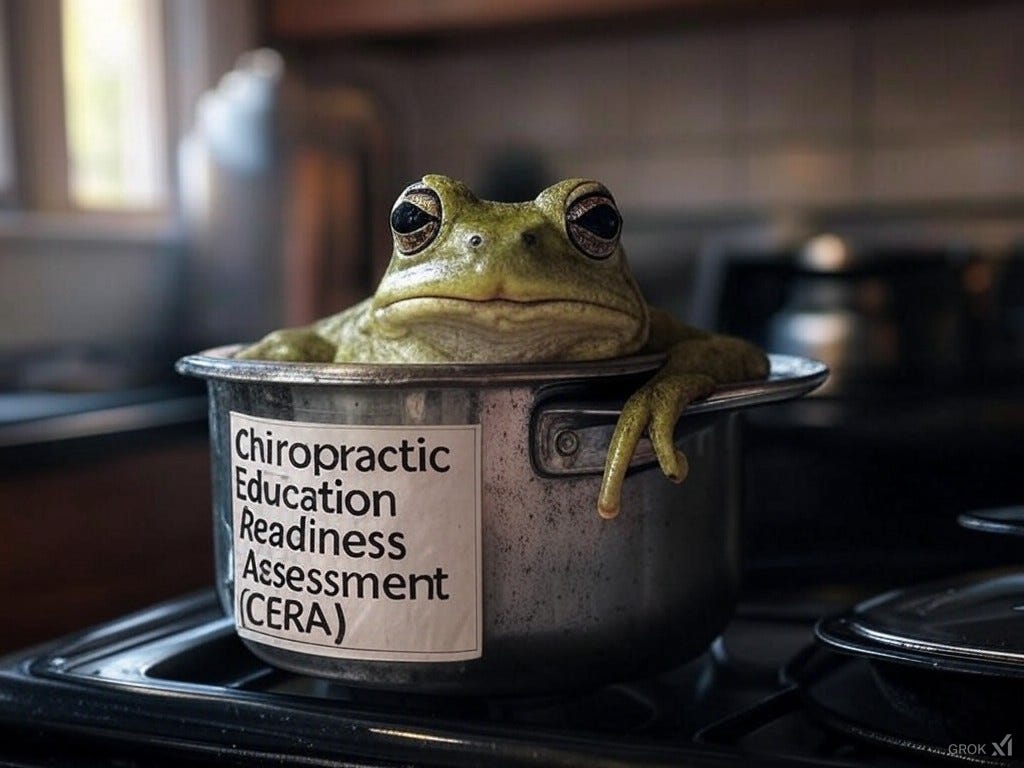
The National Board of Chiropractic Examiners (NBCE) has unveiled its latest initiative—the Chiropractic Education Readiness Assessment (CERA)—positioned as an optional tool to evaluate incoming chiropractic students’ preparedness. On the surface, CERA seems benign, even helpful: a two-part test designed to measure cognitive and non-cognitive competencies, ostensibly to help schools tailor educational strategies and improve outcomes. However, beneath the surface lies a familiar and concerning pattern: the NBCE's incremental push to expand its influence and control over the chiropractic profession.
This isn’t the first time the NBCE has introduced a “voluntary” program, only to see it become mandatory over time. The history of their practices shows a clear trend of gradually making optional initiatives compulsory, squeezing out autonomy from chiropractic schools and adding financial burdens to students and institutions. With CERA, the script seems all too familiar.
Why CERA Is Problematic for Chiropractic Schools
Unnecessary Redundancy
Chiropractic schools already collect extensive data on their students’ academic performance. Admissions requirements, GPA tracking, and existing tools for monitoring student progress provide more than enough insight into student readiness and performance. Introducing yet another layer of testing is not only redundant but adds unnecessary complexity.
As one school representative put it, “We already have enough data on current students regarding their academic performance. We don’t need more of the same.”
A Gateway to Mandatory Implementation
The NBCE has a history of using “voluntary” programs as a testing ground for eventual mandates. By initially offering CERA for free, the NBCE aims to normalize its presence in chiropractic education. Over time, this “optional” test could easily become a required part of the admissions or placement process, creating another revenue stream for the NBCE at the expense of students and schools.
Misalignment with Trends in Education
At a time when standardized testing is being de-emphasized across the educational landscape, the NBCE’s push for additional testing feels out of step with the broader movement. Critics argue that the emphasis on standardized tests does not adequately measure a student’s potential for success in chiropractic school or practice.
Financial Implications
While the NBCE is currently offering CERA at no cost, the reality is that administering, scoring, and maintaining such a program comes with a price tag. History suggests that students and schools will eventually bear the cost. One administrator noted, “It will wind up being an added cost even though they are doing it for free now.”
Encroachment on Institutional Autonomy
Perhaps the most troubling aspect of CERA is the NBCE’s overreach into areas that should remain under the control of chiropractic schools. Admissions decisions and educational strategies are best determined by the institutions themselves, not an external organization with a history of monopolistic practices.
The Bigger Picture: NBCE, CCE, and FCLB
The CERA controversy is not an isolated incident but part of a larger pattern involving the NBCE, the Council on Chiropractic Education (CCE), and the Federation of Chiropractic Licensing Boards (FCLB). These organizations wield significant power within the chiropractic profession, often acting as gatekeepers to education, licensure, and practice. Critics argue that this concentration of power stifles competition and innovation, while enriching these organizations at the expense of students, educators, and practitioners.
The NBCE already administers five exams required for licensure, a burdensome and expensive process for students. Adding another test—whether optional or mandatory—only deepens the financial and administrative strain. Chiropractic schools, which are on the front lines of educating future practitioners, must push back against this encroachment to preserve their autonomy.
Call to Action: Schools Must Take a Stand
The chiropractic profession has reached a crossroads. If schools accept CERA, even as a voluntary program, they risk setting a precedent that allows the NBCE to further entrench itself into the educational process. This is not about improving student success—it’s about consolidating power and creating another revenue stream for a monopoly that already dominates the profession.
As one school stated unequivocally, “We have no intention of using it as an admission requirement or as a placement exam.” More institutions need to adopt this stance and make it clear that they will not participate in or endorse CERA.
Conclusion: A Monopoly’s Slow Boil
The NBCE’s introduction of CERA is a classic example of “boiling the frog slowly.” By presenting the test as optional and free, the NBCE is testing the waters, hoping schools will buy into the program without realizing its long-term implications. Schools must remain vigilant and resist this latest power grab. The chiropractic profession cannot afford to hand over more control to an organization that prioritizes profit and power over the well-being of students and educators.
Chiropractic schools have the expertise, resources, and autonomy to decide who enters their programs and how they are educated. They don’t need the NBCE—or any external organization—sticking their nose into the process. It’s time to say no to CERA and yes to preserving the integrity and independence of chiropractic education.
