The Persistent Danger: New Research Uncovers Amyloid Fibrils in Children Exposed to mRNA Vaccines in Utero
Originally published: 2025-06-13
Unraveling the Long-Term Effects of mRNA Vaccines on Children
“The persistence of amyloidogenic fibrils years after gestational exposure cannot be dismissed by outdated pharmacokinetic assumptions.” — Dr. Kevin W. McCairn
Case Background: A Troubling Birth Story
The child in this study was born prematurely at 35 weeks, just one week after the mother’s second dose of the Pfizer-BioNTech BNT162b2 mRNA vaccine. The birth was difficult, with the child requiring emergency resuscitation after being born without vital signs. Over the next three years, the child experienced recurrent immune dysfunction, including frequent infections, tonsillectomy, and multiple surgeries for persistent middle ear infections. These complications raised suspicions about the underlying causes of the child’s immune system issues.
“The temporal correlation suggests a significant adverse maternal-fetal reaction that warrants further investigation into the safety of mRNA vaccines for pregnant women.” — Dr. Kevin W. McCairn
The Unsettling Discovery: Amyloid Fibrils in the Blood
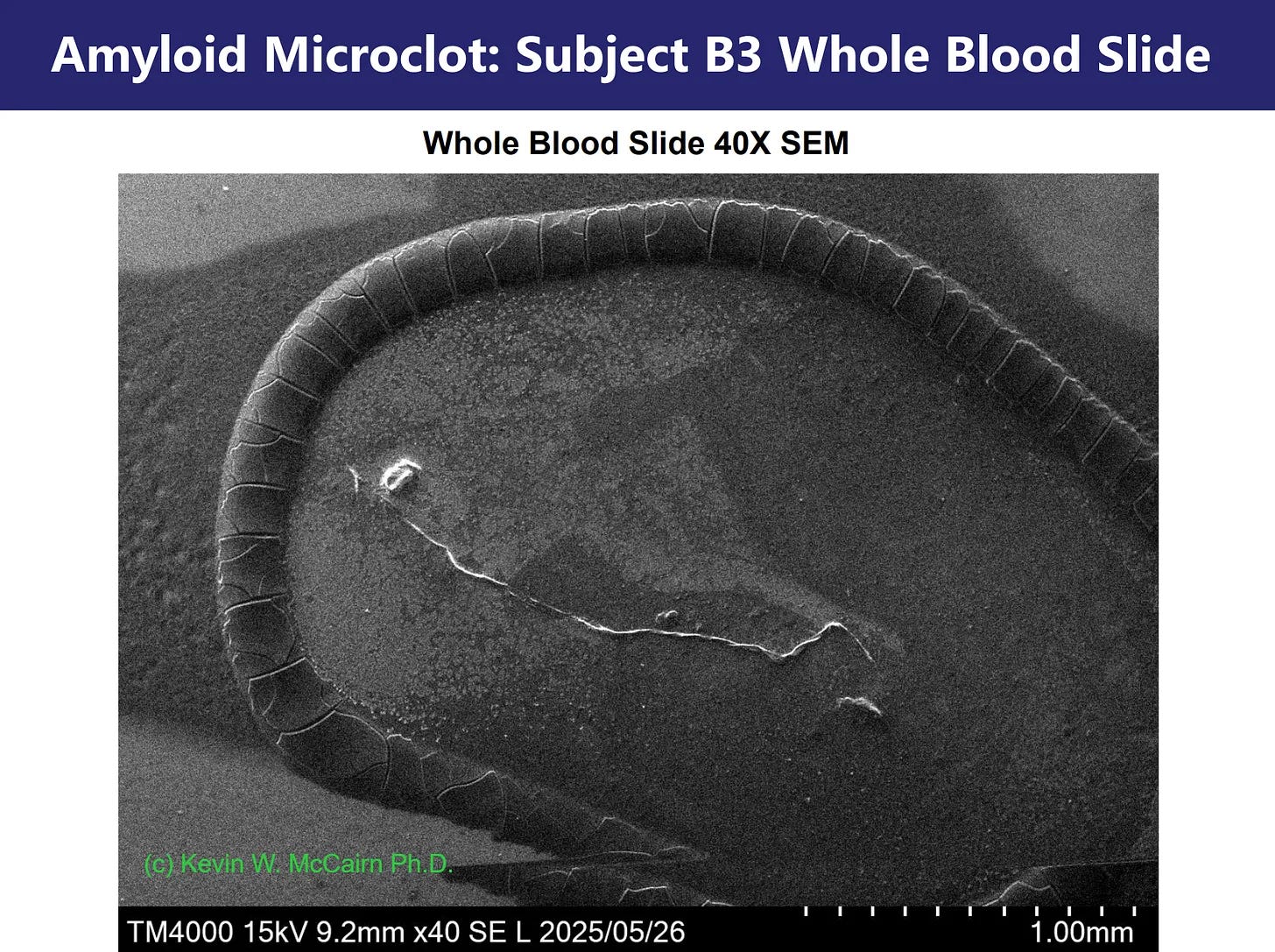
Dr. McCairn’s team analyzed the child’s blood using two advanced imaging techniques—fluorescence microscopy with Thioflavin T (ThT) staining and scanning electron microscopy (SEM). Both methods revealed the presence of fibrillar structures in the child’s blood, which displayed characteristics consistent with amyloid-like structures. These findings suggest that the child’s exposure to the spike protein encoded by the mRNA vaccine may have led to the formation of amyloid fibrils—long, twisted protein structures that are often associated with neurodegenerative diseases like Alzheimer's.
“The persistent nature of these amyloid-like fibrils in fresh, unfixed blood samples challenges the idea that the spike protein clears rapidly from the system.” — Dr. Kevin W. McCairn
Persistence of Fibrils: A Problem Beyond Coagulation
The study goes further to challenge the conventional understanding of how the body responds to the mRNA vaccine. While most experts previously believed that the spike protein would clear quickly from the body, this study provides compelling evidence that amyloidogenic fibrils persist long after initial exposure. This persistence may be due to the self-perpetuating nature of amyloid formation, which can continue even without ongoing exposure to the original protein.
Dr. McCairn points out that amyloid fibrils have a prion-like behavior, meaning they can catalyze the formation of more fibrils, even in the absence of the original seed protein. The study’s findings suggest that once seeded, these fibrils can perpetuate themselves and cause long-term health issues.
“Amyloid fibrils can self-catalyze and persist once seeded, long after the initial exposure has ended.” — Dr. Kevin W. McCairn
Has This Been Discussed Before?
While this specific case of amyloid fibrils in children exposed to mRNA vaccines in utero is unprecedented, related concerns have been raised in the scientific literature. Research has shown that the spike protein produced by mRNA vaccines can form amyloid-like fibrils, and studies have indicated that these structures can persist in the body long after vaccination.
Amyloidogenic Properties of the SARS-CoV-2 Spike Protein
Research published in the Journal of the American Chemical Society demonstrated that the spike protein has amyloidogenic potential, forming persistent microclots in human blood. This supports the idea that the spike protein can contribute to long-term health issues, such as the amyloid fibril formation seen in McCairn’s study (pubs.acs.org).
Persistence of mRNA Components
Studies have also raised concerns about the persistence of mRNA vaccine components in the body. Research has shown that modified mRNA can remain in the body for extended periods, with some studies detecting it in tissues such as the heart and skeletal muscles weeks after vaccination (pmc.ncbi.nlm.nih.gov).
Maternal and Fetal Exposure
The potential for mRNA vaccine components to reach the placenta and fetus has also been a subject of concern. Studies have confirmed that lipid nanoparticles (LNPs) and mRNA can be delivered to the fetal environment, raising the possibility of in-utero exposure to the spike protein (pubmed.ncbi.nlm.nih.gov).
“The idea that mRNA components clear rapidly from both maternal and fetal systems has been refuted by recent studies showing prolonged persistence of spike protein and mRNA.” — Dr. Kevin W. McCairn
Morphological Differences: Amyloid Fibrils vs. Atherosclerotic Plaques
In a detailed analysis, Dr. McCairn contrasts the amyloid fibrils observed in this study with traditional atherosclerotic plaques and coagulative clots. Unlike these clots, which contain lipid or cholesterol cores and are typically embedded in blood vessel walls, the amyloid fibrils in the child’s blood were found circulating freely, without the characteristic lipid or cholesterol content. This distinction further supports the idea that these fibrils are part of a pathological process distinct from ordinary coagulation or arteriosclerotic degeneration.
“These amyloid fibrils differ significantly from canonical coagulative clots or atherosclerotic plaques, supporting the hypothesis that amyloidogenesis is a distinct, systemic pathological process.” — Dr. Kevin W. McCairn
Biosecurity and Bioethical Implications
Dr. McCairn’s research doesn’t just raise questions about vaccine safety—it also highlights the potential biosecurity implications of widespread exposure to amyloidogenic proteins. With over 13 billion doses of mRNA vaccines administered worldwide, the possibility that the spike protein could trigger long-term health issues for millions of people is a grave concern.
The study also ties these findings to broader concerns about biowarfare, suggesting that the SARS-CoV-2 virus and its mRNA vaccine counterpart might have originated from research conducted under the umbrella of “Dual Use Research of Concern” (DURC)—research intended for civilian use that can also be applied for military purposes.
“The possibility that synthetic, biowarfare-spawned amyloids could have far-reaching health consequences demands urgent scrutiny and a reevaluation of vaccine safety.” — Dr. Kevin W. McCairn
Conclusion: A Call for Further Investigation and Transparency
The implications of this study are profound. Dr. McCairn’s findings challenge the prevailing narrative about the safety of mRNA vaccines and urge the scientific community to reexamine the long-term biological consequences of these vaccines, particularly for children. The persistence of amyloidogenic fibrils years after in-utero exposure raises alarming questions about the potential for widespread health consequences from mRNA vaccines.
Given the growing body of evidence on the persistence of spike protein and its amyloidogenic properties, Dr. McCairn advocates for urgent post-market surveillance, independent replication of studies, and transparency in vaccine data to address these concerns.
“Only rigorous post-market surveillance and transparent access to vaccine data can resolve these urgent questions, especially regarding the long-term safety of mRNA vaccines in children.” — Dr. Kevin W. McCairn
As more studies emerge, it is crucial for the scientific community and public health authorities to investigate these findings thoroughly. The health of future generations may depend on it.