Time for a Clean Break: WFC Must Reject the WHO
Originally published: 2025-01-21
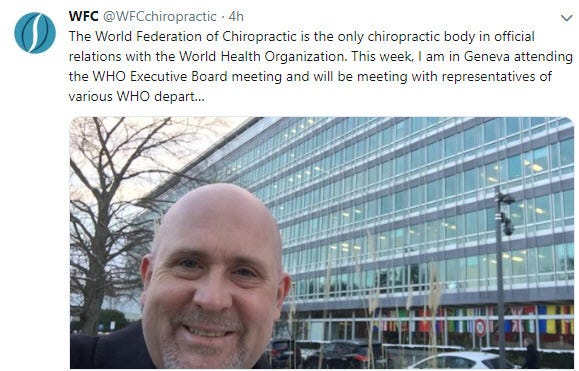
The chiropractic profession stands at a pivotal moment in its history. President Trump’s decision to withdraw the United States from the World Health Organization (WHO) has reignited debate about the alignment between chiropractic’s foundational principles and the actions of global organizations like the WHO and the World Federation of Chiropractic (WFC). It’s time for chiropractic organizations to sever ties with these entities, whose policies and positions run counter to the core tenets of chiropractic care.
The WFC: Undermining Chiropractic Principles
Since its establishment as an NGO in official relations with the WHO in 1997, the WFC has tried to position itself as a global representative of chiropractic. However, its agenda has consistently veered away from the traditional, vitalistic principles of chiropractic care, raising serious concerns about its role in shaping the future of the profession.
Denial of Subluxation
One of the most contentious issues is the WFC’s dismissal of the vertebral subluxation theory, a foundational concept in chiropractic. WFC researchers for example have publicly referred to the idea of subluxation as “absolutely rubbish,” undermining decades of clinical practice and education. Furthermore, their opposition to using x-rays for subluxation analysis—endorsing campaigns like "Choosing Wisely"—has further marginalized traditional chiropractic practices.
Promoting a Mechanistic Model
The WFC’s push to position chiropractors as “primary spine care” providers is an effort to rebrand chiropractic as a pain management discipline, aligning it more closely with allopathic medicine. This shift ignores chiropractic’s unique emphasis on the nervous system and holistic health, reducing the profession to a limited, mechanistic model of care.
Complicity in Biased Research and Policy Manipulation
The WFC has also been accused of using flawed research to support its agenda. Its controversial report dismissing chiropractic’s impact on immunity is a prime example. This document not only lacked consensus but was weaponized to discredit chiropractors who advocated for the nervous system’s role in immune function. The fallout from this report, including resignations and sponsor withdrawals, highlights the deep divisions within the profession.
The ICEC Connection: A Coordinated Attack on Subluxation
The International Chiropractic Education Collaboration (ICEC) further exemplifies the WFC’s anti-subluxation agenda. The ICEC’s position statement, heavily influenced by the WFC’s 2014 Educational Statement, calls for the exclusion of subluxation as a vitalistic construct from chiropractic curricula. It even criticizes traditional practices such as high-volume care models and x-ray analysis, labeling them as inappropriate. This stance aligns with the WHO’s support for immunization and vaccination policies, which many chiropractors view as inconsistent with chiropractic’s emphasis on natural health and informed consent.
Why Chiropractic Must Reject the WHO and WFC
The alignment between the WFC and WHO, particularly in areas like vaccination advocacy and their policies on informed consent, raises significant ethical and philosophical conflicts. Chiropractic’s commitment to drug-free, patient-centered care is fundamentally at odds with WHO’s reliance on pharmaceutical interventions. By maintaining relationships with the WHO and the WFC, chiropractic organizations risk losing their unique identity and becoming subsumed into a system that devalues their contributions.
The Need for a New Path
Chiropractic organizations, including the International Chiropractors Association (ICA), must lead the charge in rejecting the WFC’s influence. It’s time to explore alternative alliances that uphold chiropractic’s vitalistic principles and foster a future aligned with its core values. Regional partnerships and independent initiatives can provide a platform for advancing the profession without compromising its integrity.
Conclusion: A Call to Action
The chiropractic profession faces a clear choice: continue supporting organizations that undermine its foundational principles or take a bold stand for its values. The WFC’s policies and actions, in conjunction with its alignment with the WHO, have made it an untenable partner for those who believe in chiropractic’s vitalistic, subluxation-based model.
Now is the time for chiropractic organizations worldwide to withdraw from the WFC and join the U.S. in rejecting the WHO. The future of chiropractic depends on preserving its unique identity and resisting efforts to dilute its core principles. Let this moment mark the beginning of a renewed commitment to chiropractic’s true mission: improving health by honoring the body’s innate potential to heal itself.
CLICK HERE for more history of the WFC
