Troy University’s Chiropractic Leap: A Bold Move or a Familiar Pitfall?
Originally published: 2025-10-07
Troy University in Alabama is making headlines with its newly approved Doctor of Chiropractic (D.C.) program, announced on September 17, 2025, following the Alabama Commission on Higher Education’s (ACHE) greenlight on September 12. As the first such program in the state and only the second at a public university in the U.S., it’s being touted as a solution to chiropractor shortages in rural areas. But history, and economics, suggest a more nuanced story. Drawing lessons from Florida State University’s (FSU) ill-fated attempt two decades ago, this initiative could solidify chiropractic’s role as a limited musculoskeletal treatment modality rather than elevating it to a distinct profession.
“This program will address the critical shortage of chiropractors in rural Alabama and the Southeast, offering an affordable pathway into a rewarding profession.”
— Troy University Officials, September 17, 2025 Announcement
While the excitement is understandable, let’s unpack the details, the historical parallels, and the potential pitfalls for aspiring chiropractors and the profession at large.
Program Highlights: Accessibility Meets Evidence-Based Training
Set to launch at Troy’s Dothan Campus in the College of Health Sciences, the D.C. program is geared toward Fall 2027 enrollment, pending accreditation from the Council on Chiropractic Education (CCE). Key elements include:
Curriculum Emphasis: A medically oriented approach blending basic sciences, clinical rotations, and interprofessional collaboration, with a focus on musculoskeletal care and rehabilitation.
Timeline and Affordability: With an initial target of Fall 2026 now updated to 2027, the program leverages public university pricing to make it more accessible than private institutions, potentially drawing students from underserved regions.
This setup positions Troy as a pioneer in public chiropractic education, but it also raises questions about whether it truly expands the profession’s scope or merely repurposes it for cost-effective healthcare delivery.
Lessons from Florida State: A Cautionary Tale of Opposition and Satire
Troy’s venture isn’t breaking entirely new ground, nearly 20 years ago, FSU nearly became the first public university to host a chiropractic school. In 2004, the Florida Board of Governors initially approved the plan, backed by legislative funding. However, intense backlash led to its reversal in January 2005. Faculty opposition was fierce, with over 500 professors, including Nobel laureates, signing petitions decrying chiropractic as pseudoscience unfit for a research university.
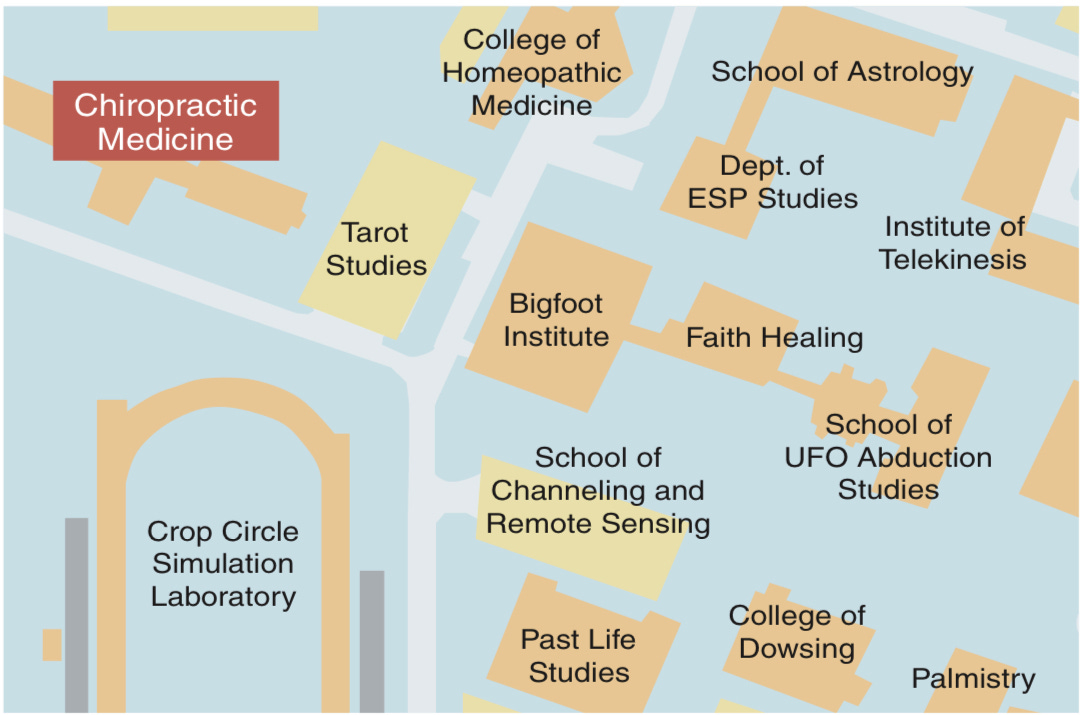
The resistance culminated in a satirical poster created by FSU professors, which circulated widely and was even turned into a billboard. The parody depicted a fictional campus map featuring “Chiropractic Medicine” alongside absurd departments like the “Bigfoot Institute,” “School of Astrology,” “Dept. of ESP Studies,” “Institute of Telekinesis,” “Faith Healing,” “School of Channeling and Remote Sensing,” “School of UFO Abduction Studies,” “Past Life Studies,” “College of Dowsing,” “Palmistry,” “Tarot Studies,” and “Crop Circle Simulation Laboratory.” This tongue-in-cheek critique equated chiropractic with fringe pseudosciences, amplifying concerns about academic credibility and ultimately contributing to the program’s demise.
FSU’s failure underscores the academic skepticism Troy may face, particularly if its curriculum leans heavily into medical integration at the expense of chiropractic’s conservative roots.
The Primary Care Mirage: Limited Scope and Economic Hurdles
Troy promotes the program as training chiropractors for primary care roles in rural Health Professional Shortage Areas (HPSAs), where physician shortages are acute. However, this claim overstates reality. Chiropractors function as portal-of-entry providers with a narrow scope, typically limited to neuromusculoskeletal issues, similar to ophthalmologists or podiatrists, not comprehensive primary care physicians who manage broad health concerns like diabetes or infections.
“Reality Check: True primary care activities have limited utility for chiropractors due to regulatory constraints in states like Alabama, where their practice is confined to adjustments and related therapies.”
Moreover, economic incentives don’t align with rural promises. Most chiropractic graduates, burdened by student debt, prioritize profitable urban practices. Rural areas offer slim pickings, as chiropractors often rely on cash-paying patients amid limited insurance reimbursements for their services. This mismatch could leave Troy’s graduates scrambling for viable careers, rather than filling rural voids.
A Cash Cow for Universities: Low Overhead, High Returns
From a university perspective, adding a D.C. program is a financial win. Institutions like Troy already offer foundational courses in basic sciences, anatomy, and physiology, minimizing new overhead. Hiring chiropractors to teach specialized classes is far cheaper than recruiting Ph.D.s for other disciplines. This model turns chiropractic education into a revenue stream, attracting tuition dollars with minimal investment.
Take the University of Pittsburgh’s (Pitt) recent D.C. program, launched in 2024 as the first at a major research university. It emphasizes rehabilitation and evidence-based treatment for back pain and musculoskeletal issues, positioning chiropractors as affordable labor in insurance-covered settings. Rather than elevating the profession, such programs integrate chiropractors into medical teams as specialists in pain management, often under physician oversight.
Cultural Authority or Cemented Subordination?
Many hope Troy’s program will grant chiropractic greater cultural authority by associating it with a public university. Yet, the medically oriented focus, echoing FSU’s science-based aspirations and Pitt’s rehab emphasis, may do the opposite. By prioritizing integration with mainstream medicine, these curricula neglect conservative chiropractic principles like subluxation theory, further entrenching the field as a modality for treating musculoskeletal pain syndromes rather than a separate, distinct profession.
“University-based programs risk diluting chiropractic’s holistic ethos, turning practitioners into adjuncts for back pain relief.”
— Insights from Chiropractic Education Debates
Aspiring students should weigh this: While affordable and accessible, Troy’s D.C. might prepare you for a niche role in rehab, not the autonomous practice many envision.
Looking Ahead: Promise vs. Pragmatism in Alabama’s Healthcare Landscape
Troy University’s D.C. program could indeed boost rural access to musculoskeletal care, but only if graduates defy economic pressures and embrace limited scopes. Learning from FSU’s satirical takedown and downfall, Troy must navigate opposition while addressing the profession’s internal divides. Ultimately, this initiative may reinforce chiropractic’s utility as a cost-effective treatment option within medicine’s framework, rather than forging a bold, independent path.
