“We’re Doing It For You” The NBCE’s $40 Million Exam Empire, Now with Free Shuttle Service
Originally published: 2025-06-25
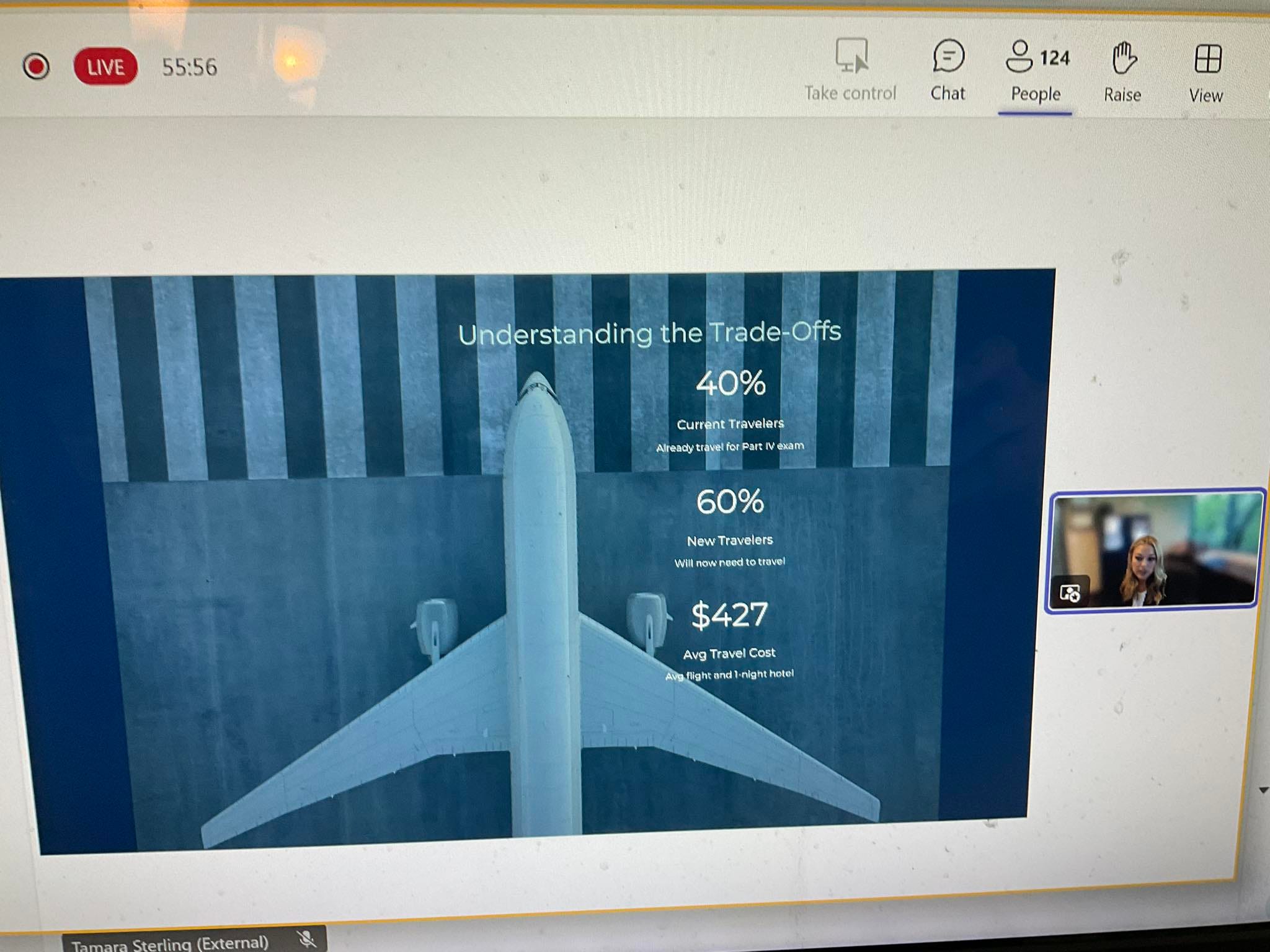
(A slide from the NBCE Webinar with Tamara Sterling - NBCE’s Vice President insulting the intelligence of listeners)
“We’re Doing It For You”: The Sales Pitch No One Asked For
On June 23, 2025, the National Board of Chiropractic Examiners (NBCE) hosted a tightly scripted webinar to justify its plan to centralize the Part IV practical exam at a single facility in Greeley, Colorado. The format was controlled—chat and Q&A disabled—and the presentation choreographed with rehearsed talking points.
The tone was clear: this isn’t a discussion. This is a decree.
And months before this webinar, in February 2025, LIFE University quietly enacted a policy requiring its students to pass all four NBCE exams—including the widely criticized Part IV—in order to graduate. This reversal by one of chiropractic’s largest institutions sent a message to every other school: resistance is over, compliance is expected.
“The NBCE boards take your money. Spread it around to the profession to buy complicity. Then they build a multi-million dollar facility to consolidate their overhead and pass the expenses onto the students.”
—Dr. Mike Guinosso
$40 Million in the Bank—But Still Squeezing Students
In the webinar the NBCE claimed that retrofitting existing testing sites would cost $5–$8 million, making a new centralized facility more “cost-effective.” But they failed to mention one crucial detail: they are sitting on $40 million of student loan money in reserves.
With that kind of surplus, they could have upgraded every test site, subsidized student travel, and still had money left over.
“With $40 million in the bank, they could’ve funded every upgrade and subsidized student travel. Instead, they centralized power.”
Instead, they’ve opted to build a monopoly fortress in Colorado—and force every student in the world wanting to practice in the US to make a pilgrimage there to sit for an exam whose value is increasingly questioned and is wholly unnecessary to begin with since schools already certify competency as a basis for graduation.
The True Cost of Centralization
NBCE officials repeatedly claimed that Greeley would be more “affordable.” They cited $427 as the average cost of airfare and lodging, though many students will pay twice or more than that with most US schools far from Denver never mind international graduates.
But here’s what they failed to mention:
Childcare expenses for student-parents away from home for 2–3 days
Meals and transportation while in Greeley
Lost income or PTO from missed work
Missed classes or clinic shifts
Travel insurance, which NBCE itself advises—but doesn’t reimburse
Out-of-pocket costs for canceled or rescheduled flights
Repeat travel when students must retake the exam
Emotional toll and stress of arranging out-of-state licensure hurdles
And while they vaguely referenced offering "partial refunds" or rescheduling in the case of “documented emergencies,” they made it clear: students will shoulder all risks and all costs.
“This isn’t affordability—it’s cost shifting dressed up as innovation.”
Stakeholder Input or Scripted Sham?
The NBCE insists it engaged the profession before making this decision. But an internal NBCE document reveals how limited and unrepresentative their so-called outreach actually was.
In early 2024, NBCE conducted outreach to testing site staff and issued a follow-up survey to assess school support. The results?
Only 11 schools responded, out of dozens worldwide.
5 opposed the move to Greeley.
7 had major reservations.
3 said they lacked enough information to decide.
The majority of schools either opposed or were unsure—yet NBCE pressed forward anyway.
“The feedback was overwhelmingly positive,” they claimed during the webinar. But their own internal memo proves otherwise.
And the chiropractic academic community is vast:
19 schools in the Association of Chiropractic Colleges (ACC)
At least 19 U.S.-based CCE-accredited programs
Over 25 additional international schools
Which makes the 11-school feedback loop more of a rubber stamp than a legitimate consultation.
Where Are the Outcomes?
In 2023, a coalition of chiropractic organizations submitted a formal request to the NBCE asking for basic licensure outcomes data to help the profession assess whether the NBCE’s exams—especially Part IV—actually measure or improve anything that matters.
The NBCE’s response? Months of silence followed by a non-answer. When a reply finally came, it included no substantive data, no documentation, and no effort to address the actual questions posed. It amounted to little more than a brush-off.
“They claim to test for competence—but won’t release a single piece of evidence proving their exams have any bearing on success, safety, or readiness to practice.”
This refusal isn’t just bureaucratic sloppiness—it’s strategic opacity. It protects the NBCE from scrutiny while preserving the illusion of necessity. With no published validity studies, no peer-reviewed outcomes, and no data transparency to back of their marketing claims, the NBCE’s exams function as a private gatekeeping tool enforced through state law and professional intimidation—not scientific merit.
Why This Matters
The NBCE claims its exams exist “to protect the public.” But how can a testing organization make that claim without producing any data that shows it actually does?
Meanwhile, medical doctors (MDs) and doctors of osteopathy (DOs) have moved away from practical licensing exams like NBCE Part IV—not because they’re anti-safety, but because the evidence didn’t support their continuation.
“If chiropractic students are paying thousands for exams, they have the right to ask: Do these exams work? The NBCE’s answer so far: We won’t tell you.”
The refusal to produce outcomes data reveals the deeper issue: the NBCE isn’t interested in accountability. It’s interested in maintaining control. And when a testing body this powerful won’t share evidence of its own marketing claims, it stops being a professional safeguard—and starts being a racket.
A Survey No One Saw, Now Sold as Gospel
As if the NBCE’s refusal to provide outcomes data weren’t damning enough, their 2025 Practice Analysis of Chiropractic—released with great fanfare—only deepened the credibility crisis.
The NBCE claimed the survey offered a “comprehensive profile” of practicing chiropractors across the U.S. In reality, it was just another marketing tool for their monopoly—masquerading as science.
NBCE’s assurances of national representativeness rest on a self-selected convenience sample, license-count weighting that cannot correct for hidden biases, and state subsamples so small their error margins can exceed fifty percent. When coupled with the deliberate omission of part-time and newly graduated cohorts, the 2025 survey is best viewed as a detailed snapshot of older, white, full-time, association-connected male chiropractors—not the entire profession.
“A survey no one saw is now being sold as gospel.”
Even NBCE admits the study is “non-experimental” with “potential selection and response bias.” In other words, interpret at your own risk—but only after the NBCE spins the numbers to justify its policies.
“When the NBCE claims it ‘ensures competency and safety,’ remember: it can’t even ensure a representative survey.”
The Real Agenda Behind the Numbers
Why does this matter? Because NBCE uses these flawed numbers to justify its centralized testing, its monopoly role in licensure, and its ongoing financial entanglements with chiropractic schools and associations.
The very students most harmed by the centralized Part IV model—young, underpaid, debt-burdened Gen Z chiropractors—were almost completely excluded from this so-called “comprehensive” report.
Part IV centralization in Greeley, Colorado continues to impose financial burdens on examinees, while NBCE builds real estate assets and executive salaries with student-loan money.
And still, no evidence has been produced that any NBCE exam—let alone Part IV—improves clinical outcomes or patient safety.
“Centralizing the exam isn’t about quality—it’s about keeping the money machine inside NBCE’s fence.”
Bottom Line: Another Rhetorical Shell Game
The 2025 Practice Analysis isn’t a “comprehensive profile.” It’s a snapshot of older, full-time, association-connected, white male chiropractors. Everyone else—new grads, minorities, women, part-timers, critics—was either filtered out or never reached in the first place.
And yet, NBCE continues to present this document to state boards, policymakers, and the public as if it represents the full profession. It doesn’t. Not even close.
“If the NBCE wants to call itself the profession’s watchdog, it’s time it learned how to measure—and answer to—the whole pack.”
LIFE University’s Capitulation
In February 2025, LIFE University reversed course and adopted a policy requiring students to pass all four NBCE exams to graduate—effectively making NBCE the arbiter not just of licensure, but graduation.
This controversial move was made with no public justification, no stakeholder input, and no evidence that the change benefits students. What it does do is hand NBCE even more leverage over the entire chiropractic education process.
“Wouldn’t passing my courses in college—and not taking unnecessary board exams—get me into practice faster?” one faculty member asked.
Contradictions in Plain Sight
The NBCE’s June webinar was filled with talking points that don’t hold up to scrutiny:
“We’re increasing student flexibility.”
→ By requiring every student in the world to travel to Colorado?“We’re making the exam more affordable.”
→ By forcing students to pay for flights, hotels, and insurance on top of the exam fee?“Now we can observe clinical decision-making.”
→ What were you observing before? Isn’t that what schools already do?“Students love the new format.”
→ Based on what data? From where? How many students? No answers given.“You’ll be able to start your career sooner.”
→ Actually, eliminating Part IV entirely would get students into practice faster—and at lower cost.
“The scripts were read, rehearsed, and passed along. They’ve obviously learned from prior backlash and are now steamrolling the process with choreography.” —Chiropractic faculty attendee
CCE: The Silent Enabler
The Council on Chiropractic Education (CCE) remains silent and complicit. Its Policy 56 mandates the use of NBCE exams for outcomes assessment, effectively outsourcing educational accountability to a private testing monopoly.
This policy leaves schools with no flexibility, no competitive options, and no voice. And with LIFE University now reinforcing NBCE's dominance, other schools will likely follow—or be forced to.
Meanwhile, a coalition of chiropractic organizations has demanded data, transparency, and reform. In October 2023, they formally requested licensing outcome data from NBCE—and received only delayed, vague, and ultimately useless responses.
A Profession Out of Step
Chiropractic now holds the distinction of being:
The only licensed health profession requiring a Part IV practical exam
The profession with the highest number of national board exams
Among the most expensive exam structures
Burdened with lower entry requirements and higher student loan debt
And still producing median incomes under $100,000
By comparison, MDs, DOs, DMDs, PTs, and RNs all require fewer exams, incur less cost, and face more accountability.
“We should all be outraged by this value-less money grab.” —Dr. Mike Guinosso
Final Thoughts: Time to Resist
The NBCE says it’s doing this “for the profession.” But make no mistake: they’re doing it to the profession.
This is not about educational quality or public safety. This is about consolidating power, protecting a statutory monopoly, and growing a financial empire at the expense of students.
The future of chiropractic shouldn’t be built on a $40 million testing empire, cemented in Greeley, Colorado. It should be built on freedom, fairness, and professional integrity.
The NBCE doesn’t serve the profession. It controls it. And it’s time we stopped pretending otherwise.
