WFC's ICEA Meeting Signals Global Expansion of Chiropractic Monopoly
Originally published: 2025-07-25
“What we are witnessing is not collaboration, but the global codification of chiropractic conformity.”
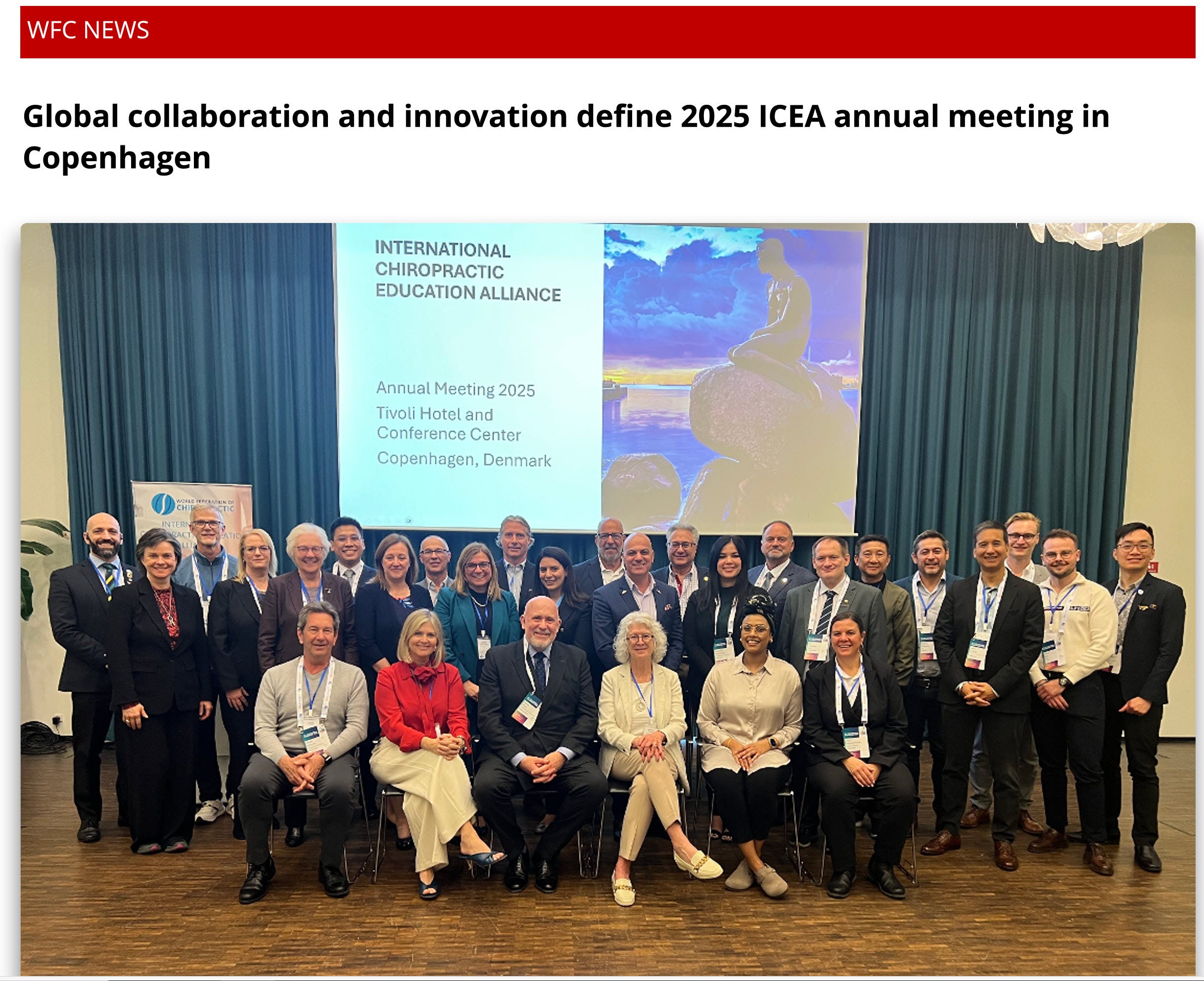
The 2025 Annual Meeting of the International Chiropractic Education Alliance (ICEA) took place in Copenhagen with bold proclamations of global cooperation, innovation, and inclusivity. But behind the polished press release and carefully curated group photo lies a deeper and more troubling narrative, one of escalating centralization, entrenched gatekeeping, and international cartelization of the chiropractic profession.
Organized under the banner of the World Federation of Chiropractic (WFC), the ICEA is being positioned as the global voice of chiropractic education. But its leadership and founding members tell another story, one that critics argue consolidates power in the hands of a small, ideologically aligned group that already dominates accreditation, testing, and educational policy in the U.S. and is now exporting that model globally.
The Faces of the Cartel: A Coordinated Power Bloc
The Copenhagen meeting, hosted by Deb Bushway (Northwestern Health Sciences University) and WFC Secretary-General Richard Brown, featured key figures in chiropractic’s most powerful private corporations including:
Karlos Boghosian, President of the National Board of Chiropractic Examiners (NBCE)
Craig Little, President of the Council on Chiropractic Education (CCE)
These organizations and individuals have long been criticized for dominating chiropractic education and licensure pathways in North America. Their presence at the helm of ICEA’s latest gathering signals the expansion of this network into an international governance model—one that many believe threatens professional autonomy and educational diversity.
“When accreditation, testing, curriculum, and licensing are all controlled by a single alliance of private actors, the profession is no longer free—it’s captured.”
A Closer Look at ICEA’s Founding Members
Chiropractors within the subluxation, family wellness faction of the profession were dismayed to see LIFE West participating in the meeting with Ron Oberstein, Immediate Past President of Life Chiropractic College West and Peter Kevorkian, President of Life West and Chair of the International Chiropractic Pediatric Association (ICPA) Board in attendance. LIFE West is a Founding member of the ICEA.
The rest of ICEA’s founding membership further illustrates the consolidation of control:
Full Founding Members include:
Life Chiropractic College West
Logan University
Parker University
Macquarie University
McTimoney College of Chiropractic
Northeast College of Health Sciences
Northwestern Health Sciences University
University of Bridgeport
University of Pittsburgh
Université du Québec à Trois-Rivières
IMU University
Teesside University
Central Queensland University
Barcelona College of Chiropractic
Universidad Central del Caribe
Fresenius University of Applied Sciences
Health Sciences University
Camara Institute for Chiropractic Sciences
Associate Founding Members include:
Council on Chiropractic Education (CCE)
National Board of Chiropractic Examiners (NBCE)
Chiropractic Educators Research Forum (CERF)
Royal College of Chiropractors (RCC-UK)
The inclusion of the CCE and NBCE as Associate Members within the ICEA confirms what many have feared: that these institutions are not merely external partners, but embedded participants in a larger structure designed to enforce compliance across national boundaries.
Globalizing the Monopoly
Session topics at the ICEA meeting included low-cost education models, faculty development, and “harmonization of competencies”, a phrase that has become synonymous with regulatory standardization. Under the guise of collaboration, critics argue that these discussions are laying the groundwork for a unified and restrictive model of chiropractic education, enforced through centralized accreditation, standardized testing, and institutional alignment.
Dr. Daniel Moore’s presentation outlined four strategic workstreams for the ICEA: global roundtables, faculty development, seed funding for pilot projects, and student collaborations. Yet none of these initiatives address the growing call for decentralization, innovation in educational philosophy, or alternatives to NBCE-administered licensure exams.
Even well-meaning projects like World Spine Day, presented at the meeting by Dr. Rebekah Wilks, are increasingly seen by critics as tools for controlling messaging and reinforcing the legitimacy of the WFC-aligned ecosystem.
“The ICEA is not an alliance—it’s an apparatus. Its function is to identify, assimilate, and regulate.”
The Cartel’s Ties to the WHO
The World Federation of Chiropractic (WFC), under whose banner the ICEA operates, holds official relations status with the World Health Organization (WHO). While this may be promoted as a mark of legitimacy and global integration, it also ties chiropractic education and policy directly to WHO frameworks and global health governance models that have come under increasing scrutiny, particularly from critics within the United States who argue that such affiliations compromise national sovereignty and professional autonomy. Robert F. Kennedy Jr., a prominent voice in the health freedom movement and HHS Secretary, has been an outspoken opponent of expanding WHO influence, warning against centralized control of health policy and the erosion of local authority and individual rights.
This growing skepticism toward the WHO’s global reach makes the ICEA’s alignment with WFC and its WHO connections especially problematic for American chiropractors and freedom-minded practitioners worldwide. The concern is not merely ideological, it is structural. As U.S.-based institutions increasingly become entangled in international alliances that reflect WHO-driven policy priorities, the chiropractic profession risks losing the distinctiveness and autonomy that once allowed it to thrive outside of allopathic paradigms and bureaucratic orthodoxy.
For schools like LIFE West, that on the surface champion the foundational tenets of chiropractic which were founded on health freedom, their support of the WHO is especially disheartening.
Chiropractic Freedom Coalition
In response, the Chiropractic Freedom Coalition has emerged as a counterforce dedicated to restoring independence and choice in chiropractic education, licensure, testing, and regulation. The Coalition advocates for alternatives to NBCE exams, challenges the monopoly of the Council on Chiropractic Education, and supports new accrediting bodies and educational models that respect philosophical diversity and local governance. Their mission is clear: to dismantle the cartel’s hold and return control of the profession to chiropractors, educators, and communities, not unelected global bureaucrats or interlocking boards of private corporations.
As the ICEA pushes further into international territory, practitioners and students alike must consider which future they want to support, one of centralized oversight and regulatory uniformity, or one of professional liberty, pluralism, and patient-centered innovation. The battle lines are no longer just national. The fight for chiropractic freedom is now global.
Implications for the Profession
For those seeking a more open, pluralistic chiropractic profession, the ICEA’s direction is alarming. The collusion between major institutions, many of which are already viewed as monopolistic entities in their home countries, suggests a coordinated effort to entrench a single worldview and regulatory framework across international borders.
This raises urgent questions:
Will new or independent chiropractic programs be allowed to flourish without aligning with ICEA-sanctioned standards?
Will national governments be pressured into adopting the ICEA model as the only “recognized” educational pathway?
And perhaps most importantly, who benefits from this consolidation of power?
With the WFC acting as host, and the NBCE and CCE embedded as founding members and schools like LIFE West lending them legitimacy from the subluxation based faction, the chiropractic cartel is no longer a domestic concern. It’s a global infrastructure.
“What began as a professional alliance has become an international enforcement mechanism. Chiropractic must decide whether to resist—or submit.”
As the ICEA pushes forward with its strategic plan, the global chiropractic community must reckon with what is being built in its name, and whether the future of the profession will be one of freedom and diversity or bureaucracy and control.
