Who’s the 'vocal, nauseous, loud minority’, Dr. Jaeger?
Originally published: 2025-09-17
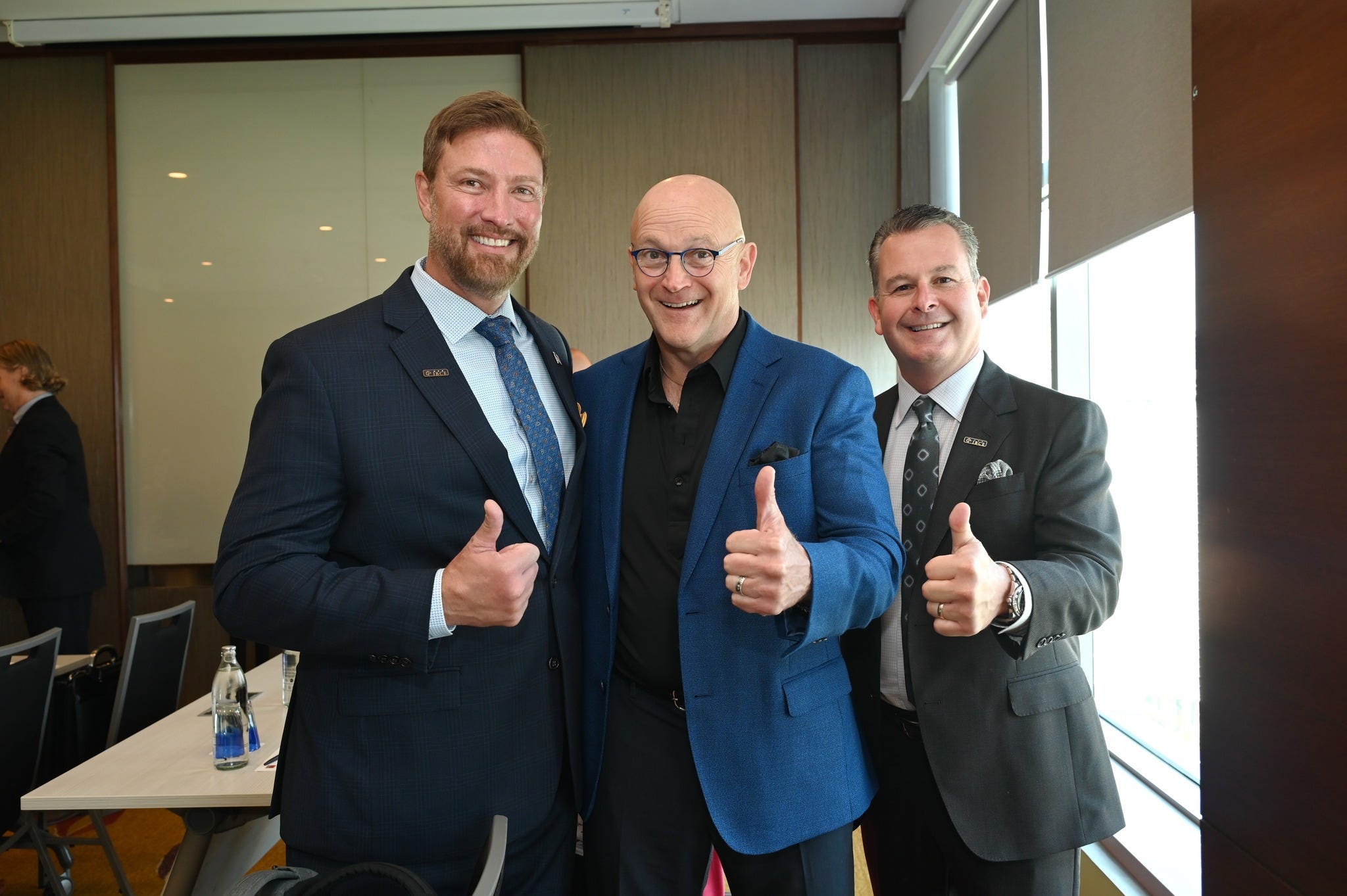
Pictured L to R: Jason Jaeger (ICA Board Member), William Morgan (Parker University President) & Norman Ouzts (Executive Director NBCE) at the WFC’s International Chiropractic Education Alliance meeting.
The moment he drew the line
In his Florida Chiropractic Association interview, Dr. Jason Jaeger urged the profession to speak with one voice and blamed a “vocal, nauseous, loud minority on the left and the right” for holding chiropractic back. He never defined who those people are, what they stand for, or why they should be excluded from the so-called mainstream. In today’s political climate, that kind of amorphous othering is not unity, it is a license to silence.
“There’s a vocal, nauseous, loud minority on the left and the right.” - Jason Jaeger DC. ICA Board Member
CLICK HERE for related article
Inflammatory, derogatory, and undefined
Words like “nauseous” are not neutral. They are meant to disgust and dismiss. Without definitions, they function as a catchall for anyone who questions exam monopolies, accreditation capture, international NGO influence, or the merger of state power with private boards. If you can tar any critic as “the minority,” you never have to answer their arguments. That is not leadership, it is framing.
“Most of us are aligned.” - Jason Jaeger DC. ICA Board Member
Which left, which right, and according to whom
If there is a left and a right in chiropractic, we deserve actual names. Are the supposed “left” the groups pushing drugs into scope, Medicare scope expansion, and a musculoskeletal rebrand tied to international policy language? Are the supposed “right” the groups that embrace Universal and Innate Intelligence, vitalism, non-therapeutic care, and vertebral subluxation as a public health construct? Where do organizations fall in Jaeger’s mind?
The ACA anchors the scope expansion lane, the WFC writes international position statements and convenes education alliances, the Chiropractic Summit Group operates behind closed doors. The ICA historically affirms vitalism, Universal Intelligence and Innate Intelligence, and asserts chiropractic is non-therapeutic. The International Federation of Chiropractors and Organizations (IFCO) and the International Chiropractic Pediatric Association (ICPA) align with a salutogenic, subluxation-centered model. The ICPA has over 10,000 members compared to the ICA’s few hundred - is the ICPA the minority?
If Jaeger means the vitalistic wing when he says “loud minority,” he should say so. If he does not, then who exactly is he pointing his finger at and waving it?
The unity paradox for an ICA director
Jaeger sits on the Board of Directors of the International Chiropractors Association. The ICA embraces UI, II, vitalism, and non-therapeutic chiropractic. In the interview he invokes subluxation, yet frames it through an orthopedic, alignment-measurement lens and celebrates interdisciplinary, code-based reimbursement strategies. That is a fair clinical opinion, yet it lives uncomfortably beside the ICA’s philosophical commitments. Does he affirm ICA’s values or not? If he does, why portray those values as the problem when voiced by others? If he does not, why represent the ICA while advancing an agenda that harmonizes with WFC, WHO and UN aligned policy circles?
“We have two associations… could we come together for the betterment of chiropractic.” Jason Jaeger DC. ICA Board Member
“Seat at the table,” for whom
He repeats the table metaphor, crediting Gerry Clum. The actual formula many of us were taught was, have a seat so you are not on the menu, then change them from within through compromise. Decades of that approach did not decentralize power, it concentrated it. Exams were centralized, accreditation was tethered to a private test, and a revolving door between boards, exam vendors, and associations hardened. If the seat at the table is only for those who already agree, then the table is a velvet rope, not a forum.
The seat at the table strategy failed miserably but they are still pushing it because they have no other valid reason to try and convince ICA members that they should support their own destruction.
“If you do not have a seat at the table, you are what is for dinner.”
The media swipe without receipts
Jaeger waves at “chiropractic media” and their focus. Which outlets? Trade publications survive on advertising from the very institutions at issue, including exam vendors, accreditation bodies, and large corporate sponsors. If he believes media alignment with those sponsors has distorted coverage, he should say so plainly and name the incentives. If he does not, he should stop implying that unnamed outlets are the problem while refusing to confront the funders that set editorial boundaries.
The Medicare-first lens that erases structural problems
His signature policy answer is a throw back to the chiropractic Mercedes 80’s to expand Medicare coverage beyond adjustments, call DCs physicians for parity purposes, and let that trickle down to private insurers. He even argues that the profession will gain cultural authority through a surge of reimbursement. He does not explain why a revenue wave would loosen the grip of the same exam, accreditation, and regulatory networks that currently gatekeep who trains, who graduates, and who gets licensed. He does not reconcile whether his unity message signals ICA support for the ACA’s Medicare scope expansion, or for drug-in-scope proposals that the ACA has advanced in statehouses. If those drug proposals are the minority, why speak of them as inevitable. If they are not the minority, why frame vitalistic chiropractors as outliers.
The numbers problem behind “most DCs are aligned”
There is no credible public dataset that shows what “most DCs” believe about WFC alignment, WHO language, Summit Group coordination, drug rights, or Medicare scope. Association membership numbers do not rescue the claim. The ICA’s membership has declined, the ACA’s membership remains a fraction of the profession, and the ICPA enrolls far more than any other. Most chiropractors do not belong to any association, which means no one can honestly claim a mandate while waving at the silent majority. Assertions about alignment without data are messaging, not measurement.
When your roles are the conflict
Jaeger is Vice President and District IV Director of the NBCE, Secretary and Treasurer of the Nevada Board of Chiropractic Physicians, and a Director of the ICA. That board, exam, association triangle is the very pattern critics identify as the Cartel. The same people who write rules, sell tests, and sit in judgment, also shape the narrative about who counts as mainstream and who is the “loud minority.” When he urges dissenters to get in the room, he does so as one of the people holding the keys.
What makes this even more jarring is Jaeger’s own nod to his mentor, the late Don Harrison, founder of CBP. Harrison was among the first and most outspoken to call out a “chiropractic cartel,” complete with the now-famous graphic tracing how money, including student loans, circulates through a tight network of bodies such as the FCLB and allied regulators. In his article “FCLB’s New ‘Model Practice Act’: A Slippery Slope,” Harrison explicitly describes the “Chiro Cartel” and directs readers to Figure 1 to study its funding flows, noting that nearly all money fueling the system originates with field chiropractors and students.
Harrison’s warning was not subtle. He argued that the FCLB’s Model Practice Act would accelerate a shift toward allopathic policy frames while cementing centralized control over education, licensing, and practice. The FCLB’s own Model Practice Act materials underscore just how sweeping that blueprint aimed to be for governments and boards, which is precisely why Harrison flagged it as a slope the profession should avoid.
Set against that history, Jaeger’s current positioning reads as a reversal of his mentor’s caution. He champions Medicare-first scope expansion, parity branding, and a “one voice” political strategy, while simultaneously occupying seats within the very institutions Harrison critiqued. If your mentor mapped the cartel, why are you staffing the turnstiles?
Mentor mismatch: Harrison mapped the “Chiro Cartel,” including student-loan-fed revenue streams. Jaeger now helps run several of the gates Harrison warned about.
The Summit and the WFC’s education alliance
This interview took place at the Florida Chiropractic Association convention in August. The same place the invite-only secretive chiropractic Summit Group held its quarterly meeting. Jaeger also attended the International Chiropractic Education Alliance gathering, seeded out of WFC circles to shape global education and usher in the Cartel internationally. If the rooms are closed to those who resist WFC, WHO, UN aligned frameworks, then the call for seats rings hollow. It is not that dissenters refuse to sit, it is that the chairs are assigned.
So who is the minority, exactly
Over sixty organizations and thousands of chiropractors have endorsed resolutions to restore freedom to chiropractic education, licensing, and practice through the Chiropractic freedom Coalition. Many of them embrace UI, II, vitalism, non-therapeutic care, and a robust, research-supported subluxation paradigm. Are these the people he calls “nauseous” and “loud.” Or are the minority the factions that want to operate state-sanctioned monopolies and restrain trade through exam and accreditation exclusivity. If the latter is true, that is the only minority that actually deserves the label, since it is small in number and oversized in leverage.
“Being in the room” only matters if the room is not locked by the exam vendor, the accreditor, and their friends on your state board.
The Nevada Chiropractic Council question
His bio lists active membership in the Nevada Chiropractic Council, whose materials describe the NCC as representing principled, subluxation-based, drug and surgery free care. If he is indeed a member, which principles does he affirm? Which principles constitute the “minority.” If he rejects UI, II, non-therapeutic care, and subluxation as a salutogenic construct, he should say so to his colleagues in the NCC and to the ICA membership he represents.
The questions he has to answer
If unity is the goal, who precisely are the left and the right? Which organizations and which leaders do you mean? Do you support ICA’s values on UI, II, vitalism, and non-therapeutic chiropractic, or do you reject them? Do you support the WFC, WHO, and UN policy frames that marginalize those values, and do you expect ICA to follow? Are chiropractors who oppose the ICA’s support for the WFC, the WHO, the UN, and the Summit Group the “loud minority.”? Is the ICA being asked to endorse ACA-driven Medicare scope expansion and drug-in-scope strategies, and if so, on what mandate? If drugs in chiropractic are the minority view, why give them policy oxygen? If they are not the minority view, what does that say about your unity claims? On what data do you claim “most DCs” agree with you? If “seats at the table” are so crucial, why are the Summit’s tables closed and why are critics routinely excluded?
Bottom line
You cannot preach inclusion while smearing unnamed colleagues as “nauseous” and unworthy of being heard. You cannot call for seats at the table while helping to curate the guest list. You cannot champion Medicare money as cultural authority while refusing to confront the machines that control accreditation, examination, and licensure. Until Dr. Jaeger defines his “left” and “right,” supplies data for his “most DCs” claim, and reconciles his ICA directorship with the values he sidestepped, his unity message reads like a familiar script. It rallies the room, it protects the cartel, and it leaves the profession exactly where the cartel wants it, divided in public, consolidated in private, and forever told that the problem is a “loud minority” that will not sit down.
